The order of an element in group theory is the smallest positive integer such that multiple group multiplication of this element gives itself a neutral element :


- .
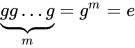
In other words, - the number of different elements of the cyclic subgroup generated by this element. If such does not exist (or, equivalently, the number of elements of a cyclic subgroup is infinite), then they say that has an infinite order. Designated as or .


Studying the orders of the elements of a group can give information about its structure. Several deep questions about the relationship between the order of the elements and the order of the group are contained in various Burnside problems , some of which remain open.
Content
Key Features
The order of an element is unity if and only if the element is neutral .
If every non-neutral element in matches its inverse (i.e. ) then and is abelian because . The converse is not true in the general case: for example, a (additive) cyclic group integers modulo 6 is Abelian, but the number 2 is of order 3:
- .
For any whole identity performed if and only if divides .
All degrees of an element of infinite order are also of infinite order. If a has finite order then order equal to the order divided by the largest common divisor of numbers and . The order of the inverse element coincides with the order of the element itself ( )
Link to Group Order
The order of any group element divides the order of the group . For example, in a symmetric group consisting of six elements, a neutral element has (by definition) order 1, three elements that are roots of - order 2, and order 3 have the two remaining elements that are the roots of elements of order 2: that is, all orders of elements are divisors of the order of the group.
Partially the converse is true for finite groups ( Cauchy-group theorem ): if a prime divides the order of the group , then there is an element , for which . The statement does not hold for composite orders, so the Klein quadruple group does not contain an element of order four.
Work Order
In any group .
There is no general formula relating the order of the product with orders of factors and . The case is possible when and , and have finite orders, while the order of the product endless, it is also possible that , and have infinite order while is finite. An example of the first case is that in a symmetric group over integer permutations given by formulas then . An example of the second case - permutations in the same group whose product is a neutral element (permutation leaving the elements in place). If a it can be argued that divides the least common multiple of numbers and . A consequence of this fact is that in a finite abelian group, the order of any element divides the maximum order of elements in the group.
Counting in the order of elements
For this final group of order , the number of elements with order ( - divider ) multiple where - Euler function giving the number of positive numbers not exceeding and mutually simple with him. For example, in the case , and there are exactly two elements of order 3; however, this statement does not provide any useful information regarding elements of order 2, since , and very limited information on compound numbers such as , insofar as , and in the group there are zero elements of order 6.
Connection with homomorphisms
Group homomorphisms tend to lower the order of elements. If a is a homomorphism, and Is an element of finite order, then divides . If a injectively then . This fact can be used to prove the absence of (injective) homomorphism between any two given groups. (For example, there is no nontrivial homomorphism , since any number, except zero, in has an order of 5, and 5 does not divide any of the orders of 1, 2 and 3 elements .) Another consequence is the assertion that conjugate elements are of the same order.
Literature
- Kurosh A.G. Group theory. - Moscow: Nauka, 1967. - ISBN 5-8114-0616-9 .
- Melnikov O. V., Remeslennikov V. N., Romankov V. A. Chapter II. Groups // General algebra / Under the general. ed. L.A. Skornyakova . - M .: Nauka , 1990. - T. 1. - S. 66-290. - 592 p. - (Reference Mathematical Library). - 30,000 copies. - ISBN 5-02-014426-6 .