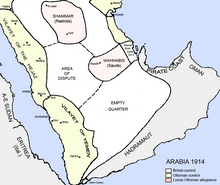
Ottoman Arabia is a historical period in the history of Arabia from 1517 to 1918, during which the region was dependent on the Ottoman Empire . The degree of Ottoman control over the region changed over four centuries depending on the strength or weakness of the central government [1] [2] .
Content
- 1 History
- 1.1 Early period
- 1.2 The Rise of the Saudi State
- 2 The collapse of the Ottoman Empire
- 3 notes
History
Early Period
In the XVI century, the Ottomans won and established their sovereignty over the territories adjacent to the Red Sea and the Persian Gulf ( Hijaz , Asir and Al-Hasa ). The main objective of these conquests was to prevent the penetration and increased influence of the Portuguese on the Red Sea and Indian Ocean [3] . As far back as 1548, the sheriff of Mecca organized raids that aimed to punish the Najd tribes who raided the oases in Hijaz [4] .
The rise of the Saudi state
In the central part of Arabia, the Saudi dynasty appears, which will play an important role in the formation of an independent Arab state on the peninsula. In 1744, Amir Ed-Diriya Muhammad ibn Saud took under the protection of the theologian Muhammad ibn Abd al-Wahhab and accepted his religious teaching, later called Wahhabism . For several decades, Ibn Saud and his descendants, relying on the religious enthusiasm of the Wahhabis, were able to subjugate the whole of Necd , west and east of the Arabian Peninsula. This period is called the First Saudi State . In 1792, after the death of Muhammad ibn Abd al-Wahhab, the Saudis united in their hands the supreme secular and spiritual power. In 1803, the Saudis captured Mecca , and in 1804 - Medina and the entire Hijaz . However, the Saudi hegemony in Arabia did not last long: in 1811, by the will of the Ottoman sultan , the Khedive of Egypt Mohammed Ali opposed them . For seven years of hard struggle, the Saudis lost everything: in 1818, after a five-month siege, the Egyptians took their capital Ed-Diriya and razed the land, Amir Abdullah I ibn Saud was sent to Istanbul , where he was beheaded.
However, already in 1821, a relative of the executed Amir of Turki, Ibn Abdallah, raised an uprising against the Ottomans, choosing the city of Riyadh as the new capital.
In 1824, the Second Saudi State was founded with its capital in Riyadh . This state lasted 67 years and was destroyed by Saudi long-standing rivals - the clan ar-Rashidi originally from Hail . The Saudi family was forced to flee to Kuwait .
The collapse of the Ottoman Empire
At the beginning of the 20th century, the Ottomans retained sovereignty over most of the Arabian Peninsula, although in some areas this sovereignty was nominal. The peninsula was a patchwork from the possessions of tribal leaders [5] [6] . The sheriff of Mecca retained strength and influence in the Hijaz [7] .
In 1902, Ibn Saud took control of Riyadh and all of Najd, thereby ensuring the unhindered return of the Saudis to Najd. Having received the support of the Ikhvans , a religious militia inspired by the ideas of Wahhabism , Ibn Saud was able to win Al-Khas from the Ottomans in 1913.
In 1916, with the support of Great Britain, sheriff Mecca Hussein ibn Ali al-Hashimi led a pan-Arab rebellion against the power of the Ottoman Empire. The rebels set themselves the goal of creating an independent Arab state [8] . Although the uprising of 1916-1918 did not have the desired success, the fall of the Ottoman Empire after the defeat in the First World War put an end to four centuries of Ottoman rule on the Arabian Peninsula [9] .
Notes
- ↑ Wayne H. Bowen. The History of Saudi Arabia . - Greenwood Publishing Group, 2008. - P. 68. - ISBN 978-0-313-34012-3 .
- ↑ Chatterji, Nikshoy C. Muddle of the Middle East, Volume 2. - 1973. - P. 168. - ISBN 0-391-00304-6 .
- ↑ William J. Bernstein. A Splendid Exchange: How Trade Shaped the World . - Grove Press, 2008 .-- P. 191. - ISBN 978-0-8021-4416-4 .
- ↑ James Wynbrandt. A Brief History of Saudi Arabia . - Infobase Publishing, 2010. - P. 101. - ISBN 978-0-8160-7876-9 .
- ↑ Murphy, David. The Arab Revolt 1916–18: Lawrence Sets Arabia Ablaze. - 2008. - P. 5–8. - ISBN 978-1-84603-339-1 .
- ↑ Al Rasheed, Madawi. Politics in an Arabian oasis: the Rashidis of Saudi Arabia. - 1997. - P. 81. - ISBN 1-86064-193-8 .
- ↑ Anderson, Ewan W. The Middle East: geography and geopolitics. - 2000. - P. 106. - ISBN 978-0-415-07667-8 .
- ↑ Tucker, Spencer. The Encyclopedia of World War I. - 205. - P. 565. - ISBN 978-1-85109-420-2 .
- ↑ Hourani, Albert. A History of the Arab Peoples. - 2005. - P. 315-319. - ISBN 978-0-571-22664-1 .