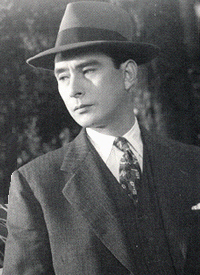
Ken Uehara ( Japanese 上原 謙 Uehara Ken ), real name: Kiyoaki Ikehata ( Japanese い け は た き よ あ き ) Born on October 7, 1909 in Tokyo - died November 21, 1991 in the same place - a Japanese actor, one of the most popular heroes lovers in pre-war Japanese cinema, in the post-war years and until the end of the 1950s proved to be an interesting character actor in the films Kei Shuke Kinoshita , Kona Ichikawa , Yasujiro Ozu , Kenji Mizoguchi , Mikio Naruse , Heinosuke Gosho , Hiroshi Shimizu and others. Later, in the 1960s, he was successful in science fiction films by Toho.
| Ken Uehara | |
|---|---|
| jap. 上原 謙 | |
 | |
| Birth name | Kiyoaki Ikehata |
| Date of Birth | |
| Place of Birth | Tokyo Japan |
| Date of death | |
| A place of death | |
| Citizenship | |
| Profession | actor |
| Career | 1935-1991 |
| IMDb | ID 0879945 |
Content
- 1 Biography
- 1.1 The early years
- 1.2 Movie career
- 1.3 Personal life
- 2 Filmography
- 3 Comments
- 4 notes
- 5 Links
Biography
The early years
Kiyoaki Ikehata's father (this is the real name of the actor) was a professional military [2] . A Japanese army colonel, originally from Kagoshima Prefecture, died when Kiyoaki was a junior high school student. After graduating from Seizo High School (in Shinjuku , Tokyo ), Kiyoaki entered Rikke University in 1929 [2] . In 1933, while still studying at the university, Kiyoaki sent his photograph for a competitive set of young actors to the Kamata movie studio of the Shёtiku movie company.
Movie career
After graduating from the university in 1935, he will be taken to Shochiku Kamata [2] , where he will start acting in films, taking the creative pseudonym Ken Uehara. He makes his debut as a student in the film of one of the well-known studio directors Hiroshi Shimizu, “A Man in the Prime of Life” (1935). One of the partners of the beginning actor in this film will also be the young actress Michiko Kuvano, who recently came to the Kamata studio. With her, the actor will play together in the next, 1936, in one of the pre-war masterpieces of Japanese cinema, the film of the same Shimizu " Mr. Thank you ." The title role in this film will make him one of the popular young actors of Japanese cinema of those years.
In 1937, Uehara played one of the main roles in the popular “ Triple Engagement ” film of that year, directed by Yasujiro Shimazu . Together with two filming partners, young actors Shin Saburi and Shuji, Sano entered the so-called "Shёtiku Trio." The film was successful at the box office and these three actors had a breakneck success with the mass audience, which the film company immediately took advantage of, starting an advertising campaign of three young actors as stars of a new generation. With no less success, he played the main role in the film "Lanterns of Asakusa" of the same Yasujiro Shimazu (1937).
Uehara was one of the most popular hero lovers of the 1930s - 1940s , playing roles in a similar role in the films Yasujiro Ozu , Hiromas Nomura, Hiroshi Shimizu , Heinosuke Gosho , Keisuke Kinoshita and others. His partners on the screen were the most popular stars of those years - Kinyu Tanaka , Mieko Takamine , Sumiko Kurishima ...
Unsatisfied with the main policy of the company, focused primarily on female stars, Uehara left the "Setika" after the war. In the late 1940s - in the 1950s, the actor created interesting characteristic roles in films classified as masterpieces of Japanese cinema, with Kon Itikawa in the dilogy 365 Nights: Tokyo and 365 Nights: Osaka (both 1948). Keisuke Kinoshita in The Ghost of Yotsui (1949) and Japanese Tragedy (1953), in the drama Yasujiro Ozu 's Sisters Munekata (1950), with Kenji Mizoguchi in Portrait of Lady Yuki (1950), in the tapes of Heinosuke Gosho Morning unrest "(1952) and" Where factory pipes are visible "(1953). But the actor was especially expressive in the works of the subtle master of traditionalism Mikio Naruse : “ Food ” (1951), “ Groan of the Mountain ” and “ Late Chrysanthemums ” (both - 1954), “ Daughter, wife and mother ” (1960). For performing the main roles in the dilogy of Mikio Naruse, “Spouses” and “Wife” (both 1953), Uehara was awarded the Mainity magazine prize as the best actor of the year [2] .
In the 1960s, the actor starred a lot in the fantastic films of the Toho film company ( Motra , 1961, Goras , 1962, Atragon: Flying Super Submarine , 1963, all directed by Isiro Honda and others). In the same period, Uehara entered the hotel business with the opening of the Pacific Park Hotel in Tigasaki ( Kanagawa Prefecture ). However, due to the difficult economic situation, the hotel went bankrupt in 1970. Faced with huge debt in this connection, Uehara left Toho.
Since the late 1960s, the actor did not appear on the set, returning to the screen only in 1983, starring in the film Nobuhiko Obayashi “The Girl Conquering Time”. For more than half a century of work in the cinema, the actor starred in 206 films [3] .
Personal life
On the set of his debut film “Youthful Innocence of the Boss’s Son” (1935), the actor gets acquainted with actress Yoko Kodzakura, the next year they will become spouses, despite the opposition to this union from the studio’s leadership. The couple will live a happy marriage for thirty-five years, until the death of the spouse in 1970. In this union, on April 11, 1937, the son of Yuzo Kayama will be born, following in the footsteps of his parents and starting his film career in 1960. The most famous works of the actor: “ 47 Ronin ” (1962, dir. Hiroshi Inagaki ), “ Confusion ” (1964, dir. Mikio Naruse ), “ Red Beard ” (1965, dir. Akira Kurosawa ), “ Genius of Judo ” (1965, director Seiichiro Utikawa), “ It began in the Alps ” (1967, director Kengo Furusawa).
In 1975, the widowed Uehara will enter into a second marriage with former club singer Masami Obayashi, who was 38 years younger than him. Due to the large age difference, this scandalous union did not leave the tabloid pages. In 1980, they will have a daughter, who now also became an actress under the name Ryô Hitomi.
In June 1991, a divorce proceedings will take place between Ken Uehara and Masami Obayashi. On November 23 of the same year, the housekeeper discovers an actor lying in the bathroom, an ambulance called in takes him to Kyorin Private University Hospital in Mitaka ( Tokyo Prefecture ), where the actor dies of acute heart failure .
Filmography
| A Selected Filmography of Ken Uehara [4] [5] | ||||||
|---|---|---|---|---|---|---|
| Year | Russian name | original name | Romaji name | English name at international box office | Producer | Role |
| 1930s | ||||||
| 1935 | " A man in his prime " | 若 旦 那 春 爛漫 | Wakadanna haru ranman | The Boss's Son's Youthful Innocence | Hiroshi Shimizu | student |
| " He, she and the boys " | 彼 と 彼女 と 少年 達 | Kare to kanojo to shônentachi | The man and the woman and the boys | Hiroshi Shimizu | person | |
| " Double Heart " | 双 心 臓 | Sōshinzō | Double heart | Hiroshi Shimizu | Kyosuke | |
| “ Constant Love ” (two-part film) | 永久 の 愛 | Eikyû no ai | Yoshinobu Ikeda | son ken | ||
| “ As a last resort, today ” | せ め て 今宵 を | Semete koyoi o | Yasujiro Shimazu | |||
| “ Love in luxury ” | 恋愛 豪華 版 | Ren'ai gōka ban | Love in luxury | Hiroshi Shimizu | Ida, tutor | |
| 1936 | " Mr. Thank you " | 有 り が た う さ ん | Arigatō-san | Mr. Thank you | Hiroshi Shimizu | Mr. Arigato |
| " Heaven and Earth for free " | 自由 の 天地 | Jiyū no tenchi | Heaven and earth are free | Hiroshi Shimizu | ||
| " Man for woman " | 男性 対 女性 | Dansei tai josei | Yasujiro Shimazu | Tetsuo, second son of Atsumi | ||
| “ Housewife with Camellias ” (two-part film) | 人 妻 椿 | Hitozuma tsubaki | Hiromasa Nomura | Toshio Kusama | ||
| “The New Way ” (two-part film) | 新 道 | Shindo | New way | Heinosuke Gosho | Ryota Kudo | |
| 1937 | " Card of the bride " | 花嫁 か る た | Hanayome karuta | Yasujiro Shimazu | Yoshikawa | |
| “ What did the lady forget? " | 淑女 は 何 を 忘 れ た か | Shukujo wa nani o wasureta ka | What Did the Lady Forget? | Yasujiro Ozu | movie star | |
| "---" | 朱 と 緑 朱 の 巻 | Shu to midori shu no maki | Yasujiro Shimazu | Yoshio Toyama | ||
| "---" | 朱 と 緑 緑 の 巻 | Shu to midori midori no maki | Yasujiro Shimazu | Yoshio Toyama | ||
| Triple Engagement | 婚約 三 羽 烏 | Konyaku sanbagarasu | The Trio's Engagements | Yasujiro Shimazu | Ken Taniyama | |
| " The outfit of the bride " | 衣裳 花嫁 | Ishou hanayome | Kaisuke sasaki | |||
| " Lanterns of Asakusa " | 浅 草 の 灯 | Asakusa no hi | The lights of asakusa | Yasujiro Shimazu | Sitiro Yamagami | |
| 1938 | " Bitten by the bride " | 噛 み つ い た 花嫁 | Kamitsuita hanayome | Yasujiro Shimazu | ||
| Departures | 出 発 | Shuppatsu | Departure | Hiroshi Shimizu | Yuji | |
| " Naive Madam " | 純情 夫人 | Junjou fujin | Kaisuke sasaki | |||
| " Poetry of fire " | 炎 の 詩 | Honoo no shi | Yasushi Sasaki | |||
| The Aizen Tree , Parts I — II | 愛 染 か つ ら | Aizen katsura | The tree of love | Hiromasa Nomura | Kozo Tsumura | |
| Home diary | 家庭 日記 | Katei nikki | Family diary | Hiroshi Shimizu | Itiro Tsuji | |
| " The Meiji Japanese " | 日本人 明治 篇 | Nipponjin meiji hen | Yasujiro Shimazu | |||
| " The Japanese of the Showa period " | 日本人 昭和 篇 | Nipponjin shōwa hen | Yasujiro Shimazu | |||
| 1939 | "---" | お 加 代 の 覚 悟 | Okayo no kakugo | Yasujiro Shimazu | Sunsaku | |
| " Love in the army " | 愛情 部隊 | Aijou butai | Yasushi Sasaki | |||
| " Brother and sister " | 兄 と そ の 妹 | Ani to sono imoto | A brother and his younger sister | Yasujiro Shimazu | Michio Arita | |
| “ Aizen tree. Part III " | 続 愛 染 か つ ら | Zoku aizen katsura | Hiromasa Nomura | Kozo Tsumura | ||
| Blooming Weed | 花 の あ る 雑 草 | Hana no aru zassō | Flowering weed | Hiroshi Shimizu | Mr. Murakami | |
| “ Mulberries are red ” | 桑 の 実 は 紅 い | Kuwa no mi wa akai | Mulberries are red | Hiroshi Shimizu | Heizo, brother of Kiyo | |
| “ Aizen tree. Part IV | 愛 染 か つ ら 完結篇 | Aizen Katsura - Kanketsu-hen | Hiromasa Nomura | Kozo Tsumura | ||
| Brides: Questions and Answers | 新 妻 問答 | Niizuma mondo | Hiromasa Nomura | |||
| 1940s | ||||||
| 1940 | “ I have a husband ” | 私 に は 夫 が あ る | Watashi ni wa otto ga aru | I have a husband | Hiroshi Shimizu | ueda teacher |
| " Storm of love " | 愛 の 暴風 | Ai no boufuu | Hiromasa Nomura | |||
| " The Story of the Tank Commander Nishizumi " | 西 住 戦 車 長 伝 | Nishizumi senshacho-den | The Story of Tank Commander Nishizumi | Kodzaburo Yoshimura | lieutenant nishizumi | |
| Silk Trading Clerk | お 絹 と 番 頭 | Okinu to bantô | Hiromasa Nomura | |||
| 1941 | “ Memorable song ” | 歌女 お ぼ え 書 | Utajo oboegaki | Notes of an Itinerant Performer | Hiroshi Shimizu | Sotaro Hiramatsu |
| “ I'll go in a good mood ” | 元 気 で 行 か う よ | Genkide yukôyo | Hiromasa Nomura | |||
| " Flower " | 花 | Hana | Kodzaburo Yoshimura | |||
| " Country of Cherries " | 桜 の 国 | Sakura no kuni | Minoru Shibuya | Saburo | ||
| 1942 | " Three sisters " | 三人 姉妹 | San nin shimai | Kenkiti Hara | ||
| "The spy is still not killed " | 間諜 未 だ 死 せ ず | Kanchô imada shisezu | Kodzaburo Yoshimura | |||
| "The spirit of man " | 男 の 意 気 | Otoko no iki | Noboru Nakamura | |||
| 1943 | "The night on the eve of the war " | 開 戦 の 前夜 | Kaisen no zenya | The night before the war begins | Kodzaburo Yoshimura | |
| " City in the struggle " | 戦 ひ の 街 | Tatakai no machi | Fight street | Kenkiti Hara | ||
| " Air raid of the enemy " | 敵機 空襲 | Teki ki kuushuu | Enemy air attack | H. Nomura , K. Yoshimura , M. Shibuya | ||
| " Daughter " | む す め | Musume | Hideo Ooba | |||
| " Flower port " | 花 咲 く 港 | Hana saku minato | Port of flowers | Kaisuke Kinoshita | ||
| Live Magoroku | 生 き て ゐ る 孫 六 | Ikite iru Magoroku | The living magoroku | Kaisuke Kinoshita | ||
| 1944 | " The decisive battle " | 決 戦 | Kessen | The decisive battle | Kodzaburo Yoshimura , Teruo Hagiyama | |
| Glee Street | 歓 呼 の 町 | Kanko no machi | Jubilation street | Kaisuke Kinoshita | Shingo Yoshikawa | |
| “ You are the future wild eagles ” | 君 こ そ 次 の 荒 鷲 だ | Kimi koso tsugi no arawashi da | You are the next wild eagle | Toshimasa Hozumi | Lieutenant Miyoshi | |
| " Military Orchestra " | 野 戦 軍 楽 隊 | Yasen gungakutai | Military combat band | Masahiro Makino | Corporal Suga | |
| " Army " | 陸軍 | Rikugun | Army | Kaisuke Kinoshita | Nisina | |
| 1945 | “ Song of Inevitable Victory ” (a film of 4 short stories) | 必勝 歌 | Hisshôka | Victory song | M. Makino , K. Mizoguchi , H. Shimizu and T. Tasaka | Makoto Itino, a sailor |
| " Wind " | そ よ か ぜ | Soyokaze | Yasushi Sasaki | Funada | ||
| " The bride from heaven " | 天国 の 花嫁 | Tengoku no hanayome | Hiromasa Nomura | |||
| 1947 | " The history of the dancer " | 踊 子 物語 | Odoriko monogatari | Eiichi Koishi | Osamu Takamura | |
| " Marriage " | 結婚 | Kekkon | Marriage | Kaisuke Kinoshita | Zumoru Sugawara | |
| "The missing corpse " | 消 え た 死 体 | Kie ta shitai | Harumi Mizuho | |||
| " First love story " | 初恋 物語 | Hatsukoi monogatari | Eiichi Koishi | |||
| “ Like a honeymoon ” | こ こ ろ 月 の 如 く | Kokoro tsuki no gotoku | Hiroshi Inagaki | |||
| 1948 | The Golden Demon (two-part film) | 金色 夜叉 | Konjiki yasha | The golden demon | Masahiro Makino | |
| “ The flower is blooming ” | 眞 知 子 よ り - 花 ひ ら く | Hana hiraku - Machiko yori | Kon Ichikawa | Saburo Seki | ||
| “ Fear of the triple mirror ” | 三 面鏡 の 恐怖 | Sanmen kyō no kyōfu | Seiji Hisamatsu | Yukiti mayama | ||
| 365 Nights: Tokyo | 三百 六 十五 夜 東京 篇 | Sambyakurokujugo ya - Tokyo-hen | Kon Ichikawa | Koroku Kawakita | ||
| 365 Nights: Osaka | 三百 六 十五 夜 大阪 篇 | Sambyakurokujugo ya - Osaka-hen | Kon Ichikawa | Koroku Kawakita | ||
| " Girl with a Rainbow " | 虹 を 抱 く 処女 | Niji o idaku otome | Girl with a Rainbow | Kiyoshi Saeki | Kotaro Hideka | |
| 1949 | 365 days | 三百 六 十五 夜 | Sambyaku-rokujugo ya | 365 nights | Kon Ichikawa | Koroku Kawakita |
| " Dreams Again " | 夢 よ も う い ち ど | Yume yo mō ichido | Hiromasa Nomura | Naga | ||
| Exotic Hill | 異国 の 丘 | Ikoku no oka | Kunio Watanabe | Kiyoshi | ||
| " The Ghost of Yotsui " (two-part film) | 新 釈 四 谷 怪 談 | Yotsuya kaidan (Zenpen; Kohen) | The Yotsuda Phantom (Part I; Part II) | Kaisuke Kinoshita | Iemon tamia | |
| " The scheme of man " | 人間 模 様 | Ningen moe | Design of a human being | Kon Ichikawa | Kunihiko | |
| 1950s | ||||||
| 1950 | " Treasure of virginity " | 処女 宝 | Shojo-dakara | Koji Shima | Sinichi Funada | |
| “ Doctor’s office ” | 女 医 の 診察 室 | Joi no shinsatsushitsu | Ren Yoshimura | Dr. Kawamura | ||
| " Munekat Sisters " | 宗 方 姉妹 | Munekata kyôdai | The Munekata Sisters | Heinosuke Gosho | Hiroshi Tashiro | |
| " Portrait of Lady Yuki " | 雪 夫人 絵 図 | Yuki fujin ezu | Portrait of Madame Yuki | Kenji Mizoguchi | Masaya Kikunaka | |
| " Maiden 's Top " | 処女 峰 | Shojohō | Keigo Kimura | Kiichiro matsuzaki | ||
| 1951 | " Night flower " | 夜来香 | Ieraishan | Nightshade flower | Kon Ichikawa | Saburo Seki |
| Elegy | 悲歌 | Aika | Elegy | Kajiro Yamamoto | Naohiko Vatori | |
| “ Stateless person ” | 無国籍 者 | Mukokuseki-sha | Kon Ichikawa | 戸 張 | ||
| " Tiger Fang " | 虎 の 牙 | Tora no kiba | Sunkai Mizuho | |||
| " Seven constellations " | 七 つ の 星座 | Nanatsu no seiza | Shigeo Tanaka | |||
| " Rock of death " | 死 の 断崖 | Shi no dangai | Senkiti Taniguchi | |||
| " Food " | め し | Meshi | Repast | Mikio Naruse | Hatsunosuke Tsukamoto | |
| " Wedding March " | 結婚 行進 曲 | Kekkon koshinkyoku | Wedding march | Kon Ichikawa | Nakahara, Senior Manager | |
| 1952 | " Heaven's oath " | 大 空 の 誓 い | Ōzora no chikai | Yutaka Abe | ||
| " Forgotten spring " | 惜春 | Sekishun | Keigo Kimura | Minotu Fujisaki | ||
| " Morning unrest " | 朝 の 波紋 | Asa no hamon | Morning conflicts | Heinosuke Gosho | ||
| Blue Waltz | 水色 の ワ ル ツ | Mizuiro no warutsu | Nobuo Aoyagi, Xue Matsubayashi | Professor Oka | ||
| Tokyo Pits | 東京 の え く ぼ | Tokyo no ekubo | Tokyo Dimples | Xue Matsubayashi | Buntaro Kinokuniya | |
| Green Wind | 緑 の 風 | Midori no kaze | The green wind | Kenkiti Hara | ||
| " It will end at Muntinlup " | モ ン テ ン ル パ の 夜 は 更 け て | Montenrupa no yoru wa fukete | It's Getting Late in Muntinlupa | Nobuo Aoyagi | Michio Kawai | |
| Blooming Hill | 丘 は 花 ざ か り | Oka wa hanazakari | Yasuki Chiba | Haruo Ishiyama | ||
| 1953 | “ Castle in the name of a woman ” (two-part film) | 女 と い ふ 城 | Onna to iu shiro | Castle named woman | Yutaka Abe | Judo oki |
| “ Spouses ” | 夫婦 | Fûfu | Husband and wife | Mikio Naruse | Isaku Nakahara | |
| “ Where factory pipes are visible ” | 煙 突 の 見 え る 場所 | Entotsu no mieru basho | Where Chimneys Are Seen | Heinosuke Gosho | Ryokichi Ogata | |
| " Wife " | 妻 | Tsuma | Wife | Mikio Naruse | Toichi | |
| " His sister " | そ の 妹 | Sono imouto | Kenkiti Hara | |||
| " Japanese tragedy " | 日本 の 悲劇 | Nihon no higeki | A japanese tragedy | Kaisuke Kinoshita | Masayuki Akzawa, teacher | |
| Frozen Fish | 白魚 | Shirauo | Hisator Kumagai | Koyama | ||
| “ Moth by the lamp ” | 誘 蛾 燈 | Yūgatō | Light trap | Kajiro Yamamoto | ||
| " Made in Japan " | に っ ぽ ん 製 | Nippon sei | Made in japan | Koji Shima | Akio Kanasugi | |
| 1954 | " Moan of the mountain " | 山 の 音 | Yama no oto | The thunder of the mountain | Mikio Naruse | Otto, Sweetie |
| “ All of me ” | わ た し の 凡 て を | Watashi no subete o | All of myself | Kon Ichikawa | Atsushi Kazama | |
| “The wind. The revival of the legend | 風 立 ち ぬ | Kaze tachi nu | Koji Shima | |||
| " Late Chrysanthemums " | 晩 菊 | Bangiku | Late chrysanthemums | Mikio Naruse | Tabe | |
| “ Mother ’s first love ” | 母 の 初恋 | Haha no hatsukoi | Mother's first love | Seiji Hisamatsu | ||
| Twelve Chapters on Women | 女性 に 関 す る 十二 章 | Josei ni kansuru jûni shô | Twelve Chapters on Women | Kon Ichikawa | Tatsuo Kurumada | |
| 1955 | " Woman 's life " | 女 の 一生 | Onna no isshou | A woman's life | Noboru Nakamura | |
| "The happiness of tomorrow " | 明日 の 幸福 | Ashita no kofuku | Tomorrow's Happiness | Harumi Mizuho | ||
| “ Impeccable court ” | の ん き 裁判 | Nonki saiban | Kunio Watanabe | |||
| " Mother's song " | 母 の 曲 | Haha no uta | Eiichi Koishi | |||
| Whisper of the Demon | 悪 魔 の 囁 き | Akuma no sasayaki | Seiichiro Utikawa | Haruhisa Oyama | ||
| " Mr. Atsukama and Mr. Oyakama " | ア ツ カ マ 氏 と オ ヤ カ マ 氏 | Atsukama-shi to Oyakama-shi | Yasuki Chiba | Kamataro Oia | ||
| “ Kiss ” (film almanac, 3rd short story) | く ち づ け | Kuchizuke | Mikio Naruse | Yuzo kaneda | ||
| 1956 | "The boss of the president " | へ そ く り 社長 | Hesokuri shachô | The president's boss | Yasuki Chiba | Onoda |
| " Rebellion in the North Sea " | 北海 の 叛乱 | Hokkai no hanran | Masaki Mori, Kunio Watanabe | Toru Yamamoto | ||
| “The boss of the president. Part 2 " | 続 へ そ く り 社長 | Zoku hesokuri shacho | The president talks bank | Yasuki Chiba | Onoda | |
| " Love and money " | 恋 と 金 | Koi to kimu | Hiroshi Edagawa | |||
| " Happiness under this star " | 幸福 は あ の 星 の 下 に | Kofuku wa ano hoshi no shita ni | Happiness Is Under That Star | Toshio Sugie | ||
| Triple Engagement | 婚約 三 羽 烏 | Konyaku sanbagarasu | Three Youngmen and a Dream Girl | Toshio Sugie | the president | |
| "Night River" (at the box office of the USSR - " Hidden Moods ") [comm. one] | 夜 の 河 | Yoru no kawa | River of the night | Kodzaburo Yoshimura | Professor Takemura | |
| " Barefoot youth " | 裸 足 の 青春 | Hadadi no seishun | Senkiti Taniguchi | Takeuchi's father | ||
| Sounds in the Fog | 霧 の 音 | Kiri no oto | Sound in the mist | Hiroshi Shimizu | Kazuhiko Onuma | |
| Shizuki and Yoshitsune | 新 ・ 平 家 物語 静 と 義 経 | Shin. hiraka monogatari sei to yoshitsune | Koji Shima | Yoritomo | ||
| " Gate of lovers " | お し ど り の 間 | Oshidori no mon | Lovebirds' gate | Keigo Kimura | ||
| 1957 | " Flowers of sorrow " | 花 は 嘆 か ず | Hana ha nageka zu | Tsuneo Tabata | Sinohara | |
| " Restless " | あ ら く れ | Arakure | Untamed woman | Mikio Naruse | Tsuru-san | |
| “A rainbow plays in my heart ” (two-part film) | わ が 胸 に 虹 は 消 え ず 第一 部 | Waga mune ni niji wa kiezu | A rainbow plays in my heart | Isiro Honda | Shuji Aso | |
| 1958 | " Spring Flowers Festival " | 春 高樓 の 花 の 宴 | Haru koro no hana no en | Teynosuke Kinugasa | Hikobe suzuki | |
| “ Ice wall ” | 氷壁 | Hyoheki | The precipice | Yasuzo Masumura | Yashiro | |
| Tokyo Vacations | 東京 の 休 日 | Tôkyô no kyûjitsu | A holiday in Tokyo | Kajiro Yamamoto | Hiroshi Komatsubara | |
| “ All About Marriage ” | 結婚 の す べ て | Kekkon no subete | All About Marriage | Kihati okamoto | Saburo Kakiuchi | |
| The Exquisite Maid Diary | 風流 温泉 日記 | Furyu onsen nikki | Sophisticated Journal of a Chambermaid | Kihati okamoto | Sentaro Kuwahara | |
| " Young daughters " | 若 い 娘 た ち | Wakai musumetachi | Young daughters | Kihati okamoto | Kotaro Nomura, father of Tomoko | |
| " Daughter 's Adventures " | 娘 の 冒 険 | Musume no boken | Daughter's adventure | Koji Shima | ||
| Koshiro Nemuri 's Merciless Plan: The Magic Sword of Hell | 眠 狂 四郎 無 頼 控 魔 剣 地獄 | Nemuri Kyôshirô burai hikae: Maken jigoku | The spell of the hidden gold | Masazumi Kawanishi | Tan | |
| 1959 | “ Three Puppets in the Ginza ” (two-part film) | 社員 無 頼 怒号 篇 | Ginza no onêchan | Three Dolls in Ginza | Toshio Sugie | |
| Ginza your maid | 銀座 の お 姐 ち ゃ ん | Ginza no o ane chan | Toshio Sugie | |||
| “ Once I ... ” | あ る 日 わ た し は | Aruhi watashi wa | One Day I ... | Kihati okamoto | Yusaku Kaneko | |
| " Young lovers " | あ る 日 わ た し は | Wakai koibitotachi | Young lovers | Yasuki Chiba | Doi | |
| " Dangerous game with fire " | 恐 る べ き 火 遊 び | Sorubeki hiasobi | Dangerous playing with fire | Jun Fukuda | Dr. Yabuki | |
| 1960s | ||||||
| 1960 | " Samurai and sister " | 侍 と お 姐 ち ゃ ん | Samurai to oneechan | Samurai and Little Sister | Toshio Sugie | Yutaro Nakahara |
| “ Storm in the Pacific Ocean ” | ハ ワ イ ・ ミ ッ ド ウ ェ イ 大海 空 戦 太平洋 の 嵐 | Hawai Middowei daikaikûsen: Taiheiyô no arashi | The storm of the pacific | Xue Matsubayashi | chief of staff | |
| “ Daughters, wives, mothers ” | 娘 ・ 妻 ・ 母 | Musume tsuma haha | Daughters, Wives and a Mother | Mikio Naruse | Sokei Gozo | |
| " Bandits from the university " | 大学 の 山賊 た ち | Daigaku no sanzôkutachi | University bandits | Kihati okamoto | Issaku Tanba | |
| “ They-chan 6: Happy Dolls ” | お 姐 ち ゃ ん は ツ イ て る ぜ | Oneichan wa tsuiteruze | The lucky dolls | Masanori Kakei | ||
| 1961 | " Woman doing makeup at night " | 女 は 夜 化粧 す る | Onna wa yoru kesshô suru | Umetsugu Inoue | ||
| " Night in Hong Kong " | 香港 の 夜 | Honkon no yoru | A night in hong kong | Yasuki Chiba | ||
| " Sir Galahad on campus " | 大学 の 若 大将 | Daigaku no wakadaishô | Sir Galahad in Campus | Toshio Sugie | President Nomura | |
| Motra | モ ス ラ | Mosura | Mothra | Isiro Honda | Dr. Harada | |
| The Crimson Sea | 紅 の 海 | Kurenai no umi | The crimson sea | Senkiti Taniguchi | ||
| The Last War | 世界 大 戦 争 | Sekai daisensô | The last war | Xue Matsubayashi | Foreign Secretary | |
| 1962 | "The Young Man in the Ginza " | 銀座 の 若 大将 | Ginza no wakadaishô | Young guy in ginza | Toshio Sugie | Kingoro Torikawa |
| Horace | 妖星 ゴ ラ ス | Yôsei gorasu | Gorath | Isiro Honda | Dr. Kono, astrophysicist | |
| " Operation" Underground Rats " " | ど ぶ 鼠 作 戦 | Dobunezumi sakusen | Operation Sewer Rats | Kihati okamoto | Seki, division commander | |
| “The Pig and the Goldfish ” | 豚 と 金魚 | Buta tokingyo | Pigs and Goldfish | Tetsuhiro Kawasaki | Mizuki Arita | |
| " The number one young man in Japan " | 日本 一 の 若 大将 | Nippon ichi no wakadaisho | Japan's Number One Young Guy | Jun Fukuda | Ishiyama, Senior Manager | |
| 47 Ronin (two-part film) | 忠臣 蔵 花 の 巻 雪 の 巻 | Chushingura - Hana no Maki Yuki no maki | Chushingura - Part One: Flowers Part Two: Snow | Hiroshi Inagaki | Tunak Seikanji | |
| 1963 | “ Wings of the Pacific Ocean ” | 太平洋 の 翼 | Taiheiyo no tsubasa | Wings of the pacific | Xue Matsubayashi | |
| " Young man in Hawaii " | ハ ワ イ の 若 大将 | Hawaii no wakadaisho | Young Guy in Hawaii | Jun Fukuda | Ueda | |
| "---" | ク レ ー ジ ー 作 戦 く た ば れ! 無 責任 | Kure — ji — sakusen kutabare! musekinin | Takashi Tsuboshima | president hatanaka | ||
| Atragon: Flying Super Submarine | 海底 軍艦 | Kaitei gunkan | Undersea battleship | Isiro Honda | Kusumi, retired admiral | |
| 1965 | "The electric guitar of a young man " | エ レ キ の 若 大将 | Ereki no wakadaishô | Electric Guitar Young Guy | Katsumi Iwauti | Matsubara, father of Michiko |
| 1966 | " Night in Bangkok " | バ ン コ ッ ク の 夜 | Bangkok no yoru | Night in bangkok | Yasuki Chiba | Bunnosuke, Father Masayo |
| " Complete young daughter " | 若 い 娘 が い っ ぱ い | Wakai musume ga ippai | Masanori Kakehi | Yoda Haruki | ||
| 1968 | " Spring is in full swing " | 春 ら ん ま ん | Haru ranman | Yasuki Chiba | Sagara | |
| 1980s | ||||||
| 1983 | " Girl who conquered time " | 時 を か け る 少女 | Toki o kakeru shôjo | The Girl Who Leapt Through Time | Nobuhiko Obayashi | Masaharu Fukamashi |
| 1987 | " Movie actress " | 映 画 女優 | Eiga joyû | Actress | Kon Ichikawa | played himself |
| 1990s | ||||||
| 1990 | " Seasonal flower " | 花 の 季節 | Hana no kisetsu | Xinyichi Nakata | ||
Comments
- ↑ The film was shown at the Soviet box office from July 1959, r / u Goskino USSR No. 1021/59 (until January 31, 1964) - published: “Annotated catalog of films of the current fund: Feature Films”, M .: “Art” -1963, S. 303.
Notes
- ↑ Find a Grave - 1995. - ed. size: 165000000
- ↑ 1 2 3 4 上原 谦 —baidu.com
- ↑ JMDb.ne.jp (Japanese)
- ↑ Japanese Movie Database (JMDb) was used in the creation of the filmography ( ja )
- ↑ The imdb.com data was used in the creation of the filmography ( en )
Links
- Ken Wehara on the Internet Movie Database