RT-2PM2 Topol-M ( URV Strategic Rocket Forces Index - 15P165 [4] (mine) and 15P155 [5] ( mobile ), under the START treaty - RS-12M2 , according to NATO classification - SS-27 Sickle B , in translation - Sickle ) [6] - the Russian strategic missile system with ICBMs 15Zh65 ( 15Zh55 - PGRK [7] ), developed in the late 1980s and early 1990s on the basis of the RT-2PM Topol complex . [2] The first ICBM , the development of which was completed in Russia after the collapse of the USSR .
| RT-2PM2 "Topol-M" | |
|---|---|
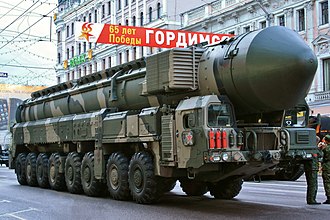 Launcher with a transport and launch container of the Topol-M complex on Tverskaya Street in Moscow during a rehearsal of the parade on May 9 | |
| General information | |
| A country |  Russia Russia |
| Index | 15ZH65 |
| START Code | RS-12M2 |
| NATO classification | SS-27 Sickle B |
| Appointment | ICBMs |
| Developer | MIT |
| Manufacturer | Votkinsk plant |
| Main characteristics | |
| Number of steps | 3 |
| Length (with GP) | 22.55 m [1] |
| Length (without MS) | 17.5 m |
| Diameter | 1.81 m [1] |
| Starting weight | ~ 46 500 kg [1] |
| Cast weight | ~ 1 200 kg |
| Type of fuel | solid blended |
| Maximum range | 12,000 km [1] |
| Accuracy, quo | 150-200 meters [2] |
| Type of head | monoblock |
| Number of War Blocks | one |
| Charge power | 1 Mt [2] [3] |
| Control system | autonomous, inertial based on BTsVK |
| Basing method | Silos and PGRK |
| Launch history | |
| condition | in service |
| Launch locations | 1 GIK "Plesetsk" |
| Number of starts | 17 |
| • successful | 16 |
| • unsuccessful | one |
| Adopted | 1997 year |
| First start | December 20, 1994 |
| Last run | January 16, 2017 |
| Options | RS-24 |
In the mine version of the basing adopted for service in 2000 . In the next decade, Topol-M was to become the basis for armament of the Strategic Missile Forces .
In 2011, the Ministry of Defense of the Russian Federation refused further purchases of Topol-M missile systems in favor of the further deployment of RS-24 Yars ICBMs with the RGCh IN [8]
Content
- 1 Development
- 2 Accommodation
- 3 Performance characteristics
- 3.1 Engineering and masking machines
- 4 Tests
- 4.1 Testing equipment
- 5 In philately
- 6 Photos
- 7 Comments
- 8 Notes
- 9 Literature
- 10 Links
Development
Work on the creation of a new complex began in the mid -1980s . The decree of the Military Industrial Commission of September 9, 1989 prescribed the creation of two missile systems (stationary and mobile) and a universal solid fuel three-stage intercontinental ballistic missile for them. This development work was called "Universal", the complex being developed is the designation RT-2PM2. The development of the complex was carried out jointly by the Moscow Institute of Heat Engineering and the Dnepropetrovsk Design Bureau "South" .
The missile was supposed to be unified for both types of complexes, but in the initial draft, a difference in the system for breeding the warhead was assumed. The combat stage for a mine-based missile was to be equipped with a liquid propellant rocket on the promising Pronit mono-fuel based on propylene glycol dinitrate [9] . For mobile MIT developed a propulsion system on solid fuel [2] . There were also differences in the launch container. For the mobile complex, it had to be made of fiberglass. For stationary - from metal, with a number of ground equipment systems mounted on it. Therefore, the rocket for the mobile complex received the index 15Zh55, and for the stationary - 15Zh65 [10] .
In March 1992, it was decided to develop the Topol-M complex on the basis of the groundwork under the Universal program (in April, Yuzhny ceased its participation in the complex). By decree of Boris Yeltsin of February 27, 1993, MIT became the head company for the development of Topol-M. It was decided to develop a unified missile with only one option of military equipment - with a propulsion system of a combat stage on solid fuel.
The rocket tests began in 1994 . The first launch was carried out from a silo launcher at the Plesetsk cosmodrome on December 20, 1994 . In 1997 , after four successful launches, mass production of these missiles began. The act on the adoption of the Topol-M intercontinental ballistic missile by the Strategic Missile Forces of the Russian Federation was approved by the State Commission on April 28, 2000 , and the Decree of the President of the Russian Federation on the adoption of the DBK was adopted by Vladimir Putin in the summer of 2000, after which the mobile soil missile system went into flight tests (PGRK) based on the eight-axis chassis MZKT-79221 . The first launch with a mobile launcher was carried out on September 27, 2000 [2] .
- Involved Structures
The following structures were involved in the development and production of combat and training weapons of the Topol-M systems:
- Rocket - CJSC “Scientific and Technical Center“ Complex-MIT ” , Moscow (development); [11] Votkinsk Plant OJSC , Votkinsk , Udmurt Republic (production); [12]
- Control system - FSUE Scientific and Practical Center for Automation and Instrumentation named after Academician N. A. Pilyugin ” , Zyuzino , Moscow (development); OJSC “LOMO” , St. Petersburg (development / production); [13]
- The warhead and warheads - RFNC "VNIIEF" , Sarov , Nizhny Novgorod region. (development / production); [fourteen]
- Drives - State Unitary Enterprise "Research Institute" Signal " , Kovrov , Vladimir Region. (development); OJSC “PO“ Plant named after A.V. Ukhtomsky ” , Lyubertsy , Moscow Region (production); [fifteen]
- Launcher and support machine - FSUE TsKB Titan (development) [16] and SE PO Barrikady , Volgograd , Volgograd Region. (production); [17]
- Starting rocket engine, basic load-bearing structures (BNK) for missiles - FTsDT Soyuz , Dzerzhinsky , Moscow Region (development); [eighteen]
- Mine launchers - FSUE Vympel Design Bureau , Moscow (development, creation and re-equipment of existing missiles); [19] OAO GOZ , St. Petersburg (manufacture of structures); [twenty]
- Container made of composite materials - Central Scientific Research Institute of Spetsmashinostroeniya OJSC , Khotkovo , Moscow Region
Accommodation
The deployment of the first missiles in the modified mines used for the UR-100N missiles (15A30, RS-18, SS-19 Stiletto) was launched in 1997 on December 25, 1997 for pilot combat duty in the 60th missile division (town of Tatishchevo ) the first two [21] 15Zh65 missiles (launch minimum) were delivered for the first regiment in the Strategic Missile Forces armed with the 15P065-35 missile system [22] [approx. 1] - 104th Missile Regiment . [23] And on December 30, 1998 , the 104th missile regiment (commander - Lieutenant Colonel Yu. S. Petrovsky [24] ) took up combat duty with a full force of 10 silos with a silo-based Topol-M ICBM. [21] Four more regiments with a silo-based Topol-M ICBM entered combat duty on December 10, 1999 [25] , December 26, 2000 (rearmament from 15P060 ), [25] December 21, 2003 [26] and December 9 2005 year . [27]
The process of rearmament to the mobile-based complex began on November 21, 2005 in the 54th Guards Missile Division ( Teykovo ), when two divisions and a mobile command post (PKP) of the 321st missile regiment ( 321 rp ) were decommissioned. A year later, in November 2006 , 321 RP took up pilot combat duty as part of one division (3 launchers) and a missile regiment control panel at the Topol-M complex. The 1st Missile Division and PKP 321 rp entered combat duty on December 10, 2006 at 15:00. [5] [28] Then it became known that President Vladimir Putin signed the new state arms program until 2015 , which provides for the purchase of 69 Topol-M ICBMs. [29]
In 2008, Nikolai Solovtsov announced the start of the soon equipping of Topol-M missiles with multiple warheads. Equipping the Topol-M RGCh will become the most important way to maintain Russia's nuclear potential. "Topol-M" with RGCh began to enter service in 2010 . [thirty]
In April 2009, the Strategic Missile Forces commander Nikolai Solovtsov announced that the production of Topol-M mobile ground missile systems was discontinued, and more advanced systems would come into service with the Strategic Missile Forces. [31]
The location of the 54th Missile Division as of 2010 continued to be modernized [32] .
As of the end of 2012, there were 60 mine Topol-M missiles and 18 mobile based on alert duty. All mine-based missiles are on alert in the Taman Missile Division ( Svetly, Saratov Region ). [33]
| Deliveries of Topol-M ICBMs to the troops [approx. one] | ||||||||||||||||
|---|---|---|---|---|---|---|---|---|---|---|---|---|---|---|---|---|
| 1997 | 1998 | 1999 | 2000 | 2001 | 2002 | 2003 | 2004 | 2005 | 2006 | 2007 | 2008 | 2009 | 2010 | 2011 | 2017 | |
| Silos for the year | +2 [21] [34] | +8 | +4 [35] | +6 [35] | +6 [35] | +6 [35] | +6 [35] (+4 [36] ) | +4 [35] (+2 [37] ) | +3 [35] | +4 [38] | +2 [39] | 0 | +2 [40] | +2 [40] (plan - 4 [41] ) | ||
| Total silos | 2 | 10 [21] | 36 | 48 [38] | 50 [42] [43] | 52 | 54 | 60 | ||||||||
| PGRK for the year | - | - | - | - | - | - | - | - | - | +3 [44] | +3 [45] | +9 [39] | +3 [43] | 0 | 0 | |
| Total PGRK | - | - | - | - | - | - | - | - | - | 3 | 6 | fifteen | 18 [43] | eighteen | eighteen | eighteen |
| In total for a year | +2 | +8 | +4 [35] | +6 [35] | +6 [35] | +6 [35] | +6 [35] (+4 [36] ) | +4 [35] (+2 [37] ) | +6 [35] | +7 [35] | +11 [46] | +3 | +2 | +2 | ||
| TOTAL in the troops on beginning / end of the year | 2 [approx. 2] | 10 | 30/36 [47] | 36/40 [36] [48] | / 42 [approx. 3] [49] | / 48 [50] | / 54 [51] | 54/65 [51] | 65 [51] / 68 | 68/70 | 70/72 | 78 | ||||
Performance Specifications
The 15P165 stationary missile system includes 10 15Zh65 intercontinental ballistic missiles mounted in transport and launch containers (TPK) and installed in silos launchers 1515765-35 silos ( 15157 re-equipped silos 15P735 ) or 15P765-60 silos 1515760 ), as well as the unified command post (UKP) 15V222 of high security (located on the suspension in the mine with the help of special depreciation). [2]
The 15P155 Mobile Soil Missile Complex (PGRK) includes 9 15Zh55 intercontinental ballistic missiles mounted on 15U175 autonomous launchers (APUs). The autonomous launcher 15U175 of the mobile complex is a single rocket 15Zh55 , placed in a high-strength fiberglass transport and launch container (TPK) mounted on an eight-axle chassis MZKT-79221 . [2]
At the permanent deployment point (PPD), an autonomous launcher with a missile is located in a special building 15U182 Krona with a retractable roof. [2]
The rocket 15ZH65 (15ZH55) consists of three stages with solid propellant marching engines. Marching steps are made of composites by winding like cocoon. All three stages are equipped with a rotary nozzle to deviate the thrust vector (there are no lattice aerodynamic rudders). The first stage has a thrust of 100 tf , a mass of 26 t, of which the mass of the stage is 3 t, length is 8.5 m, and the operating time is 60 s. The second stage has a thrust of 50 tf, weight 13 t, of which 1.5 t stage, length 6 m, stage run time 64 s. The third stage has a thrust of 25 tf, weight 6 t, of which 1 t step, length 3.1 m, operating time 56 s. [52]
The launch method is mortar for both options. The marching solid-propellant rocket engine allows it to gain speed much faster than previous types of missiles of a similar class, created in Russia and the Soviet Union. This greatly complicates its interception by missile defense systems on the active flight site .
Type of warhead: detachable monoblock (high power class) thermonuclear, second (upper) level of resistance to the damaging factors of a nuclear explosion with a high-speed uncontrolled warhead with a capacity of 1 MT. [2] Given the accuracy of the new missile ( KVO 150-200 meters), the warhead allows you to confidently hit any small-sized high-strength strategic targets (command posts, communication centers, ammunition depots). In the future, it is possible to equip a rocket with a controlled warhead or a multiple warhead with individual guidance blocks with the number of warheads from 3 to 6 with a power of 500 kT and 150 kT, respectively. [2] The warhead is also equipped with missile defense systems . KSP PRO consists of passive and active false targets , as well as means of distorting the characteristics of the head part. Means of distorting the characteristics of the head part consist of a radio-absorbing (combined with heat-shielding) coating of the warhead, generators of active radio interference, aerosols (infrared sources containing sodium-lithium mixture), dipole reflectors. Several dozen auxiliary correction engines, instruments and control mechanisms allow the rocket to make maneuvers on the trajectory, making it difficult to intercept on the active part of the trajectory. The KSP missile defense system includes 15–20 small-sized atmospheric (quasi-heavy) false targets of the wave class class with a working height of 2–5 km and a relative mass of ~ 5–7% of the mass of the warhead. False targets are indistinguishable from warheads in all ranges of electromagnetic radiation (optical, laser, infrared, radar); this allows you to simulate the characteristics of the warhead for all breeding attributes on the extra-atmospheric, transitional and a significant part of the atmospheric section of the descending branch of the flight path of the warhead of the missile. The combat unit and false targets are resistant to the damaging factors of a nuclear explosion and the radiation of a super-powerful nuclear-pumped laser . [2] [53]
In connection with the termination of the START-2 treaty , which prohibited the creation of multiply charged intercontinental ballistic missiles, the MIT carried out work on equipping the Topol-M with a separate warhead with individual guidance units with the number of warheads from 3 to 7 depending on the class of warheads: medium or a small power class, respectively, - or on a maneuvering monoblock warhead. Perhaps the result of this work is the RS-24 Yars .
Engineering and masking machines
In 2013, the Topol-M mobile missile systems were armed with the first 12 vehicles (9 of them in the Teykov missile division ) of engineering support and camouflage (MIOM). [54] The machines provide camouflage (sweeping) of the tracks of combat mobile missile systems on duty, as well as the creation of high-contrast, clearly visible from satellites tracks to false combat positions. [54]
Tests
The flight tests of the rocket of the mine-based variant were carried out in the period from 1994 to 2000, with their completion; in the period 2000-2004, tests of the mobile version of the complex were conducted.
| No. | Time | date of | A place | goal | Result | Notes |
|---|---|---|---|---|---|---|
| one | 12:50 | 12/20/1994 | Plesetsk | Kura | successfully | The first test of Topol-M, from the mine |
| 2 | 11:50 | 09/05/1995 | Plesetsk | Kura | successfully | From the mine |
| 3 | 07/25/1996 | Plesetsk | Kura | successfully | From the mine | |
| four | 16:25 | 07/08/1997 | Plesetsk | Kura | successfully | From the mine |
| 5 | 15:53 | 10/22/1998 | Plesetsk | Kura | unsuccessful | From the mine. The missile deviated from the course and was eliminated. |
| 6 | 14:25 | 12/08/1998 | Plesetsk | Kura | successfully | |
| 7 | 18:20 | 01/03/1999 | Plesetsk | Kura | successfully | |
| 8 | 15:44 | 09/03/1999 | Plesetsk | Kura | successfully | |
| 9 | 12:05 | 12/14/1999 | Plesetsk | Kura | successfully | |
| 10 | 13:59 | 02/09/2000 | Plesetsk | Kura | successfully | From the mine. First launch by command from the missile force control center |
| eleven | 3 p.m. | 09/26/2000 | Plesetsk | Kura | successfully | |
| 12 | 13:50 | 09/27/2000 | Plesetsk | Kura | successfully | First launch from a mobile installation |
| 13 | 15:20 | 06/06/2002 | Plesetsk | Kura | successfully | From a mobile installation. |
| fourteen | 9:30 p.m. | 04/20/2004 | Plesetsk | Pacific Ocean | successfully | From a mobile installation. Limit test run. |
| fifteen | 12:39 | 12/24/2004 | Plesetsk | Kura | successfully | From a mobile installation. [55] |
| 16 | 11/01/2014 | Plesetsk | Kura | successfully | From the mine | |
| 17 | 01/16/2017 | Plesetsk | Kura | successfully | From the mine [56] |
Combat Equipment Tests
Despite the completion of testing the missile system and putting on combat duty serial equipment, work on improving the complex was continued in the direction of developing combat equipment for the warheads, while the modified Topol missile was used as a carrier. [57]
On November 1, 2005, the RT-2PM Topol rocket [58] was successfully launched from the Kapustin Yar firing range in the Astrakhan Region as part of the tests of a single combat unit and a number of newly developed elements of a complex of missile defense and missile defense systems , supporting up to six combat units, while the level of breeding is unified for installation on an ICBM sea (" Bulava ") and ground ("Topol-M") based. The use of a new combat unit on a standard RT-2PM missile was combined with testing in the interests of extending the Topol warranty resource. For the first time in Russian practice, launch was carried out from the Kapustin Yar test site at the 10th Sary-Shagan test site located in Kazakhstan ( Priozersk district). [59] This was done, firstly, due to the limited capabilities of the Kura firing range, which prevented the recording of warhead maneuvers after their separation from ICBMs. Secondly, these maneuvers are tracked by American measuring instruments located in Alaska . The flight parameters from Kapustin Yara to Sary-Shagan became known exclusively to Russian means of control. [60]
In philately
In 2009, in honor of the anniversary of the Strategic Missile Forces of Russia and in 2014, in honor of the anniversary of the Barricades factory , postage stamps depicting the Topol-M complex were issued:
Stamp 2009, dedicated to the anniversary of the Strategic Missile Forces of Russia.
2014 stamp dedicated to the anniversary of the Barricades factory.
Photos
The launcher of the RT-2PM2 Topol-M complex at the training of the Victory Parade in Alabino.
Comments
- ↑ 1 2 The table shows the deliveries of missiles to the Strategic Missile Forces, the number of missiles on combat duty may differ from the indicated numbers. This can happen both because of the reasons for the presence of missiles (launchers) in a state of repair (regulation), and may be related to the peculiarities of the process of putting into operation and putting new missiles on alert.
- ↑ According to data published in the Krasnaya Zvezda newspaper (the official publication of the RF Ministry of Defense), on December 24, 1997, in the Taman Missile Division, the mine, the first Topol-M rocket, was installed for continuation of tests - without a nuclear warhead. And the first missile regiment, armed with the 15Zh65, took up pilot combat duty only a year later.
- ↑ It was planned to put 4 silos on alert and increase the number of missiles of this type to 44.
Notes
- ↑ 1 2 3 4 Strategic Ground-Based Missile Systems / Ed. Shevchenko S. N. .. - M .: "Military Parade", 2007. - S. 186-194. - ISBN 5-902975-12-3 .
- ↑ 1 2 3 4 5 6 7 8 9 10 11 “Topol-M”: the history of creation and prospects . Rocket technology. Date of appeal September 17, 2017.
- ↑ Nikolaev, Yu. M. Panin, S.D. Solomonov, Yu. S. 2 // Fundamentals of the design of solid-fuel guided ballistic missiles. - MSTU named after N. E. Bauman, 1998.
- ↑ Strategic missile systems. - S. 191.
- ↑ 1 2 Samoilov G. E. et al. Guards Order of Kutuzov II degree rocket division / Under the general. Ed .: I.R. Fazletdinova. - Teykovo: STELS-design, 2008 .-- S. 41.
- ↑ SS-27 Sickle B
- ↑ RT-2PM2 intercontinental ballistic missile, unified for mine and mobile basing options
- ↑ Lenta.ru: Weapons: Novosibirsk missiles will begin to rearm on Yars in 2012
- ↑ Suvorov A.V. Improving the method for assessing the thermal hazard of high-energy substances and choosing safe conditions for their production and operation. Dis. ... cand. tech. sciences. - SPb. - 2018.
- ↑ Strategic missile systems. - S. 186-187, 191.
- ↑ Tikhonov, Vol. 1, 2010 , p. 41.
- ↑ Tikhonov, Vol. 2, 2010 , p. 61.
- ↑ Tikhonov, Vol. 2, 2010 , p. 191.
- ↑ Tikhonov, Vol. 1, 2010 , p. 163.
- ↑ Tikhonov, Vol. 2, 2010 , p. 448.
- ↑ Tikhonov, Vol. 2, 2010 , p. 42.
- ↑ Tikhonov, Vol. 2, 2010 , p. 43.
- ↑ Tikhonov, Vol. 1, 2010 , p. 465.
- ↑ Tikhonov, Vol. 1, 2010 , p. 403.
- ↑ Tikhonov, Vol. 2, 2010 , p. 57.
- ↑ 1 2 3 4 Intercontinental ballistic missile 15ZH65 Topol-M (RS-12M2) . Information and news system "Rocket Technology" BSTU . Date of treatment January 18, 2011.
- ↑ Vladimir Rocket Strategic: A Brief Chronicle of the Main Events of the History of the Rocket Army / Comp. I.V. Vershkov et al., Ed.: V. G. Gagarin. - Vladimir: Arkaim, 2006. - S. 68. - ISBN 5-93767-023-X .
- ↑ Military Industrial Courier, No. 16 (33), 2004
- ↑ Vladimir Rocket Strategic: A Brief Chronicle of the Main Events of the History of the Rocket Army / Comp. I.V. Vershkov et al., Ed.: V. G. Gagarin. - Vladimir: Arkaim, 2006. - S. 70. - ISBN 5-93767-023-X .
- ↑ 1 2 Vladimir Rocket Strategic: A Brief Chronicle of the Main Events of the History of the Rocket Army / Comp. I.V. Vershkov et al., Ed.: V. G. Gagarin. - Vladimir: Arkaim, 2006 .-- S. 72-73. - ISBN 5-93767-023-X .
- ↑ Vladimir Rocket Strategic: A Brief Chronicle of the Main Events of the History of the Rocket Army / Comp. I.V. Vershkov et al., Ed.: V. G. Gagarin. - Vladimir: Arkaim, 2006. - S. 77. - ISBN 5-93767-023-X .
- ↑ Vladimir Rocket Strategic: A Brief Chronicle of the Main Events of the History of the Rocket Army / Comp. I.V. Vershkov et al., Ed.: V. G. Gagarin. - Vladimir: Arkaim, 2006. - S. 84. - ISBN 5-93767-023-X .
- ↑ The next division “Topol-M” takes up combat duty
- ↑ RF Ministry of Defense plans to purchase 69 Topol-M complexes by 2015 RIA Novosti (14:37 13/07/2006)
- ↑ In the Saratov Region, new “Poplars” took up combat duty, novopol.ru, January 10, 2008 (inaccessible link) . Date of treatment January 26, 2008. Archived on April 9, 2010.
- ↑ Shishlin, Vladimir "Poplar" with the right to exist . Interfax (April 10, 2009). Date of treatment December 21, 2009.
- ↑ Russian Nuclear Forces 2010 , fas.org (English) (Retrieved July 12, 2010)
- ↑ http://function.mil.ru/news_page/country/more.htm?id=11368246@egNews http://en.rian.ru/video/20121127/177745393.html
- ↑ Sokov N. Evolution of Russian strategic offensive weapons (Rus.) // Nuclear control . - M .: PIR Center , 1998 .-- T. 31 , no. January-February , No. 1 . - S. 49-64 .
- ↑ 1 2 3 4 5 6 7 8 9 10 11 12 13 14 15 State defense order in 2000-2007 Magazine “New defense order. Strategies
- ↑ 1 2 3 The deployment of the fourth regiment of Topol-M missiles . Website "Strategic Nuclear Arms of Russia" (December 16, 2004). Date of treatment January 6, 2012. Archived February 4, 2012.
- ↑ 1 2 Data of the START Treaty: changes in the composition of strategic forces . Website "Strategic Nuclear Arms of Russia" (April 3, 2006). Date of treatment January 6, 2012. Archived February 4, 2012.
- ↑ 1 2 Four Topol-M complexes began combat duty . Website "Strategic Nuclear Weapons of Russia". Date of treatment January 6, 2012. Archived February 4, 2012.
- ↑ 1 2 Execution of the state defense order of Russia in 2008. New Defense Order. Strategy »№2 2009
- ↑ 1 2 В наступившем году завершится перевооружение Татищевского ракетного соединения на ракетный комплекс «Тополь-М» . Of. сайт Минобороны России (5 января 2012). Дата обращения 6 января 2012. Архивировано 4 февраля 2012 года.
- ↑ Андреев Д. Татищевский мегаполи . Газета «Красная звезда» (1 сентября 2011). Дата обращения 6 января 2012.
- ↑ Последний обмен данными в рамках Договора СНВ Сайт «Стратегическое ядерное вооружение России»
- ↑ 1 2 3 Фролов Андрей. Исполнение государственного оборонного заказа России в 2009 году . Журнал «Новый оборонный заказ. Стратегии». Дата обращения 6 января 2012. Архивировано 4 февраля 2012 года.
- ↑ Опубликованы данные СНВ-1 за январь 2007 г. Сайт «Стратегическое ядерное вооружение России»
- ↑ Российские стратегические силы в 2007 году Проект «Стратегическое ядерное вооружение России»
- ↑ Исполнение государственного оборонного заказа России в 2008 году. Часть 2 Журнал «Новый оборонный заказ. Стратегии»
- ↑ Поставлен на боевое дежурство новый полк ракет Тополь-М Проект «Стратегическое ядерное вооружение России»
- ↑ Командующий РВСН обнародовал планы развития ракетных войск . Сайт «Стратегическое ядерное вооружение России» (12 декабря 2004). Дата обращения 6 января 2012. Архивировано 4 февраля 2012 года.
- ↑ Начато развертывание пятого полка ракет Тополь-М . Сайт «Стратегическое ядерное вооружение России» (17 декабря 2005). Дата обращения 6 января 2012. Архивировано 4 февраля 2012 года.
- ↑ Мобильные комплексы Тополь-М начали боевое дежурство Проект «Стратегическое ядерное вооружение России»
- ↑ 1 2 3 Россия продолжает ликвидацию старых носителей
- ↑ Topol M (недоступная ссылка) . Дата обращения 23 сентября 2012. Архивировано 5 октября 2012 года.
- ↑ Межконтинентальная баллистическая ракета 15Ж65 Тополь-М (РС-12М2) . ИС «Ракетная техника». Дата обращения 30 июня 2017.
- ↑ 1 2 Российские ракетчики получили новые машины маскировки . Дата обращения 29 ноября 2013.
- ↑ Заключительный испытательный пуск ракеты мобильного комплекса Тополь-М Проект «Стратегическое ядерное вооружение России»
- ↑ Запущенная с Плесецка ракета "Тополь-М" поразила цель Российская газета
- ↑ Ранее, для испытаний головных частей использовалась жидкостная ракета-носитель К-65М-Р
- ↑ Испытание ракеты «Тополь» прошло успешно «Взгляд». Деловая газета
- ↑ Россия скрещивает боеголовки стратегических ракет «Булава» и «Тополь-М» Коммерсантъ (Волгоград), № 73 (3404) от 25.04.2006
- ↑ Москва испытала асимметричный ответ Коммерсантъ
Literature
- Стратегические ракетные комплексы наземного базирования / Под ред. Шевченко С. Н.. — М. : Военный парад, 2007. — 248 с. — ISBN 5-902975-12-3 .
- Тихонов С. Г. Оборонные предприятия СССР и России : в 2 т. . — М. : ТОМ, 2010. — Т. 1. — 608 с. - 1000 copies. — ISBN 978-5-903603-02-2 .
- Тихонов С. Г. Оборонные предприятия СССР и России : в 2 т. . — М. : ТОМ, 2010. — Т. 2. — 608 с. - 1000 copies. — ISBN 978-5-903603-03-9 .
Links
- На Викискладе есть медиафайлы по теме РТ-2ПМ2
- Межконтинентальная баллистическая ракета «Тополь-М» (РС-12М2)
- Ракетный комплекс «Тополь-М»
- «Тополь-М» сможет преодолеть противоракетную оборону США
- Красная Звезда
- «Тополь-М» на марше. Учебный пуск. (video)
- Программа «Ударная сила» , выпуск «Неотвратимая расплата», посвященный мобильному комплексу «Тополь-М»