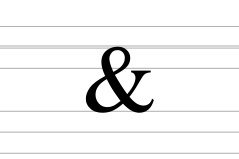
Ampersand (sometimes - ampersand ; English ampersand ) - sign & . It is a logogram replacing the union “and”, and arose as a ligature of the letters et (from lat. - “and”).
| Ampersand | ||||||||||||
|---|---|---|---|---|---|---|---|---|---|---|---|---|
| & | ||||||||||||
Picture
| ||||||||||||
| ||||||||||||
| Specifications | ||||||||||||
| Title | ampersand | |||||||||||
| Unicode | U + 0026 | |||||||||||
| HTML code | & or & | |||||||||||
| Utf-16 | 0x26 | |||||||||||
| Url | % 26 | |||||||||||
| Mnemonics | & | |||||||||||
Content
Origin
Ampersand is a graphic abbreviation ( ligature ) of the Latin union et ("and") - this is clearly seen in the image of the ampersand in italics.
In the “Brief Information on Printing” it is called “a sign replacing the union of“ and “”, in the “Reference book of a printing technologist” - “a conjunction mark”, in the “Reference book of the corrector and editor” (1974) - “a special companion mark, a kind of ligatures » [1] .
The authorship of the ampersand is attributed to Mark Tullius Tyrone , a faithful slave and secretary of Cicero. . Even after Tyrone became a freedman, he continued to write down Cicero's texts. And by 63 BC e. invented his abbreviation system to speed up writing, called “ Tiron signs ” or “Tiron notes” (Notæ Tironianæ, the originals were not preserved), which were used until the 11th century (so that Tiron is also considered the founder of Roman shorthand ).
Ampersand from the second half of the VIII century is actively used by scribes, and from the middle of the XV century - by printers.
Title
Ampersand became such a familiar part of writing in Europe and North America that it came to the last place in the English alphabet in all primers by the beginning of the 19th century (and only began to disappear by the beginning of the 20th century).
When pronouncing the English alphabet (for example, when memorizing it by English and American schoolchildren), before the names of letters that coincided with single-letter words, they pronounced per se (from Latin - “in itself”, “as such”) in order to distinguish the letter from the word coinciding with her. They said, for example: “ I, per se I ”, so as not to confuse the letter with the English pronoun “ I ” (that is, “I”). The last one was “&”, and they finished the pronunciation of the alphabet with the words: “ X, Y, Z, and per se and ” (““ ex, “wye,“ zed “and“ and “in itself”, ““ and “ as such "). In 1837, the word ampersand was recorded in dictionaries.
Usage
In Russian
The union “and” itself is short, and it does not need a reduction. Therefore, in the USSR, the ampersand was limitedly used in scientific and technical documentation to denote the logical operation “and” (for example, for logical elements “AND” in electrical circuits).
In Computer Science
Ampersand in software:
In the macro language of the Assembler EC computer, the ampersand serves as a parameter sign.
- In Microsoft Excel, the “&” character is used as a concatenation operator for text values.
- In C , C ++ , Java , C # , JavaScript, and others, the & character is used to refer to several operators:
- to get a reference to a variable, the unary operator, "&" must precede the identifier (name) of the variable with a prefix;
- the & operator denotes the bitwise AND;
- the && operator denotes a conditional logical AND (verifying the truth of a subsequent expression only if the previous one is true).
- In a GET ( HTTP request encoding system), the & operator separates the arguments in the query string.
- In BASIC, the & symbol immediately after the variable name indicates the type of the variable "long integer", and the combination of characters & H means that the number is written in the hexadecimal number system , and in Visual Basic , in addition, using the & operation concatenates (concatenates) lines.
- In SGML (including HTML , XML ), the
&name;displays a character by its name. Her subspecies&#xxxx;(where xxxx is a number) prints a character with code xxxx from a Unicode space. - In most command interpreters of unix-like OSs, a command terminated by an ampersand will run in the background.
Encoding
There are also many other ampersand variations in Unicode. Below is their encoding:
| Grapheme | Title | Unicode | HTML |
|---|---|---|---|
| & | Ampersand | U + 0026 | & or & |
| ⅋ | TURNED AMPERSAND | U + 214B | ⅋ |
| ﹠ | SMALL AMPERSAND | U + FE60 | ﹠ |
| & | FULLWIDTH AMPERSAND | U + FF06 | & |
| 🙰 | SCRIPT LIGATURE ET ORNAMENT | U + 1F670 | 🙰 |
| 🙱 | HEAVY SCRIPT LIGATURE ET ORNAMENT | U + 1F671 | 🙱 |
| 🙲 | LIGATURE OPEN ET ORNAMENT | U + 1F672 | 🙲 |
| 🙳 | HEAVY LIGATURE OPEN ET ORNAMENT | U + 1F673 | 🙳 |
| 🙴 | HEAVY AMPERSAND ORNAMENT | U + 1F674 | 🙴 |
| 🙵 | SWASH AMPERSAND ORNAMENT | U + 1F675 | 🙵 |
Notes
- ↑ Reference book of the corrector and editor. Under the total. ed. Milchina A. E., M., “The Book”, 1974, p. 142
Literature
- Kolomnin P.P. Brief information on printing. St. Petersburg, 1899. 604 pp.
- Ivanova O. E. , Lopatin V.V. , Nechaeva I.V. et al. Russian Spelling Dictionary: About 180 Thousand Words / Ed. Lopatina V.V. 2nd ed., Rev. and add. M .: Publishing house of Inst. lang them. V.V. Vinogradova, 2005. 960 pp. ISBN 5-88744-052-X .
- Reference technologist-polygraphist. Part 1. Composing processes / Comp. Schulmeister M.V., Tal G.A. M.: Book, 1981. 255 pp.
- GOST 2.743-91. Unified system of design documentation. Conditional graphic designations in schemes. Elements of digital technology
Links
- Allan Haley. Ampersand fonts.com