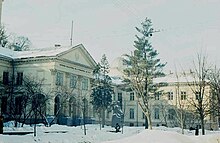
The Ossolinski National Library , or the Ossolinium , is the national library of Poland . It was founded by Count Ossolinsky in Lviv in 1817, in the building of the former monastery of sisters of the Order of Carmelites , and donated to the city community. After the Second World War, part of the funds moved to Wroclaw , but in Lviv they established the National Library named after Vasily Stefanik .
Content
History
In 1817, Count Jozef Maximilian Ossolinsky founded in Lviv, in the building of the former monastery of sisters of the Order of Carmelites, a private library, the funds of which totaled books from the collections of counts Lubomirsky, Skarbkov, Sapieh and other private collections. In 1827, on the basis of the library, the Polish Ossolineum Research Institute, or the Ossolinski Institute, was created. In the Austro-Hungarian period of the history of Lviv, society became the center of Polish scientific life. Until 1939, the publishing house and the Lubomirsky Museum also functioned in society.
In 1939, when Western Ukraine was incorporated into the USSR, the Ossolinsky Institute was closed. In December 1939, the Polish communist Jerzy Boreysh was appointed new director.
During the German occupation of Ukraine (1941-1944), the Lviv State Library (German Staatsbibliothek Lemberg) was created on the basis of the Ossolineum funds combined with the Bavorovsky Library (now the art department of the Leningrad National Library named after Stefanik), and part of the collection was moved to Krakow . The head of the library was Mechislav Gembarovich. In the period before the liberation of Lviv by Soviet troops in July 1944, he tried to protect the Ossolineum assembly from destruction.
On June 26, 1946, "Soviet Ukraine" published a communiqué of the government of the Ukrainian SSR on the transfer of cultural property to the Polish government. The communiqué noted that the Government of the Ukrainian SSR, given the end of the repatriation of Polish citizens from Ukraine, decided to transfer to the Polish people the values of the Lviv book depository "Osoleineum", " Raclawice panorama ", paintings by prominent artists, numerous museum exhibits, valuable manuscripts, as well as other artistic and historical Monuments of Polish national culture, science and art. In 1947, 30% of the Ossolineum funds were transferred to the Polish People’s Republic. This amounted to 217,000 units, which filled the wagons of two railway trains; already in September of that year, library funds were open to readers in Wroclaw. In the same year, 10 thousand volumes were transferred to the Library of the USSR Academy of Sciences in Moscow.
Some of the Polish workers at the Ossolinsky Institute (headed by the last Polish library director Mechislav Gembarovich) in 1946 did not leave for Poland, but remained to work in the Leningrad National Library named after Stefanika. Gembarovich, however, was in Lviv in a state of social isolation, as he took an unacceptable for the Western Ukrainian intelligentsia revanchist position in relation to the “historically Polish”, in his opinion, the character of Lviv and Galicia [1] .
Notes
- ↑ Roman Golik. Legend of the Lviv Ossolіneumu: position, vision and social role of the library of the Ossolinsky in the manifestations of the Galicians of the 19th-20th centuries // The site of LNL im. Stefanika (inaccessible link) . Date of treatment July 2, 2014. Archived on November 16, 2017.
Literature
Palіnko M., Srіbnyak I. The information-potential potential of the archives of the National Establishment of the name of the Ossolinsky at the Wroclaw University of History (collection 22/53) // National History of Europe. - K., 2018 .-- Vip. 54. - S. 127-140. http://ethnic.history.univ.kiev.ua/ua/archive/2018/143/19_palіnko_srіbnyak.pdf (unavailable link)