
Linothorax ( Greek: λινοθώραξ ) is an ancient Greek shell made of linen . It was also known in other parts of the ancient world . Similar shells were probably used from the Mycenaean period , and from the end of the VI century BC. e. they become the standard hoplite armor . Compared with bronze shells, linothoraxes were lighter, cheaper, and less restrictive of movement, while providing a comparable degree of protection [1] . Linothoraxes were used until the III century BC. e., when they were replaced by chain mail [2] .
The Linothorax of the Etruscans
Linothoraxes were also used by the Etruscans , who often covered them with metal plates. A similar carapace with narrow, vertically oriented plates in the Assyrian style can be seen on the statue of Mars from Todi , located in the Gregorian Etruscan Vatican Museum . Etruscans also used quilted linothoraxes, in which breasts, shoulder valves and a semicircular part on the abdomen were covered with metal scales. Images of such shells date back to the 3rd century BC. e. , then the Etruscans appeared chain mail , shortly before that invented by the Celts, and the latter were made in the form of linothorax - with rectangular shoulder valves fixed on the chest. Later, the Celts themselves borrowed this form [3] , and it was also characteristic of Roman chain mail [4] .
Linothorax in the Macedonian Army
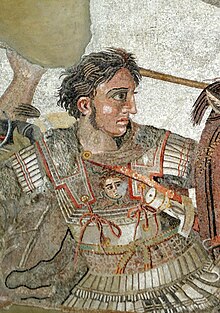
On the mosaic from Pompeii , Alexander the Great is depicted in linothorax, with supposedly metal shoulders and a chest plate, a strip of scales passes along the waist [5] . Presumably, such protection was common for getai cavalry [6] .
According to the Late Macedonian inscriptions from Amphipolis containing the military charter of Philip V , linothorax (called cotthybos ) was the standard carapace of rank-and-file phalangites , while the commanders and soldiers of the first line of phalanx used probably metal, thorax or hemorax ( thorax , hem ). For the loss of kotfib, the soldier had to pay a fine two times less than for the loss of thorax / hemitrax , which gives an idea of the price ratio of these two types of armor. Probably, during the time of Philip II and Alexander, the Macedonian soldiers outfitted in the same way [7] .
An iron shell made in the form of linothorax was found in a tomb excavated in Vergin , presumably by Philip II. The main part of the shell consists of four plates - one in front, behind and on each side; there are also shoulder pads of a characteristic shape, articulated on the back and extending onto the chest plate. The plates are decorated with gold borders and rosettes in the form of lion faces [8] .
Design
Linothorax was made of several layers of linen cloth glued together, with a total thickness of about 0.5 cm.The main part of the shell was a kind of wide ribbon with cutouts in the area of the armholes, which wrapped around the hull and fastened on the left side (A, B, C, D and E in the diagram above). The lower part of this main part was cut in the form of ribbons (the so-called birds , indicated by the letter G in the diagram), which covered the upper part of the hips, without restricting the movement of the legs. Another layer of tissue was attached from the inside, the feathers of which were located opposite the cuts of the feather of the outer layer. On the figure of a warrior, the birds formed a kind of scalloped skirt, sometimes they could be made detachable. A U-shaped part was attached from above to the top, the ends of which were thrown over the shoulders and fixed on the chest (indicated by the letter F in the diagram). Being unfastened, these shoulder pads, due to their elasticity, were straightened and occupied a vertical position. Shoulders sticking out from behind can be seen in some ancient Greek images, and this gives a good idea of the degree of elasticity and rigidity of the glued fabric. Sometimes linothorax could additionally be covered with metal plates or flakes. A replica of linotorx without metal parts, made by historian Peter Connolly , weighed 3.6 kg, while an antique cuirass with a poddeskodnika weighed about 6 kg [2] .
Achilles bandages the wounded Patroclus . Both figures in linotorax reinforced with scales, Patroclus' untied left shoulder pad straightened. Image from a red-figure vase from Vulchi , about 500 BC. e.
Amazon in Linothorax, VI century BC e.
Mars statue from Todi, V century BC e.
The warrior in linothorax, a fragment of the fresco from the "tomb of the Amazons" in Tarquinia , IV century BC e.
Greek hoplite in linothorax, 19th century drawing
Notes
- ↑ Connolly, 2001 , p. 58: “Although linen provided quite reliable protection, such armor was sometimes reinforced with scales or plates. ... Among the significant advantages of linen shell can be attributed to low cost, relative flexibility and lightness. ".
- ↑ 1 2 Connolly, 2001 , p. 58.
- ↑ Connolly, 2001 , p. 99, 124-125.
- ↑ Connolly, 2001 , p. 133.
- ↑ Connolly, 2001 , p. 72.
- ↑ Second, McBride, 2004 , p. 28.
- ↑ Connolly, 2001 , p. 70.
- ↑ Connolly, 2001 , p. 58-59.
Literature
- Connolly, Peter . Greece and Rome. Encyclopedia of Military History = Greece and Rome at War. - M .: EXMO- Press, 2001 .-- 320 p. - ISBN 5-04-005183-2 .
- Second N., McBride A. Army of Alexander the Great. - AST, 2004 .-- 56 p. - ISBN 5-17-022244-0 .
See also
- Spolas
- Lorika Linthea