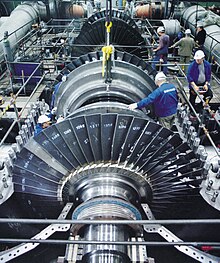
Turbine ( fr. Turbine from lat. Turbo - vortex, rotation ) is a blade machine in which the kinetic energy and / or internal energy of the working fluid ( steam , gas , water ) is converted into mechanical work on the shaft. The jet of the working fluid acts on the blades , fixed around the circumference of the rotor , and sets them in motion.
It is used as an electric generator drive in thermal, nuclear and hydroelectric power plants , as part of drives in sea, land and air transport, a compressor drive in a gas turbine engine, as well as hydrodynamic transmission, hydraulic pumps.
Content
History
Attempts to create mechanisms similar to turbines have been made for a very long time. The description of a primitive steam turbine made by Heron of Alexandria (1st century AD) is known. According to I. V. Linde [2] , the 19th century gave rise to a “mass of projects” that stopped before the “material difficulties” of their implementation. Only at the end of the 19th century, when the development of thermodynamics (increasing the efficiency of turbines to a comparable level with a piston machine), mechanical engineering and metallurgy (increasing the strength of materials and manufacturing precision needed to create high-speed wheels), Gustaf Laval ( Sweden ) and Charles Parsons ( Great Britain ) independently steam turbines suitable for industry were created from each other. [3]
Timeline
- I c. n e .: The steam turbine of Heron of Alexandria ( eolipilus ) - for centuries was considered as a toy and its full potential has not been studied.
- 1500: In the drawings of Leonardo da Vinci there is a " smoke umbrella ". Hot air from the fire rises through a series of blades that are interconnected and rotate the skewer for frying.
- 1551: Tagi al-Din invented a steam turbine that was used to power a self-rotating skewer.
- 1629: A strong stream of steam rotated a turbine, which then rotated a driven mechanism that allowed the Giovanni Branca mill to operate.
- 1678: Ferdinand Verbeyst built a steam engine model of a wagon.
- 1791: Englishman John Barber received a patent for the first real gas turbine. His invention had most of the elements present in modern gas turbines. The turbine was designed to drive a horseless cart.
- 1832: French scientist Bourdin created the first water turbine [4] .
- 1837: I.E. Safonov [4] .
- 1872: Franz Stolz developed the first true gas turbine engine.
- 1887: Russian engineer and inventor Pavel Kuzminsky designed the world's first gas reversible turbine, which operated on a “gas-vapor” - vapor-gas mixture obtained in the combustion chamber he created in 1894. [five]
- 1894: Sir Charles Parsons patented the idea of a steam turbine-powered ship and built a demonstration vessel, Turbinia . This traction principle is still in use.
- 1895: Three four-ton 100 kW Parsons radial flow generators were installed at Cambridge power plants and used to electrically illuminate the streets of the city.
- 1903: Norwegian, Edgidius Elling , was able to build the first gas turbine, which gave out more energy than was spent on servicing the internal components of the turbine, which was considered a significant achievement in those days when knowledge of thermodynamics was limited. Using rotary compressors and turbines, she produced 11 liters. with. (significant power for that time). His work was subsequently used by Sir Frank Whittle .
- 1913: Nikola Tesla patented the Tesla turbine based on the boundary layer effect.
- 1918: General Electric , one of the leading turbine manufacturers in the world, launched its gas turbine division.
- 1920: The practical theory of gas flow through channels was transformed into a more formalized (and applied to turbines) theory of gas flow along an aerodynamic surface by Dr. Alan Arnold Grifitz .
- 1930: Sir Frank Whittle patented a gas turbine for jet propulsion . For the first time this engine was successfully used in aviation in April 1937.
- 1934: Raul Pateras Pescara patented a piston engine as a generator for a gas turbine.
- 1936: Hans von Ohain and Max Hahn in Germany developed their own patented engine at the same time that Sir Frank Whittle was developing it in England.
Developments by Gustaf Laval
The first steam turbine was created by the Swedish inventor Gustav Laval in 1883 . According to one version, Laval created it in order to operate a milk separator of its own design. For this, a high - speed drive was needed. The engines of that time did not provide a sufficient speed. The only way out was to design a high-speed turbine. Laval chose steam that was widely used at that time as the working fluid. The inventor began to work on his design and eventually assembled a workable device. In 1889, Laval supplemented the turbine nozzles with conical expanders, so the famous Laval nozzle appeared, which became the progenitor of future rocket nozzles. The Laval turbine was a breakthrough in engineering. It is enough to imagine the loads experienced by the impeller in it to understand how difficult it was for the inventor to achieve stable operation of the turbine. At huge revolutions of the turbine wheel, even a slight displacement at the center of gravity caused strong vibration and overload of the bearings . To avoid this, Laval used a thin axis, which during rotation could bend.
Charles Parsons Developments
In 1884, the English engineer Charles Parsons received a patent for a multi-stage turbine. The turbine was designed to drive an electric generator. In 1885, he developed an improved version, which was widely used in power plants. In the design of the turbine, a leveling apparatus was used, which was a set of fixed crowns (disks) with vanes that had a reverse direction. The turbine had three stages of different pressure with different geometry of the blades and the step of their installation. Thus, both the “ active ” and “ reactive ” principles were used in the turbine.
In 1889, already about three hundred such turbines were used to generate electricity. Parsons tried to expand the scope of his invention and in 1894 he built a pilot ship , Turbinia , driven by a steam turbine. In tests, it showed a record speed of 60 km / h.
The inability to obtain large aggregate power and a very high speed of rotation of single-stage Laval steam turbines (up to 30,000 rpm for the first samples) led to the fact that they retained their significance only for driving auxiliary mechanisms. Active steam turbines developed in the direction of creating multi-stage structures, in which the expansion of steam was carried out in a number of successive stages. This made it possible to significantly increase the unit power, while maintaining the moderate rotational speed necessary for directly connecting the turbine shaft with the mechanism it rotates.
The Parsons steam turbine was used for some time (mainly on warships), but gradually gave way to more compact combined active-jet turbines, in which the high-pressure reactive part was replaced by a single or two-stage active disk. As a result, losses due to steam leakage through gaps in the scapular apparatus were reduced, the turbine became simpler and more economical.
Turbine Design
The turbine stage consists of two main parts. Impeller - blades mounted on the rotor (moving part of the turbine), which directly creates rotation. And the nozzle apparatus - blades mounted on a stator (fixed part of the turbine), which rotate the working fluid to give the flow the necessary angle of attack with respect to the blades of the impeller.
In the direction of flow of the working fluid , axial steam turbines are distinguished, in which the flow of the working fluid moves along the axis of the turbine, and radial , the flow direction of the working fluid in which is perpendicular to the axis of the turbine shaft. Centrifugal turbines (turbochargers) are also distinguished as a separate type of turbine.
According to the number of circuits, turbines are divided into single-circuit, double-circuit and three-circuit. Very rarely, turbines can have four or five circuits. A multi-circuit turbine allows the use of large thermal differences in enthalpy by placing a large number of stages of different pressures.
By the number of shafts, one-shaft, two-shaft, less often three-shaft, distinguished by a common thermal process or a common gear transmission ( gearbox ) are distinguished. The location of the shafts can be either coaxial or parallel with an independent arrangement of the axes of the shafts.
In the places where the shaft passes through the walls of the housing, end seals are installed to prevent leakage of the working fluid outward and air suction into the housing.
At the front end of the shaft, a limit regulator (safety regulator) is installed, which automatically stops (slows down) the turbine when the speed increases by 10-12% above the nominal.
Classification
By type of working fluid
- Gas turbines
- Steam turbines
- Hydroturbines (from other Greek: ὕδωρ “water”)
See also
- A turbocompressor is a device similar to a turbine, but having a blade rotation drive from the shaft.
- Gas turbine engine
- Turbojet
- External combustion engine
- Emergency aircraft turbine
- Wales Turbine
- Radial Axial Turbine (Francis Turbine)
- Rotary vane turbine (Kaplan turbine)
- Bucket Turbine (Pelton Turbine)
- Screw turbine
Notes
- ↑ Technical Encyclopedia / Editor-in-Chief L.K. Martens . - M: State Dictionary and Encyclopedic Publishing House "Soviet Encyclopedia", 1934. - T. 24. - 31,500 copies.
- ↑ I.V. Linde. Steam turbines, fans and high-pressure centrifugal pumps by engineer A. Rato . // Notes of the Moscow branch of the Imperial Russian Technical Society, 1904. P. 563-641.
- ↑ Konstantin Vladislavovich Ryzhov. [lib.aldebaran.ru/author/ryzhov_konstantin/ryzhov_konstantin_100_velikih_izobretenii/ 100 great inventions]. - M. , 2006. - ISBN 5‑9533‑0277‑0.
- ↑ 1 2 Bilimovich B.F. Laws of mechanics in engineering. - M .: Education, 1975. - Circulation of 80,000 copies. - S. 169.
- ↑ Merkulov I.A. Gas turbine / ed. prof. A.V. Kvasnikova. - Moscow: State Publishing House of technical and theoretical literature, 1957. - P. 25 - 26.
Literature
- I.V. Linde. Steam turbines, fans and high-pressure centrifugal pumps by engineer A. Rato . // Notes of the Moscow branch of the Imperial Russian Technical Society, 1904. P. 563-641.