Arthropleuridea (lat.) - a subclass of extinct giant millipedes from the class of two - legged (Diplopoda) [1] (or a class in the superclass of millipedes). Some representatives reached 2 m in length, which makes them one of the largest representatives of the entire type of arthropods . About 10 species. Detection time: Silurian , Devonian , Carboniferous and Permian (400-300 Ma) [2] [3] .
| † Arthropleuridea |
Arthropleura armata |
| Scientific classification |
|---|
| No rank : | Bilateral symmetrical |
| Subtype : | Tracheo-breathing |
| Subclass : | † Arthropleuridea |
|
| International scientific name |
|---|
Arthropleuridea Waterlot , 1934 |
| Detachments |
|---|
- † Arthropleurida Waterlot, 1934
- † Eoarthropleurida
Shear & Selden, 1995 - † Microdecemplicida
|
|
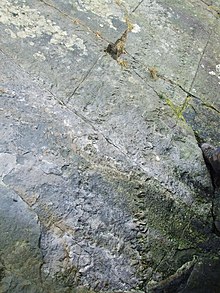
Fossil prints of artopleura
The most famous representatives of the group, such as arthropleura , reached gigantic sizes, up to 2 m or more. This allows them to be considered as one of the largest representatives of the entire type of arthropods. They reached such large sizes due to the absence of terrestrial predators among vertebrates and the high oxygen content in the atmosphere at that time [4] . Arthropleurids lived in moist marshy places and, possibly, buried in the litter layer. Supposedly ate plants or detritus . They were distinguished by a very solid outer cover (exoskeleton), legs of 8 segments (and in total they had at least 30 pairs of walking legs) [3] . Arthropleuridea began to die out after the climate became drier and the coal marshes dried out [3] . Fossilized traces of Arthropleura up to 50 cm long were found in Joggins ( Canada ) [5] . Most Arthropleuridea are thought to be terrestrial animals without any noticeable external respiratory structures (spiracles, etc.) [6] . Eoarthropleura were discovered in the period from the Upper Silurian to the Lower Devonian of Europe and North America [7] . The smallest representatives among Arthropleurida were Microdecemplex (several mm long), which were found in the Middle and Upper Devonian in the USA [8] .
The systematic position of Arthropleuridea has been debated for several decades, but since 2000 they have been included in the Diplopoda class [9] [1] . However, there is still disagreement regarding the relationship between the three extinct units and the modern centipede groups [2] [1] . Some authors include Arthropleuridea in Chilognatha , as a sister group to modern chylogenate centipedes ( Pentazonia + Helminthomorpha ) [9] [10] . An alternative hypothesis divides the subclass by placing the Arthropleurida and Eoarthropleurida squads within the Penicillata basal group (as sister to the modern Polyxenida ), and leave only Microdecemplicida as the sister group to modern Chilognatha [11] . According to this hypothesis, Arthropleuridea is paraphyletic.
Classification
The subclass includes three extinct orders, each with a single family and genus [8] :
- Order Arthropleurida Waterlot, 1934
- Arthropleuridae Zittel Family , 1848
- Genus Arthropleura Meyer, 1853 (5 species, carbon , perm ; Europe , North America )
- Order Eoarthropleurida Shear & Selden, 1995
- Eoarthropleuridae Størmer Family , 1976
- Genus Eoarthropleura Størmer, 1976 (3 species, Silurian , Devon ; Europe, USA , Canada )
- Order Microdecemplicida
- Genus Microdecemplex ( Devon ; United States )
Alternative Classification
According to the Paleobiology Database website, as of April 2018, there is only one extinct squad with one family and 6-7 genera [12] :
- Order Arthropleurida Waterlot, 1934
- Arthropleuridae Scudder Family , 1885 [ syn. Tiphoscorpionidae Kjellesvig-Waering, 1986 ]
- Genus Arthropleura Jorden & Meyer, 1854 (6 species)
- Genus Arthropleurion Goldenberg, 1877 (1 species)
- Genus Branchiopus Dumeril, 1806
- Genus Branchipusites Goldenberg, 1873 (1 species)
- Genus Eoarthropleura Størmer, 1976 (1-2 species)
- Genus Leptozoa Goldenberg, 1877 (1 species)
- Genus Propater Troschel, 1863 (1 species)
One genus and one species were declared nomen dubium within the Arthropleuridae family: Troxites Goldenberg, 1854 , Troxites germari Goldenberg, 1854 [12] .
Order Microdecemplicida and genus Microdecemplex are not in the Paleobiology Database.

