Petar "Peko" Dapchevich ( Serb. Peko Dapcheviћ / Peko Dapčević ; June 25, 1913 , Lubotin - February 10, 1999 , Belgrade ) - Yugoslav military leader , Colonel General .
| Petar Dapchevich | ||||||||||||
|---|---|---|---|---|---|---|---|---|---|---|---|---|
| Petar Dapcheviћ | ||||||||||||
 Dapchevich in 1942 | ||||||||||||
| Nickname | Peko | |||||||||||
| Date of Birth | June 25, 1913 | |||||||||||
| Place of Birth | Lubotinj , Kingdom of Montenegro | |||||||||||
| Date of death | February 10, 1999 (85 years old) | |||||||||||
| A place of death | Belgrade , Federal Republic of Yugoslavia | |||||||||||
| Affiliation |  Yugoslavia / Yugoslavia /  Second Spanish Republic Second Spanish Republic | |||||||||||
| Type of army |  Yugoslav People's Army : Ground Forces Yugoslav People's Army : Ground Forces | |||||||||||
| Years of service | 1937-1955 | |||||||||||
| Rank | lieutenant Colonel General | |||||||||||
| Part |
| |||||||||||
| Commanded |
| |||||||||||
| Battles / wars |
| |||||||||||
| Awards and prizes | Yugoslav awards :
Soviet awards :
| |||||||||||
| Communications | Milena Vrsaykov-Dapchevich (wife) Vlado Dapchevich (brother) | |||||||||||
| Retired | deputy of the Assembly, writer | |||||||||||


Content
- 1 Biography
- 1.1 The early years
- 1.2 Spanish Civil War
- 1.3 The People's Liberation War of Yugoslavia
- 1.4 After the war
- 1.5 Family
- 2 Military scientific heritage
- 2.1 Proceedings
- 3 Awards
- 4 notes
- 5 Literature
Biography
Early years
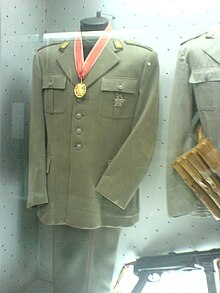
Peko Dapchevich was born on June 25, 1913 in the village of Lyubotin , near the city of Cetinje . By nationality - Montenegrin . Father - Jovan Dapchevich, Orthodox priest. The family also included brothers Vlado , Drago and Milutin and sister Danica. Peko studied at the gymnasium in Cetinje, where he became interested in the labor movement. Twice participated in strikes, once for participating in a youth speech he was arrested by the police. After graduating from high school, he entered the Faculty of Law of the University of Belgrade , in 1933 joined the Communist Party of Yugoslavia . Three years later, he returned to his homeland and began to work in the Tsetinsky district committee.
Spanish Civil War
In May 1937, Peko went with a group of Yugoslav volunteers to Spain to help the Republicans who fought against Francisco Franco and his fascist movement. Peko went through military training and was appointed a machine gunner. He served in the 15th brigade, Dimitrovsky battalion . During the Brunet operation, he was wounded in the head and out of order. After recovering, Peko was appointed platoon political officer and then became a company political officer. In this position, he proved himself as a talented commander and soon began to command the company. In the battle of Ebro Dapchevich was again wounded in the head, and in 1938 he was wounded for the third time, but already in the arm. However, this did not stop him: in the battles of Quinto, in Belchite and Catalonia, he showed himself as a brave soldier. He rose to the rank of lieutenant of the Spanish Republican Army.
In February 1939, the remnants of Yugoslav volunteers crossed the Spanish-French border, where they were immediately thrown into concentration camps. Many Yugoslavs were sent to a concentration camp in the town of Angeles, and Dapchevich himself and a group of Spaniards ended up in the Kolyure fortress, where he got out in October 1940 with Fadil Jahic . Since Yakhich planned the escape of all prisoners, Dapchevich had to cover up the fugitives: in April 1941 he arrived in Austria to work, from where he secretly supervised the transfer of volunteers to Yugoslavia.
Yugoslav People's Liberation War
Dapchevich had already arrived in a completely different country: Yugoslavia had already capitulated after the April war . Dapchevich was captured in Sombor and exiled to Montenegro, but escaped from the train and disappeared into Niksic , contacting local communists. He also initiated the beginning of anti-German and anti-Italian resistance. On July 13, 1941, an uprising broke out in Montenegro : Dapchevich joined the Tsetinsky district committee of the Communist Party and led the Lovchen partisan detachment . In the battles for Koszhel on the Cetinj – Rijek- Crnoevich road on July 15, 1941, a Dapchevich detachment destroyed a motorized convoy and a motorized battalion of the 18th Messina infantry division . Since August 1941, Dapchevich is a member of the General Staff of the NOAA in Montenegro . As a member of the headquarters and commanding a detachment, he provided great assistance in the formation of partisan detachments in Montenegro.
During the crisis of the uprising in the vicinity of Kolasin , in the winter and spring of 1942, Peko, as deputy commander of the General Headquarters, united all the troops and shock battalions in the territory of Sinyaevina, in the direction of Moraca-Kolasin and Pole, starting fights against the Chetniks and Italians. In early April 1942, he began to command the General Staff of the NOAU in Montenegro and the Bay of Kotor, and in May became part of the Supreme Headquarters of the NOAU , commanding the Montenegrin units until June 10 . Then the Montenegrins subordinate to him fought against Italian divisions, Chetnik divisions and separatist paramilitary groups. The troops fought on the Kolasin fields, in Sinyaevin and Durmitor, near Niksic and on the way to Grakhovo and Cetinj , reflecting the Third anti-partisan offensive . On June 11, 1942 , the 4th Montenegrin proletarian shock brigade was formed , and Peko was appointed its commander. The team participated in the campaign in the Bosnian Krajina . By mid-July, Hadzicice (on the Sarajevo - Mostar road), Gorni-Vakuf were taken, battles for Bugoyno were fought. In August, twice the brigade unsuccessfully stormed Kupres . Later, at Manyach, the Montenegrins started fighting against the Wehrmacht, in September they participated in the attack on the Egg , and then they fought on the lines Egg - Doni-Vacuf and Egg - Travnik . In October, the brigade took Mrkonich-Grad .
On November 1, 1942, after the formation of the 2nd proletarian division, Dapchevich was appointed its commander. Until mid-September 1943, the 2nd Division fought under the command of Dapchevich in Yugoslavia. From November 1942 to February 1943 she operated between Bosnia and Dalmatia: in November she defeated the enemy on the Knin - Bosansko-Grahovo line , on December 14 freed Livno , attacked Kupres again, freed Shuitsa and Duvno and started fighting on the Duvno - Imotsky line ; from the end of December 1942 to the beginning of January 1943, it launched an offensive in the Cetinje Territory. She distinguished herself during the battle on the Neretva , freeing Dreznitsa and Yablanitsa and attacking Konits . In February-March 1943, especially heavy battles ensued: the main forces of the division were deployed on the Gorni-Vakuf - Prozor line , another part of the division conducted protracted battles on the Neretva. The 2nd proletarian, under the command of Dapchevich, crossed the Neretva in March 1943 and discarded the Chetniks. When the main offensive began, the division moved in the direction of Chichevo - Glavatichovo - Kalinovik - Focha and defeated the Chetniks. Some of the soldiers Dapchevich also fought in Herzegovina. At the final stages of the battle, with the help of the 1st proletarian 2nd division, crossed the Drina, defeated the Chetniks and Italians again and liberated Northern Montenegro. Together with the 3rd shock in the battles for Yavorik and Bioko, the Montenegrins again defeated the Chetniks.
In May 1943, during the Battle of Sutjesk , the 2nd Division fought against the 1st Wehrmacht Mountain Division in the area of Mojkovac and Kolasin, and later formed bridgeheads at Vuchevo and Yavorka. In battles in the Sutjeske Valley, the brigades of the division participated in the attack on Koshur and the defense of Bar. During the breakthrough on Zelengor, heavy defensive battles were fought on the Lubin Tomb and Koshut, and there was also a breakthrough of the Focha-Kalinovik line. In October, Dapchevich was already appointed commander of the 2nd shock corps of the NOAU , which became an elite partisan unit. In the fall of 1943, the territories of Montenegro, Herzegovina and Sandzak were liberated. The corps participated in the battles for Montenegro in 1944, namely: in the Limsk-Drinsky, Mojkovatsky and Andrievitsky operations. In July 1944, Peko was appointed commander of the Operational Group of Divisions, with which he frees part of Serbia between the rivers South and West Morava. In September 1944, took command of the 1st Army Group, which participated in battles for Western Noise and Belgrade operations; near Uzice Dapchevich inflicted a serious defeat on the Chetniks.
On January 1, 1945, Dapchevich commanded the 1st Yugoslav Army, which fought on the Sremsky Front and on April 12 broke through the front line. At the end of the war, the 1st Army occupied Slavonia and Croatia, and together with the 3rd Army on the Celje - Maribor line, it defeated 300,000 troops backing German troops under the command of Alexander Lehr .
After the war
In May 1945, Dapchevich was appointed commander of the 4th Army and the military commandant of Istria . During the war years, he was also a member of the Anti-Fascist Council of People's Liberation of Yugoslavia and a member of the Presidium of the Montenegrin Anti-Fascist Assembly of People's Liberation . From 1946 to 1948 he studied at the Higher Military Academy named after K. E. Voroshilov in Moscow . Upon returning from the USSR, he entered the General Staff of the Yugoslav People's Army: until 1953 he was deputy chief, and from 1953 to 1955 he was chief of the General Staff. He retired in 1955. He received the following military ranks: in 1943 he was promoted to major general , in 1944 - to lieutenant colonel , in 1947 - to colonel general .
As part of his civic activities, Peko Dapchevich was the ambassador of the Provisional and Constituent Assembly of Democratic Federative Yugoslavia. He was repeatedly elected to the Union Assembly and the Republican Assembly of the Slovak Republic Montenegro. At the VII and VIII congresses of the Union of Communists of Yugoslavia was elected to the Central Committee of the UCC. He was a member of the Presidium of the Socialist Union of the Working People of Yugoslavia , the Main Committee of the Union of Veterans of the People's Liberation War and the Council of the Federation of the SFRY .
He died on February 10, 1999 in Belgrade . He was buried in the New cemetery of Belgrade .
Family
Wife - Milena Vrsaykov-Dapchevich , theater and film actress. Children: daughter Militsa and son Vuk. Brother - Vladimir "Vlado" Dapchevich - also a partisan commander; anti-revisionist critic of the Tito regime and the USSR, leader of the Serbian Labor Party.
Military Science Heritage
The author of military-historical and military-theoretical works.
Proceedings
- Rat at Korea. - Beograd, 1951.
- Meaning and snag maneuver. - Beograd, 1954.
- Somehow they led the rat. - Beograd, 1956.
- Male Ratne. - Beograd, 1961.
- Tactics of partisan auditing and brigade. - Beograd, 1961.
- Od Pirineјa to Tsetiњa. - Beograd, 1981.
- Kazivaњa about the Beograd operation. - Beograd, 1981.
- For Beograd. - Beograd, 1984.
- Look around from Warne Mesli. - Beograd, 1986.
Rewards
He was awarded a number of orders and medals, including the Order of the National Hero of Yugoslavia (received the title on October 22, 1945 ). In October 1945, he was the first to receive the title of Honorary Citizen of Belgrade . He was awarded the Soviet orders of Kutuzov I degree (10/15/1945) and Suvorov II degree (05/09/1944) [1] .
September 18, 2014 in memory of the 70th anniversary of the liberation of Belgrade by Soviet troops on the map of Belgrade appeared Peko Dapchevich Boulevard [2] .
Notes
- ↑ Decree of the Presidium of the Supreme Soviet of the USSR on the award "For outstanding military activity and for the courage and courage shown in the struggle against the common enemy of the USSR and Yugoslavia - Hitler Germany" (Russian)
- ↑ OD DANAS ZVANIČNO: Koča Popović i Peko Dapčević dobili svoju ulicu! (Serb.)
Literature
- Zalessky K. A. Who was who in the Second World War. Allies of the USSR. - M., 2004.
- Encyclopedia Kugoslavia (kњiga osma). “Goslosvensky Lexicographic Plant”, Zagreb 1956. Godina.
- War encyclopedia (kiga friend), Beograd 1972. Godina
- " Folk Heroes of Ugoslavia ", 1975