Phintella (lat.) - a genus of spiders from the family of jumping spiders ( Salticidae , Heliophaninae ). South and Southeast Asia (from India and Sri Lanka to Indonesia and the Philippines). Also noted in other regions: Oceania, Africa, the Palearctic part of Eurasia. About 40 species [1] [2] .
| Phintella |
Phintella versicolor |
| Scientific classification |
|---|
| No rank : | Bilateral symmetrical |
| Infrastructure : | Araneomorphic Spiders |
| Superfamily : | Salticoidea Blackwall, 1841 |
|
| International scientific name |
|---|
Phintella Strand , 1906 |
|
Content
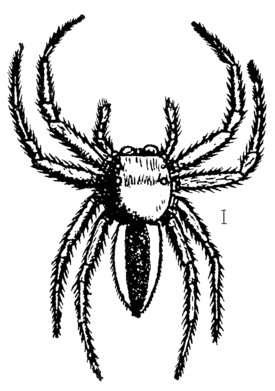
Light or brightly colored horse spiders are found on shrubs and broad-leaved trees, most often on leaf tops. The cephalothorax is high with a flat front head part and an inclined posterior thoracic half; sides, more or less vertical. The abdomen is oval, widened in front and narrowed posteriorly. Moderately spiky legs are long and thin, and all are about the same size, except for the enlarged male front legs, which are slightly larger and stronger than other pairs of legs [1] . The eyes are arranged in 3 rows. Shins with one large apophysis (process) or with two small ones; one major apophysis on the hip. Spermatheca and vas deferens are simple, highly sclerotized [3] . Some representatives (for example, Phintella piatensis ) form a myrmecophilic association with weaver tree ants ( Oecophylla smaragdina ) to protect against more dangerous predatory spider spiders ( Scytodes , Scytodidae ) [4] [5] . The taxon was distinguished in 1906 by the Norwegian arachnologist Embrik Strand (Embrik Strand, 1876-1947), professor at the University of Riga [2] [6] .
Includes about 40 species. Some species were transferred from the genera Telamonia and Icius . Five species were found in Russia : Phintella abnormis , Phintella arenicolor , Phintella linea , Phintella parva and Phintella popovi [7] :
- Phintella abnormis (Bösenberg & Strand, 1906)
- Phintella accentifera (Simon, 1901)
- Phintella aequipeiformis Zabka, 1985
- Phintella aequipes (Peckham & Peckham, 1903)
- Phintella africana Wesolowska & Tomasiewicz, 2008 [8]
- Phintella arenicolor (Grube, 1861)
- Phintella argenteola ( Simon , 1903)
- Phintella assamica Prószyński, 1992
- Phintella australis (Simon, 1902)
- Phintella bifurcata Prószyński, 1992
- Phintella bifurcilinea (Bösenberg & Strand, 1906) typus
- Phintella Bunyiae Barrion & Litsinger, 1995
- Phintella caledoniensis Patoleta, 2009
- Phintella castriesiana (Grube, 1861)
- Phintella cavaleriei (Schenkel, 1963)
- Phintella clathrata ( Thorell , 1895)
- Phintella conradi Prószyński & Deeleman-Reinhold, 2012
- Phintella coonooriensis Prószyński, 1992
- Phintella debilis (Thorell, 1891)
- Phintella dives (Simon, 1899)
- Phintella hainani Song, Gu & Chen, 1988
- Phintella incerta Wesolowska & Russell-Smith, 2000
- Phintella indica (Simon, 1901)
- Phintella leucaspis (Simon, 1903)
- Phintella linea (Karsch, 1879)
- Phintella Lucai Zabka, 1985
- Phintella lucida Wesolowska & Tomasiewicz, 2008 [8]
- Phintella lunda Wesolowska, 2010 [9]
- Phintella macrops (Simon, 1901)
- Phintella monteithi Zabka, 2012 [10]
- Phintella multimaculata (Simon, 1901)
- Phintella mussooriensis Prószyński, 1992
- Phintella nilgirica Prószyński, 1992
- Phintella parva (Wesolowska, 1981) [11]
- Phintella piatensis Barrion & Litsinger, 1995
- Phintella planiceps Berry, Beatty & Prószyński, 1996
- Phintella popovi (Prószyński, 1979) [12]
- Phintella pygmaea (Wesolowska, 1981) [11]
- Phintella reinhardti (Thorell, 1891)
- Phintella suavis (Simon, 1885)
- Phintella suknana Prószyński, 1992
- Phintella versicolor (CL Koch, 1846)
- Phintella vittata (CL Koch, 1846)
- Phintella volupe (Karsch, 1879)
