The Moluccan Islands ( indon. Kepulauan Maluku ), also known as the Spice Islands, are an Indonesian group of islands between Sulawesi and New Guinea , north of the island of Timor . They are located on the Halmacher plate and in the zone of collision with the plate of the Moluccan Sea . The territory of the islands is 74 505 km², the population is 2.5 million inhabitants (2010).
| Moluccas | |
|---|---|
| indone. Kepulauan maluku | |
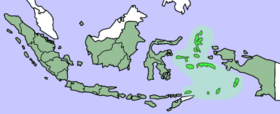 Moluccas are shown in light green. | |
| Specifications | |
| Number of islands | 1027 |
| Largest island | Halmahera |
| total area | 74 505 km² |
| Highest point | 3027 m |
| Population | 2,500,000 (2010) |
| Population density | 33.55 people / km² |
| Location | |
| Water area | Pacific Ocean |
| A country |
|


Historically, the islands received the name Spice Islands from the Chinese and Europeans, however, this name mainly refers to the small volcanic islands of the Banda archipelago, where nutmeg is grown . In addition, the island of Grenada received the same name. In addition, the same name is used for other islands where spices are grown, in particular, for the Zanzibar archipelago off the coast of East Africa .
The etymology of the name of the region of the Moluccas dates back to the Arab Jazirat al- Muluk (the island of kings), as merchants from the Middle East called it.
Geography and geology
The total area of the archipelago of the Moluccas is 850,000 km², 90% of it is covered by water [1] . In total, the archipelago includes 1,027 islands [2] . The three largest islands, Halmahera - 17,780 km², Seram - 17,100 km² and Buru - 9,505 km² are barely inhabited, and the most developed are the small islands of Ambon and Ternate [2] .
Most of the islands are mountainous and covered with forests and mountains. Tanimbar Islands are dry and hilly, while Aru Islands are flat and swampy. Mount Binaya (3027 m) on the island of Seram - the highest point of the archipelago. On some islands there are active volcanoes. Many islands similar to Ternate (1721 m) are volcanic peaks rising from the sea, with villages along the coast. Over the past 500 years, there have been more than 70 powerful eruptions of volcanoes and earthquakes in the region [2] .
The geology of the Moluccas is characterized by the same features and processes as the nearest region of Nus Tenggar. Despite the fact that the geology of the region has been studied since the colonial period , scientists still have not formed an unambiguous picture of geological formations and processes, and theories of the geological evolution of islands have been constantly changing in recent decades [3] . The Moluccas are one of the most geologically complex and active regions of the world [4] , due to the fact that they are at the meeting point of four geological plates and two continents.
Flora and Fauna
The vegetation of these small-sized islands is very diverse: they grow tropical rainforests , sago , rice , as well as famous spices - nutmeg , cloves and others.
Biogeographically, all islands of the archipelago, except for the Aru Islands, are located in Wallace , a region located between the Sunda shelf (part of the Asian continental shelf) and the Arafura shelf (part of the Australian continental shelf). Thus, they are located between the Weber line and the Lidecker line , so the fauna of the islands is more Australasian than Asian. The tectonic activity of the region influences the Moluccan biodiversity and its variability; most of the islands are geologically very young, they are only 1 to 15 million years old, and they have never been parts of large continents. The Moluccas differ from other regions of Indonesia; some of the country's smallest islands are located in this region, coral island reefs are separated by some of the deepest seas in the world, and the archipelago has no such large islands as Java or Sumatra . The movement of flora and fauna between the islands is very difficult, therefore, the islands of the archipelago are characterized by a high level of endemicity [3] .
The ecology of the Moluccas has been studied by many naturalists since the discovery of the islands by Europeans; Alfred Wallace ’s book “The Malay Archipelago” became the first scientific work that described the history of the region’s ecology; it became the most important source for studying Indonesian biodiversity. The Moluccas are the subject of two major historical works on the natural history of George Rumfius, “Ambonesian Herbarium” and “Ambonesian Kunstkamera” [5] .
Rainforests cover most of the northern and central islands of the archipelago, they were replaced by plantations on small islands, including endemic cloves and muscat trees. The islands of Tanimbar and other southeastern islands are arid and their vegetation is poor, as in nearby Timor [2] . In 1997, Manuzela National Park was created, and in 2004 - Aketojave-Lolobata National Park , their goal is to save rare endemic species from extinction.
Nocturnal marsupials , such as couscous and bandicut , are represented by a large number of species; mammals from other regions are represented by civet and wild pigs [2] . Among the birds, about 100 endemic species are known with large variations on the large islands of Halmacher and Seram. Two species of endemic birds of paradise live in the northern Moluccas [2] . Unlike the rest of the Moluccas, the island of Aru is inhabited by purely Papuan fauna, including kangaroos, cassowaries, and birds of paradise [2] .
Despite the fact that environmental pollution affects both small and large islands, small islands also have their own specific environmental problems. The influence of civilization on small islands is increasing, and the effects are not always predictable. Despite the fact that Indonesia is rich in natural resources, the resources of the small islands of the Moluccan archipelago are limited and specialized; in addition, the population density on small islands is usually low [6] .
Common features [7] of small islands, which also appear on the Moluccas, are [6] :
- volcanic activity , earthquakes, landslides and destructive cyclones influence a large land surface;
- The marine climate prevails ;
- The catchment area is small, and the degree of erosion is high;
- Most of the land is the sea coast;
- High level of specialization, a relatively large number of endemic ;
- Society has a distinctive culture due to relative isolation;
- The population of small islands is significantly affected by economic migration.
Climate
The climate is humid. The central and southern Moluccas are dominated by dry monsoons from October to March and wet monsoons from May to August, unlike the rest of Indonesia. The average maximum temperature of dry monsoons is 30 ° C, wet - 23 ° C. In the northern Moluccas, wet monsoons dominate from December to March, as in the rest of Indonesia. Each island group has its own climatic variations, and large islands are characterized by dry coastal lowlands and more humid mountainous inland areas [2] .
History
Overview
The indigenous inhabitants of the Banda Islands traded spices with other Asian peoples, in particular with the Chinese , back in the days of the Roman Empire . With the spread of Islam , Muslim merchants became the main trading partners. One ancient Arab source indicates the location of the islands as 15 days by sea east of the 'Jaba island' - apparently Java , but direct evidence of the penetration of Islam into the archipelago dates back to the late 14th century, when Chinese interest in dominating the region waned . With Muslim traders, not only Islam came to the islands, but also a new social organization, the Sultanate , which replaced the local councils of wealthy people ( orang kaya ) on the most important islands, and which was more effective in conducting foreign policy. (See the sultanates of Ternate and Tidore ).
Trading with Muslim states, Venice had a monopoly on the spice road in Europe from 1200 to 1500, as it controlled the Mediterranean trade routes and ports, such as Alexandria , after the Mongols and Turks appeared on the usual land route. The financial incentive to open new trade routes that could constitute an alternative to the Venetian monopoly in this lucrative business may have been the most important factor that triggered the start of the era of great geographical discoveries . The Portuguese took the lead in finding a way through the southern tip of Africa , opening and equipping settlements along the route, even opening the coast of Brazil in search of convenient southern currents. The success of the Portuguese and the creation of their colonial empire pushed the other maritime powers of Europe, primarily Spain , France , England and the Netherlands , to create their own colonies and squeeze Portuguese positions.
Due to the high price of spices in Europe and the high profits brought by their trade, the Dutch and British soon entered into armed conflict over the monopoly in this trade and the crowding out of the Portuguese. The struggle for control of these small islands escalated in the 17th and 18th centuries, when the Dutch even gave Manhattan to the British in exchange, among other things, for the tiny island of Rune , which gave the Dutch complete control over the production of nutmeg in the Banda archipelago. The Bandanese were the most affected side in this fight, as most of them were slaughtered or enslaved to the European invaders. Over 6,000 people were killed during the Spice War.
During the search for the Spice Islands, which eventually became part of the Dutch East Indies , the West Indies were accidentally discovered, which began a century-long competition between European maritime powers for control of world markets and resources. The mysterious mystique of the Spice Islands eventually disappeared when the French and British successfully exported seeds and plant samples from the islands to their colonies in Mauritius , Grenada and other regions, which ultimately led to the fact that spices became an ordinary product these days.
The first European settlements were founded in 1512 by the Portuguese , who controlled the beginning of the seasoning trade route to Europe.
In 1663, the Moluccas passed into the possession of the Netherlands .
During the Napoleonic Wars, the islands were temporarily occupied by Great Britain (between 1796 and 1802 , and also between 1810 and 1816 ).
During World War II, Japan occupied the islands.
After 1945, the Moluccas became an integral part of the new state of Indonesia .
Early History
The oldest archaeological evidence of the presence of humans on the islands of the region is about 32 thousand years old, but archaeological finds of more ancient settlements in Australia suggest that people most likely visited the Moluccas before. Evidence of an increase in the radius of trade relations and a denser settlement of many islands are between 10 and 15 thousand years old. Onyx beads and parts of a silver dish that were used as money in the Indian subcontinent about 200 BC. e. found on several islands. In addition, in local dialects, the word Malay is used to indicate silver, in contrast to the word with the same meaning that was used in the Melanesian community, which has etymological roots in the Chinese language, which was a consequence of the development of regional trade with China in VI and VII centuries.
The Moluccas were a cosmopolitan society in which traders from all over the region could live in their settlements or the nearest enclaves, including Arab and Chinese merchants who visited these places or lived in the region. The social organization was usually local and relatively even - the council of the community, which included the elders and the most wealthy people ( Orang kaya ), had power.
Arab merchants, who intensified trade with the region in the XIV century, brought Islam . Religious conversion to Islam took place peacefully, and swept many islands, mostly those that were in the center of trade, while traditional animism remained the main religion in the most remote and isolated islands. Archaeological evidence of the spread of these religions is the frequency of pig teeth, depending on whether their aborigines ate or abstained from eating pork [8] .
Portuguese period
Apart from some relatively small cultural influence, the most significant long-term consequences of the Portuguese presence were the destruction and reorganization of trade in Southeast Asia and the emergence of Christianity in eastern Indonesia, including the Moluccas [9] . The Portuguese captured the city of Malacca at the beginning of the 16th century and their influence on the Moluccas and throughout eastern Indonesia increased significantly [10] . The Portuguese took Malacca in August 1511, and as one of the participants in the diary wrote, “thirty years after it became Moorish ” [11] , indicating a confrontation between Islamic and European influence in the region. Afonso de Albuquerque, who studied the route to the Banda Islands and other "Spice Islands", sent a three-vessel research expedition under the command of Antonio di Abreu , Siman Afonso Bizagudo and Francisco Serrana [12] . On the way back, Francisco Serran crashed at Hitu (north of the island of Ambon ) in 1512. Here he met a local ruler who was impressed by his military capabilities. The rulers of the rival sultanates of Ternate and Tidore also wanted to receive help from the Portuguese and attract them as buyers of spices during the lull in local trade, which came about in connection with the temporary cessation of voyages of Javanese and Malay merchants, which occurred after the events of 1511 in Malacca. Spice trade soon resumed, but the Portuguese have never been able to monopolize or stop this trade [10] .
Choosing the Sultan Ternate as an ally, Serran built a fortress on this small island and led a division of mercenaries from the Portuguese sailors in the service of one of the two local sultans who controlled most of the spice trade. Service in a colony located far from Europe could attract only the most desperate and greedy people, and the Portuguese misbehaving with local residents was also accompanied by weak attempts to spread Christianity, which complicated relations with the Muslim rulers of Ternate [10] . Serran convinced Fernand Magellan to join him in the Moluccas and sent him information on the Spice Islands. However, both Serran and Magellan died before they could meet [10] . In 1535, the Sultan Tabarigi was overthrown and ferried by the Portuguese to Goa. He converted to Christianity and changed his name to House Manuel. After the charges against him were dropped, he set off on the return trip to take his throne, but died on the way to Malacca in 1545. He bequeathed the island of Ambon to his godfather, the Portuguese, Hordau da Freitas. After the Portuguese killings of Sultan Khairun, the Ternats expelled the foreigners after a five-year siege in 1575.
The Portuguese first landed on Ambon in 1513, and subsequently became the new center of Portuguese activity in the Moluccas after being expelled from Ternate . The influence of Europeans in the region was weak, and Islam and anti-European sentiments intensified during the reign of Sultan Baab Ulla (1570-1583) and his son Sultan Said [13] on Ternat. However, the Portuguese were constantly attacked by local Muslims on the north coast of the island, especially in Hitou, which maintained commercial and religious ties with the largest port cities of the northern coast of Java. In 1521 they founded a trading post, but until 1580 its existence was not peaceful. In fact, the Portuguese never controlled the local spice trade, nor were they able to consolidate their influence on the Banda Islands, a center for the production of nutmeg.
The Portuguese missionaries did a great job, thanks to them they created large Christian communities in eastern Indonesia, which exist in our time, which contributed to the increased influence of Europeans on the inhabitants of the islands, especially on the Ambonese [13] . In the 1560s, about 10,000 inhabitants of the region were converted to the Catholic faith, mainly on Ambon, and in the 1590s their number was already from 50,000 to 60,000, but most of the islands surrounding Ambon were Muslim [13] . The Spanish missionary Francis Xavier made a great contribution to the spread of Christianity in the Moluccas.
Another legacy of Portuguese influence was the borrowing of Portuguese words in the Indonesian language , a mixture of which with the Malay became the lingua franca of the region at the beginning of the XIX century. Modern Indonesian words, such as pesta (“party”), sabun (“soap”), bendera (“flag”), meja (“table”), Minggu (“Sunday”), are borrowed from the Portuguese language. Many families in the Moluccas have Portuguese surnames, including da Lima, da Costa, Dias, da Freitas, Gonzales, Mendoza, Rodriguez and da Silva. In addition, Portuguese roots are found in romantic ballads to the Kronkong guitar.
Spanish Period
The Spaniards gained control of Tidore in 1603 and set up an outpost to trade in spices and oppose the Dutch expansion into the archipelago. The territory became part of the Spanish East Indies and was ruled from Manila in the Philippine Islands . The missionary Francis Xavier preached on the Moluccas in the years 1546-1547 among the peoples of Ambon, Ternate and Morotai and laid the foundations of Christianity in the region. The Spanish presence lasted until 1663, when settlers and soldiers were transported to the Philippines. Some of these people later created a settlement near Manila called Ternate.
Dutch period
The Dutch appeared in the region in 1599, and exploited the discontent of the locals with the Portuguese attempts to monopolize their traditional trade. After the Ambonians helped the Dutch build a fort at Hita Larna, the Portuguese launched a military campaign in response, in which the Ambonians supported the Dutch. In 1605, Frederick de Hautman became the first Dutch governor of Ambon.
The Dutch East India Company , a trading corporation, met with confrontation on three sides: the Portuguese, the local population, and the British. Over time, the Dutch were able to prevail over all three and seized almost complete control over the islands, which they held until the modern period, leaving smuggling the only alternative to their European monopoly. In the XVII century, the Bandanese attempted to independently trade with the British, and the East India Company in response destroyed the local population of the Banda Islands, sent the survivors to other islands, and began to use the labor of slaves.
Despite the fact that other peoples inhabited the Banda Islands, the rest of the Moluccas under foreign control remained troubled, and even after the Portuguese opened a new shopping center in Makassar , popular uprisings took place in 1636 and 1646. During Dutch rule, the northern Moluccas were controlled by the Dutch from a residence in Ternate, and the southern from Ambon.
During World War II, the Moluccas were occupied by the Japanese. The Moluccans resisted the invaders by going to the mountains and waging a guerrilla war. After the war, the island's political leaders entered into negotiations with the Dutch government for independence. Under the 1949 agreements, the Moluccas came under Indonesia's control with the guarantee of the possibility of secession from Indonesia. These agreements gave the Moluccas the right to self-determination.
As part of Indonesia
After the independence of Indonesia was declared on April 25, 1950, the Christian part of the population proclaimed the independent republic of South Molucca (Maluku-Selatan) in the southern Moluccas. The islands of Seram , Ambon and Buru became the center of the Republic of South Molucca, led by the separation movement Chris Saumokil (former Chief Prosecutor of East Indonesia) with the support of Moluccan soldiers who served in the Netherlands special forces. This attempted secession was thwarted by force by the Indonesian army, and by agreement with the Netherlands, their troops were transferred to Europe. In the 1960s, the Indonesian government began to implement a program of transmigration (mostly Javanese) of the population to less populated islands (including the Molluks), which increased religious and ethnic tensions in the region. Outbreaks of ethnic and nationalist violence were noted.
Since 1945, Maluku has been a single Indonesian province, but in 1999 a new province of Northern Maluku with an administrative center in Ternat was separated from the province.
Religious Conflict 1999-2003
In January 1999, a religious conflict erupted in the region. Over the next 18 months, violent clashes took place between large local groups of Muslim and Christian populations, resulting in the destruction of thousands of homes, about half a million people became refugees, and thousands of people died [14] . Over the next 12 months, episodic outbreaks of violence continued. Gradually, by 2004, the conflict had subsided.
Demographics
The population of the Moluccas is about 2 million people, less than 1% of the population of Indonesia [2] .
The native population is Melanesians ( Alfuras ) [15] , however, their number decreased significantly after the discovery of the islands by Europeans, especially on the Banda Islands , where they died in the 17th century during the war for control of the spice trade. At the beginning of the 20th century, when the islands were controlled by the Netherlands , a wave of Austronesian immigration continued in the Indonesian period.
About 130 languages were previously distributed in the region, however, to our time, many of them were mixed and the most common local pidgin dialects of Ternat and Ambonese , lingua franca of northern and southern Maluku, respectively [2] .
The long history of trade and navigation has led to a high degree of mixing of the blood of the peoples of the Moluccas [2] . The Austronesian peoples began to mix with the indigenous Melanesian population 4 thousand years ago [16] . Most Melanesians live in percentage terms on the islands of the Kay and Aru archipelagos, as well as in parts of the islands of Seram and Buru . Later, Indian, Arab, Chinese and Portuguese genes were added to this Austronesian-Melanesian mixed race. Bugis , merchants from Sulawesi, and transmigrants from Java became even more recent aliens [2] .
Administrative Division
Administratively, the Moluccas from 1950 to 1999 represented one province of Indonesia. In 1999, the northern islands ( Halmahera , Ternate and the islands of Sula and others) became part of the province of Northern Maluku , the administrative center of the province is Ternate . Mostly the population of this province is Muslim, with the exception of a small Christian enclave in the north of Halmahera.
The rest of the archipelago remained in the province of Maluku , the most important islands of which are Ambon , Seram , Buru , as well as the archipelagos of Banda , Aru and Tanimbar . The administrative center of the province is the city of Ambon .
Northern Maluku Province
- Ternate , which houses the former administrative center of Ternate
- Tidore
- Bachan
- Halmahera , the largest of the Moluccas, on which is the capital Sofia [17]
- Morotai
- The Ob Islands
- Sula Islands
Maluku Province
- Ambon , on which the administrative center of Ambon is located
- Aru Islands
- Babar
- Northwest Islands
- Banda Islands
- Buru
- Kay Islands
- Islands fly
- Mclan
- Saparua
- Seram
- Tanimbar Islands
- Wind
Economics
Cloves and nutmegs still occupy an important part of agricultural production, and cocoa, coffee and fruits are also grown. Fishing plays an important role in the economy, most developed around Halmahera and Bachan . On the Aru islands pearls are grown, Seram exports lobsters. The forest industry is of great importance for large islands: iron tree grows on Seram, and teak and ebony are extracted on Buru [2] .
Interesting Facts
In December 1979, the Soviet dissident Yuri Aleksandrovich Vetokhin, while sailing on the Ilyich sightseeing boat along the Moluccan archipelago, in the Moluccan Sea, made an escape, having reached the island of Bachan. [18]
Notes
- ↑ Monk, KA The Ecology of Nusa Tenggara and Maluku. - Hong Kong: Periplus Editions Ltd., 1996. - P. 9. - ISBN 962-593-076-0 .
- ↑ 1 2 3 4 5 6 7 8 9 10 11 12 13 Witton, Patrick. Indonesia - Melbourne: Lonely Planet, 2003 .-- P. 818. - ISBN 1-74059-154-2 .
- ↑ 1 2 Monk (1996), page 9
- ↑ Monk ,, KA The Ecology of Nusa Tenggara and Maluku. - Hong Kong: Periplus Editions Ltd., 1996. - P. 9. - ISBN 962-593-076-0 .
- ↑ Monk ,, KA The Ecology of Nusa Tenggara and Maluku. - Hong Kong: Periplus Editions Ltd., 1996. - P. 4. - ISBN 962-593-076-0 .
- ↑ 1 2 Monk ,, KA The Ecology of Nusa Tenggara and Maluku. - Hong Kong: Periplus Editions Ltd., 1996. - P. 1. - ISBN 962-593-076-0 .
- ↑ Beller, W., P. d'Ayala, and P. Hein. 1990. Sustainable development and environmental management of small islands. Paris and New Jersey: United Nations Educational, Scientific, and Cultural Organization and Parthenon Publishing Group Inc .; Hess, A, 1990. Overview: sustainable development and environmental management of small islands. In Sustainable development and environmental management of small islands. eds W. Beller, P. d'Ayala, and P. Hein, Paris and New Jersey: United Nations Educational, Scientific, and Cultural Organization and Parthenon Publishing Group Inc. (both cited in Monk)
- ↑ Lape, PV. (2000). Contact and Colonialism in the Banda Islands, Maluku, Indonesia (Link not available) . Archived September 23, 2009. ; Indo-Pacific Prehistory Association Bulletin 20 (Melaka Papers, Vol. 4)
- ↑ Ricklefs, MC A History of Modern Indonesia Since c. 1300, 2nd Edition. - London: MacMillan, 1991 .-- P. 26. - ISBN 0-333-57689-6 .
- ↑ 1 2 3 4 Ricklefs, MC A History of Modern Indonesia Since c. 1300, 2nd Edition. - London: MacMillan, 1991 .-- P. 24. - ISBN 0-333-57689-6 .
- ↑ Lach, DF. (1994) Asia in the Making of Europe: The Century of Discovery (Vol 1) , Chicago University Press
- ↑ EC Abendanon and E. Heawood. Missing Links in the Development of the Ancient Portuguese Cartography of the Netherlands East Indian Archipelago (Eng.) // The Geographical Journal: journal. - Blackwell Publishing, 1919. - December ( vol. 54 , no. 6 ). - P. 347-355 . - DOI : 10.2307 / 1779411 .
- ↑ 1 2 3 Ricklefs, MC A History of Modern Indonesia Since c. 1300, 2nd Edition. - London: MacMillan, 1991 .-- P. 25. - ISBN 0-333-57689-6 .
- ↑ Troubled history of the Moluccas , BBC News (June 26, 2000). Date of treatment May 17, 2007.
- ↑ IRJA.org unopened (inaccessible link) . Archived on April 14, 2009.
- ↑ Taylor, Jean Gelman. Indonesia: Peoples and Histories. - New Haven and London: Yale University Press, 2003 .-- P. 5-7. - ISBN 0-300-10518-5 .
- ↑ Monk, KA The Ecology of Nusa Tenggara and Maluku. - Hong Kong: Periplus Editions Ltd., 1996. - P. 7. - ISBN 962-593-076-0 .
- ↑ Shatravka, A. Escape from Paradise / Alexander Shatravka - Liberty Publishing House, Inc, 2010.
Literature
- George Miller (editor), To The Spice Islands And Beyond: Travels in Eastern Indonesia , Oxford University Press, 1996, Paperback, 310 pages, ISBN 967-65-3099-9
- Severin, Tim The Spice Island Voyage: In Search of Wallace , Abacus, 1997, paperback, 302 pages, ISBN 0-349-11040-9
- Bergreen, Laurence Over the Edge of the World , Morrow, 2003, paperback, 480 pages
- Bellwood, Peter (1997). Prehistory of the Indo-Malaysian archipelago . Honolulu: University of Hawai'i Press. ISBN 0-8248-1883-0 .
- Andaya, Leonard Y. (1993). The World of Maluku: Eastern Indonesia in the Early Modern Period . Honolulu: University of Hawai'i Press. ISBN 0-8248-1490-8 .
- Donkin, RA (1997). Between East and West: The Moluccas and the Traffic in Spices Up to the Arrival of Europeans . American Philosophical Society. ISBN 0-87169-248-1 .
- Monk, Kathryn A., Yance De Fretes, Gayatri Reksodiharjo-Lilley (1997). The Ecology of Nusa Tenggara and Maluku . Singapore: Periplus Press. ISBN 962-593-076-0 .
- Van Oosterzee, Penny (1997). Where Worlds Collide: The Wallace Line . Ithaca: Cornell University Press. ISBN 0-8014-8497-9 .
- Wallace, Alfred Russel (2000; originally published 1869). The Malay Archipelago . Singapore: Periplus Press. ISBN 962-593-645-9 .