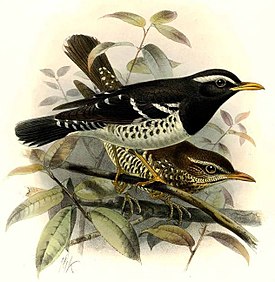
The piebald earth thrush is a bird of 22–22.5 cm in size and weighing from 52 to 72 g with a wing length of 11 to 12 cm. In males, the upper part of the body is black and shiny with white markings (on the tail is a white rim), the head is black with long and broad “eyebrows”, the chest is black, the belly to the tail is white with transverse black stripes, the underside of the wings is white. The beak is yellow during the mating season, darker (sometimes black) at the base, the rest of the beak surface darkens at other times of the year. Legs are yellow, olive or yellowish-brown. In flight, the color of the underside of the wings is characteristic of all birds of this genus, white spots are clearly visible at the end of the tail. Females are colored similar, but brown rather than black, with a large number of white or light yellow marks. The forehead and back of the head to the middle of the back are olive-brown, closer to the tail the plumage acquires a grayish tint, the ends of the longest covering feathers are white or off-white. The tail is brown with numerous white markings, the extreme tail feathers are white with a brown fringe. In the coloring of the wings there are various shades of brown, from dark brown to olive, also with white markings. The bill is brown or dirty-yellow from above, the lower part is lighter. Dirty-white or yellowish "eyebrows" go from the base of the beak to the back of the head and are usually wider than in males, the cheeks and the mandible brown, the throat is olive or brown with large white oval spots. The white color becomes more noticeable in the chest area, where the white and brown feathers form a pattern in a frequent strip or scale; belly and undertail are white, legs are yellowish-brown.
The eyebrows and white markings on the upper body reliably distinguish the spotted earth thrush from other birds within its range. The Siberian thrush , wintering in more eastern regions, has the most similar appearance, but there are no white markings in its plumage, the lower part of the body is darker, and the beak is black (while the groundbarrow has a yellow one).
The Pied Groundbird is usually silent, but from time to time it may emit a sharp line of tweets or clattering sounds. The song is non-melodic, resembles singing bybulbyuly , consists of repeating phrases, including two notes (in English is transmitted as pee-dee ) and sometimes ending with an additional high sound ( zik ). The Pied Groundbird sings usually in early spring at dawn from the tops of the trees.
In general, the piebald earth thrush is a cautious and secretive bird, especially in the mating season. In May, you can see males fight for the territory. Usually found in pairs, but may form small flocks, especially during the period of migration and wintering. The mating season lasts from May to July, including one clutch per year. During this period, a deep cup-shaped nest is built of moss, grass and leaves, lined inside with branches, earth and grass. The nest is usually located in a fork between the branches or on a branch of a small tree near the trunk at a height of 5 m above the ground. In the nest there are three or four white, pale blue or pale green eggs with small reddish markings over the entire surface or on the broad end. The construction of the nest, incubation and care of the chicks are both parents.
Mostly piebald earth thrush is insect-like, but can eat berries and other fruits, especially mulberries , guava, and wild figs . It feeds on land, where it searches for food under dead and rotting leaves, as well as on bushes and trees. On the ground, it can walk or jump, usually staying near a safe haven in the trees.
The piebald earth thrush is a migratory bird , the whole population migrates from the nesting sites to the south during the winter months. It nests in the Himalayas , from the Kullu valley in the Indian state of Himachal Pradesh in the west to the southeast of the state of Assam in the North Kachar district . The permanent range also includes Nepal and Bhutan . It winters in Sri Lanka , mainly in the hilly terrain in the center and in the south of the island, as well as in smaller quantities in the hilly areas of the southern Indian state of Tamil Nadu . The flight takes place in autumn, from September to November, in the opposite direction - from early March to May.
Habitat - deciduous forests , including wooded ravines and mountain slopes at altitudes from 1.5 to 2.4 km, often in damp places near running water. Occurs in gardens and cultivated plantations within its range. In winter, it lives in similar terrain, as well as in less wooded places, which, however, provide adequate protection - in gardens and parks, at altitudes from 750 to 1500 m.