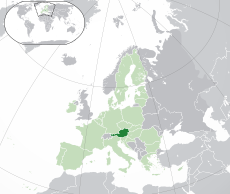
The situation of LGBT rights in Austria has improved in recent years. The country abolished the discriminatory laws introduced in 1971 after the decriminalization of same-sex relationships and introduced the institution of same-sex civil partnerships , which as of December 2017 are almost equal to marriages.
| LGBT Rights in Austria | |
|---|---|
 | |
| Fundamental Rights Overview | |
| Legality of contacts | Same-sex contacts have been legal since 1971. |
| Adoption | Yes |
| Laws against discrimination | Protection against discrimination since 2004 when hiring and since 2017 when providing goods and services |
| Gender change | Transgender people can change gender; no operation required |
Content
- 1 Legal status
- 1.1 Background
- 1.2 The beginning of liberalization
- 1.3 Same-sex marriage
- 2 Summary table of rights
- 3 See also
- 4 notes
- 5 Literature
Legal Status
Background
The Penal Code of Joseph II, which entered into force in 1787, quashed the death sentence for sexual intercourse between persons of the same sex, changing the punishment to hard labor for a term of one to five years (§ 71 and § 72). The Joseph II Code was valid until 1852, when the new Austrian Criminal Code was introduced.
The Penal Code of 1852 in paragraphs 129 and 130 contained a list of so-called crimes that were classified as sodomy . “Unnatural debauchery with persons of the same sex” was criminalized in part Ib of paragraph 129 and extended to both men and women [1] .
§ 129. The following types of debauchery are considered and punished as crimes:
I. Unnatural debauchery:
b) with a person of the same gender.Original text (German)§ 129. Als Verbrechen werden auch nachstehende Arten der Unzucht bestraft:I. Unzucht wider die Natur (...)
b) mit Personen desselben Geschlechtes.
The rather loose wording of the text of the paragraph allowed the judges to interpret it quite widely [1] . The comments on this article contained instructions on the use of punishment in the form of imprisonment for a term of one to five years, and in cases of threats and violence, for a term of five to ten years [1] .
The beginning of liberalization
Same-sex sexual activity between adults of the same sex was decriminalized in Austria in 1971. However, with the lifting of the ban on sexual contacts, four new paragraphs concerning homosexuals were introduced into the criminal code [2] .
So, with the introduction of paragraph 220, “propaganda of debauchery between persons of the same sex” was prohibited and punished with imprisonment for up to 6 months, which in fact meant a ban on the creation of LGBT organizations and educational activities. This ban was lifted only in 1997 [2] [3] . Paragraph 221, which lasted until 1989, prohibited the creation of "organizations to support same-sex debauchery." Until 1989, homosexual prostitution was also criminalized (§ 210 of the Criminal Code). In addition, the age of sexual consent for same-sex relationships between men was raised to 18 years. Only in 2002 was it reduced [2] . Homosexual pornography was allowed in 2000 [2] .
|
|
|
The existence of such criminal articles contributed to the fact that, in contrast to other countries, in the 1970s and 1980s in Austria there was practically no LGBT movement that began only in the late 1980s and early 1990s [3] .
Same-sex marriage
Since 2010, same-sex civil partnerships have been registered in Austria. By December 2017, they are fully equated to marriages (the exception is that marriages and partnerships are registered in different bodies). On December 5, 2017, the Austrian Constitutional Court adopted a ruling that, since 2019, has legalized same-sex marriage in Austria [4] . The Austrian national authorities must adopt the relevant laws by the end of 2018.
Rights Summary Table
| Type of | Status |
|---|---|
| Same sex | (since 1971) |
| Equal age of consent | (since 2000) |
| Anti-discrimination laws only in employment | (since 2004) |
| Anti-discrimination laws for the provision of goods and services | (since 2017) |
| Anti-discrimination laws in all other areas (including indirect discrimination, incitement to hatred) | (since 2016) |
| Same-Sex Marriages | (since 2019) |
| Recognition of same-sex couples | (since 2003) |
| Adopting a child by same-sex couples | (since 2013) |
| Adoption for single people regardless of sexual orientation | |
| Permission for gays and lesbians to openly serve in the army | |
| The right to change the legal gender | (since 2009) |
| Access to IVF for lesbians | (since 2014) |
| Surrogacy for gay couples | (It is illegal for all couples regardless of sexual orientation) |
| Permission to be a blood donor for MSM | [5] |
See also
- Civil Partnerships in Austria
- Conchita Wurst
- LGBT Rights in Germany
Notes
- ↑ 1 2 3 Wahl, 2004 , p. 23.
- ↑ 1 2 3 4 Homosexualität in Österreich seit 40 Jahren legal (German)
- ↑ 1 2 Erna Appelt. Karrierenschere // Gleichstellungspolitik in Europa, Band 1. - S. 190—191 (German)
- ↑ Austrian Constitutional Court upholds same-sex marriage
- ↑ Österreichisches Rotes Kreuz. Rotes Kreuz: Wer darf Blutspenden? (German) . www.roteskreuz.at. Circulation date May 22, 2019.
Literature
- William A. Percy. Austria // Encyclopedia of Homosexuality: [ eng. ] / Edited by Wayne Dynes. - N. Y .: Garland Publishing, 1990. - P. 97-99. - 1522 p. - ISBN 0-8240-6544-1 .
- Niko Wahl. Verfolgung und Vermögensentzug Homosexueller auf dem Gebiet der Republik Österreich während der NS-Zeit (German) . - Wien: Oldenbourg Verlag, 2004 .-- 94 S. - ISBN 3-7029-0506-5 .