The Battle of Downs is a naval battle at the Downs raid (Great Britain) , which took place on October 21 (31), 1639 during the Eighty Years War . During the battle, the Dutch squadron of Admiral Martin Tromp defeated the Spanish squadron of Admiral Antonio de Oquendo.
| Battle of the Downs | |||
|---|---|---|---|
| Main Conflict: Eighty Years War | |||
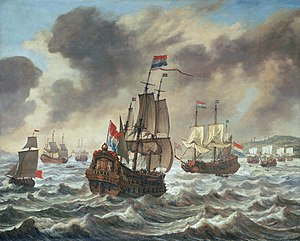 Before the battle at Downs, thin. R. Nooms | |||
| date | October 21 (31), 1639 | ||
| A place | Raid Downs (UK) | ||
| Total | victory of the Dutch | ||
| Opponents | |||
| |||
| Commanders | |||
| |||
| Forces of the parties | |||
| |||


Background
The entry of France into the Thirty Years' War in 1635 blocked the ground "Spanish Road", along which the Spaniards brought ammunition and soldiers to Flanders . To support the army in Flanders, Cardinal Infant Ferdinand of Austria began using the sea route through Dunkirk , the last Spanish-controlled port on the North Sea coast . The Spanish fleet under the command of Admiral Lope de Osesa y Cordoba managed to escort cargo to Dunkirk in 1636-1637, without catching the attention of the Dutch squadrons. In 1638, the French invaded Spain and besieged Fuentarrabia. Lope de Hosez hastened to the rescue, but his fleet was destroyed by the French fleet of Henri de Surdi near Getaria. Since the rest of the Spanish fleet was in the Mediterranean and Brazil, it was not possible to conduct convoys to Dunkirk that year.
In the spring of 1639, the Earl-Duke of Olivares began building a new fleet in La Coruña to carry out new convoys in the North Sea. 29 warships were assembled in four squadrons, to which in the near future another 22 ships from the Mediterranean joined. Twelve British transport ships arrived under the terms of the contract under the flag of English neutrality. Lope de Osesu was offered general command of the fleet, but he refused. As a result, command passed to Antonio de Oquendo , commander of the Mediterranean Fleet. Oquendo used his usual tactic - building ships in the shape of a crescent moon. The flagship was placed on the right flank, and not in the center, since it was expected that the Dutch would concentrate all the firepower in the center of the Spanish formation. Also, smaller ships were to be protected by larger ones. The vanguard was to consist of seven ships of the "Dunkirk squadron" under the command of Miguel de Orne - he had rich experience in navigation in the English Channel .
The Dutch General States made their preparations. From intelligence, the Dutch learned that the Spanish fleet might try to anchor in the Downs raid, off the English coast, between Dover and Deal. There they could receive protection of English neutrality and transport the army and supplies with smaller and faster boats to Dunkirk. The General States organized the construction of a fleet of 23 ships and several firewalls under the command of Martin Tromp to prevent this possibility. The rest of the fleet was still being completed. Therefore, Tromp received orders to patrol the strait and, if necessary, to pursue and detain the Spanish fleet, but not to engage in battle until the rest of the Dutch fleet - about 50 ships under the command of Johan Evertsen - joins him. Tromp divided his fleet into three squadrons. One consisted of 15 ships under the command of Rear Admiral Jost Bunkert and was sent to Downs, the second (of 6 vessels) under the command of Witte de Witt took up patrolling the English coast. Tromp himself, at the head of the remaining 12 ships, patrolled the English side of the English Channel.
Start of battle
The Spanish fleet of 75 ships and 24,000 soldiers and sailors on board left La Coruna on August 27, 1639 (according to other sources, the fleet consisted of 51 galleons with 8,000 sailors and 8,000 soldiers on board, 7 brig and 12 English transporters). On September 11, the fleet reached the English Channel . On September 15, the Spaniards learned from an English ship passing by that the Dutch squadron was anchored near Calais .
On the morning of September 16, the Spanish fleet and a squadron of 12 Martin Tromp ships met off the French coast. Tromp immediately sent one ship to warn Bunkert. The Dutch ships were clearly visible at a distance, but failed to catch them. With a ratio of 57 to 11, Oquendo would surely defeat Tromp and frustrate the Dutch plans, but the Spanish commander did not use this chance. Perhaps not representing the size of the Spanish fleet, Tromp did not give up the battle, but built a squadron in a dense battle line. Believing that Tromp's squadron would try to slip past his right wing, Oquendo tore his formation and ordered the right flank to turn around. Some of the ships near Oquendo followed the flagship, but others were confused and held the original line. As a result, only the "Dunkirk squadron" and the galleon "San Juan" were able to immediately complete the maneuver.
If Oquendo ordered the entire fleet to change course, the Dutch squadron would surely be surrounded. But Oquendo started the maneuver too late, and Tromp's flagship was already out of reach. Then Oquendo decided to attack the ship following the flagship in the Dutch convoy, but also unsuccessfully. As a result, Oquendo’s flagship galleon “Santiago” broke away from the rest of the squadron, and, noticing this, Tromp deployed his convoy and attacked him. Due to the wind, the Dunkirk Squadron could not turn around in time. Only the targeted shooting of the Spanish musketeers saved Santiago from boarding.
The skirmish lasted for three hours, as a result the Dutch ship "Groot Christoffel" accidentally exploded. By noon, six ships of the de Witt squadron arrived in time for Tromp, and the Dutch fleet grew to 16 ships. At the same time, the situation of the Dutch remained difficult. A significant part of the Spanish fleet was disorganized, but Oquendo had already begun rebuilding. Moreover, the Spanish avant-garde could easily cut off the Dutch retreat paths or force them to run aground. But at this moment Oquendo ordered the fleet to restore the formation of the "crescent". The Spanish ships turned, allowing Tromp's squadron to catch the wind and avoid danger.
The next day, Banckert's squadron arrived, as a result of which the total number of the Dutch fleet increased to 32 ships. On September 18, the Dutch attacked the Oquendo fleet. Despite the numerical superiority, Oquendo could not cope with the management of such a large fleet. As a result, the battle ended with the forced retreat of the Spaniards. To protect the ships, Oquendo decided to take cover in the Downs raid, near the English squadron under the command of Vice Admiral John Pennington. He hoped that autumn storms would soon disperse the Dutch fleet.
On the evening of September 28, Tromp and de Witt set off to replenish gunpowder. On the way back, they feared that the Spaniards, having learned about this, had already anchored. However, upon arrival to Downs, the Spanish fleet was again discovered in the raid. In the course of the blockade, the completed ships of the General Staff fleet and other Dutch ships sailing the strait, counting on trophies, began to join Tromp. By the end of October, Tromp had 95 ships and 12 firewalls.
Meanwhile, the Spaniards, being blocked in Downs, began to use British ships to transport soldiers and ammunition to Flanders. Tromp tried to prevent this, but the General States forbade him to be aggressive towards formally neutral British.
Legend has it that Tromp in a message asked Oquendo why he refused to fight, although he had superior numbers. Oquendo allegedly replied that his fleet was in dire need of a tree for repairs. Upon learning of this, Tromp delivered the necessary materials for repairs to the Spaniards, but the Spaniards were in no hurry to leave the English coast.
Battle
On October 21 (31) , taking advantage of the east wind, Tromp sent 30 ships under the command of de Witt to look after the British ships and prevent their interference in the impending battle [3] . He also sent two squadrons to the north (under the command of Cornelis Yola) and south (under the command of Jan Hendrix de Niys) to block the Spanish retreat, after which he launched an attack on the Oquendo fleet. Some of the large and clumsy Spanish ships quickly panicked and lowered their sails. Others tried to break into the strait.
Five flaming firewalls were sent to Spanish ships. The flagship Oquendo Santiago managed to pass them, but three of them at the last moment collided in the galleon Lope de Osesa Santa Teresa, who had just managed to repel the attack of two other firewalls. The Santa Teresa was too clumsy to dodge, and exploded, Admiral de Auxéz had already died of wounds by then. According to some sources, about 15,200 Spaniards died as a result of the Dutch attack. The death toll to date has not been conclusively determined and is often greatly exaggerated. So, it is often not taken into account that a third of the Spanish troops have already reached Flanders in British transport.
Oquendo managed to escape in the fog at the head of ten ships and reach Dunkirk [4] .
Losses
According to the Spanish naval historian Fernandez Duro, of the 38 ships that attempted to break the Dutch blockade, 12 were aground by Downes, one was burned by firewalls, 9 surrendered (three of them were so damaged that they sank on the way to the port) and 3 ran aground off the coast of France or Flanders to avoid capture [5] .
The French diplomat de Estrad, in a letter to Cardinal Richelieu, claimed that the Spaniards lost 13 ships burned or sunk, 16 were captured from 4,000 prisoners and 14 died off the coast of France and Flanders [6] . The diplomat also said in his letter that the Dutch lost 10 ships sunk or burned [6] .
The Portuguese admiral and historian Ignacio Costa Quintella gives the following figures: 43 ships and 6,000 people lost the Spaniards and several ships and more than 1,000 soldiers lost the Dutch [7] .
Dutch sources mention only one lost ship. The historian M. de Boer, who did extensive research and published a book on this subject, confirms this and denotes Spanish losses in ships and people at about 40 and 7000 [8], respectively.
Consequences
The Dutch victory at Downs marked an important moment in the changing balance of the naval forces. The Spanish mission generally failed, although most of the troops were able to reach Flanders. However, many of the vessels that managed to break the blockade were seriously damaged. In the context of the Thirty Years War, Spain was no longer able to restore its former naval domination [9] . Serious expenses for the organization of convoys in the North Sea affected the well-being of the colonies of Spain. The Dutch, British and French hastened to take advantage of the weakening of the Spanish fleet and captured several small Spanish islands in the Caribbean. But, of course, the worst consequences for Spain were the weakening of its dominance in the Southern Netherlands.
Tromp was proclaimed a hero upon returning home and was rewarded with 10,000 guilders. De Witt received only 1,000, which forced him to publish several anonymous brochures in which he portrayed Tromp as an avaricious and himself as a true hero of the past battle.
The Battle of Downs was seen in England as a flagrant violation of English neutrality. Perhaps this fact was one of the reasons for the start of the Anglo-Dutch War in 1652 .
Notes
- ↑ (n.) Schittering en schandaal, Biografie van Maerten en Cornelis Tromp. p.84
- ↑ (nid.) Tromp en de armada van 1639 , p. 127
- ↑ (nid.) Tromp en de armada van 1639 , p. 114
- ↑ Cesáreo Fernández Duro, Armada española desde la unión de los reinos de Castilla y de León , Est. tipográfico Sucesores de Rivadeneyra, Madrid, 1898, Vol. IV, pp. 215-216
- ↑ Fernández Duro, p. 221
- ↑ 1 2 Comte d'Estrades, p. 45
- ↑ Costa Quintanella, p. 353
- ↑ (nid.) Tromp en de armada van 1639 , p. 132
- ↑ Wilson, Peter H. A History of the Thirty Years' War Allan Lane (Penguin) 2009 p.651
Literature
- (Spanish) Cesáreo Fernández Duro (1898). Armada Española desde la unión de los reinos de Castilla y Aragón IV. Est. tipográfico Sucesores de Rivadeneyra.
- (Fr.) Godefroi Louis Estrades (comte d '), Charles Colbert de Croissy (marquis), Jean-Antoine de Mesmes Avaux (comte d') (1743). Lettres, memoires et négociations de Monsieur le comte d'Estrades: tant en qualité d'ambassadeur de SMTC en Italie, en Angleterre & en Hollande, que comme ambassadeur plénipotentiaire à la paix de Nimegue, conjointement avec Messieurs Colbert & J. Nourse.
- (Fr.) Jean Le Clerc (1728). Histoire des Provinces-Unies des Pays-Bas, depuis la naissance de la République jusqu'à la Paix d'Utrecht & le Traité de la Barrière en 1716. Avec les principales médailles et leur explication 2. L'Honoré et Chatelain.
- (port.) Ignacio da Costa Quintella (1839). Annaes da marinha portugueza. Acad. das sci. de Lisboa.
- (English) George Edmundson (1906). "Frederick Henry, Prince of Orange." In Adolphus William Ward. Cambridge Modern History 4. Cambridge University Press.
- (English) Oliver Warner (1981). Great Sea Battles. Cambridge Ferndale Edns.
- (nid.) R. B Prud'homme van Reine (2001). Schittering en schandaal - Biografie van Maerten en Cornelis Tromp. Arbeiderspers.
- (English) Francis Vere (1955). Salt in their blood: The lives of the famous Dutch admirals. Cassell.
- (nid.) JCM Warnsick (1938). Drie zeventiende-eeuwsche admiraals. Piet Heyn, Witte de With, Jan Evertsen. van Kampen.
- (nid.) JCM Warnsick (1941). 12 doorluchtige zeehelden. van Kampen.
- (nid.) Dr MG De Boer (1941). Tromp en de armada van 1639.