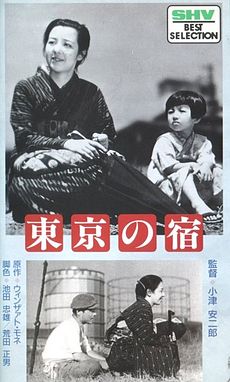
Tokyo Overnight ( Japanese 東京 の 宿 , Tōkyō no yado ) is a silent film directed by Yasujiro Ozu , released in 1935 . The last of the surviving silent films of the master.
| Tokyo overnight stay | |
|---|---|
| Japanese 東京 の 宿 ( Tōkyō no yado ) | |
 | |
| Genre | drama |
| Producer | Yasujiro Ozu |
| Author script | Tadao Ikeda Yasujiro Ozu Masao Arata |
| In the main cast | Takeshi Sakamoto Choko Iida |
| Operator | Hideo Shigehara |
| Composer | Keizo Horiuchi |
| Film company | " Shёtiku " |
| Duration | 80 min |
| A country |  Japan Japan |
| Tongue | silent movie Japanese (intertitles) |
| Year | 1935 |
| IMDb | ID 0027118 |
Story
Unemployed Kihati, along with his young sons, is forced to wander around Tokyo for days in search of at least some kind of work. By evening, they often face a difficult choice: eat and spend the night in the field or stay hungry in the overnight stay. Here, in a rooming house, they meet a woman named Otaka, who ended up in a similar situation with her little daughter Kimiko. The boys immediately make friends with Kimiko. One day, Kihihti brings an old acquaintance of Otsune who decides to help him: gives shelter and helps get a job at the factory. Chihati cannot forget about Otaku and wants to help her, as Otsune helped him himself. Otak soon disappears: her daughter is seriously ill, but there is not enough money for treatment. When Kihati finds out about this, he falls into despair from powerlessness. Only with the help of a crime does he manage to get money. The film ends with Kihati confessing to the police station.
Cast
- Takeshi Sakamoto - Chihati
- Choko Iida - Otsune
- Yoshiko Okada - Otaka
- Tomio Aoki - Zenko
- Kazuko Ojima - Kimiko
- Takayuki Suematsu - Masako
- Tishu Ryu - Police Officer
About the movie
The film was shot from June to September 1934 [1] and was released to Japan on November 21, 1935 [2] . Although this is the master’s last silent film (Ozu resisted working in sound films to the last, explaining his reluctance by the fact that the sound recording technique in the studio is still not perfect and he will wait until this problem is resolved, as well as the promise given to cameraman Hideo Mohara [ 1] ), the studio management still insisted on the soundtrack (music and noise).
... a magnificent scene of an imaginary dinner of the unemployed and homeless by the name of Kihati and his two hungry sons in the "Tokyo night shelter" is quite comparable in virtuosity with the famous Chaplin interlude "Dance of the Buns" in the "Gold Rush". In general, in the works of Odzu in the 30s, the social nature of the comic is more strongly felt, and most importantly - the gag ceases to be a formative beginning, but does not disappear at all, only dissolves in the ordinary narrative and begins to play a contrasting role against the background of a vitally dramatic story. - Sergey Kudryavtsev [3] |
The film credits the scriptwriter Uinzato Mone , which is the pseudonym Yasujiro Ozu, as it is assumed [1] , obtained from the English phrase “without money”. The main character of this tape is penniless, and the financial situation of Ozu was not the best at that time (perhaps due to the death of his father in the previous year). In his diary, he often mentioned this problem [1] .
Again on the screen is a hero named Kihati, again he wanders back and forth, leading a restless lifestyle, sometimes staying in shelters, sometimes he has to sleep in the open. With no permanent residence, Kihati settled in Tokyo's old poor neighborhoods. The conditions of his life are close to those shown earlier in the film “ Caprice ”, only here Kihati is even more cornered, even more he will have to face the harsh reality.
The Tokyo Overnight House belongs to a series of social films that show the global economic crisis in Japan, which began in 1929 . As in Tokyo Choir ( 1931 ), there is mention of dysentery , the children are much less selfish, and their parents have to make extreme decisions (theft or humiliating work) to satisfy their needs.
Kihati wandered with his sons through a deserted industrial landscape that resembles the events of Italian neorealism films. It is no coincidence that many critics (including Donald Ritchie , American biographer Odzu, and the famous Japanese film historian Tadao Sato) find parallels with "The Bicycle Thieves " ( 1948 ) by Vittorio De Siki , and in 1958 Nagisa Oshima would call this "pre-war naturalism" as one of the few alternatives to traditional ideology " [4] .
Notes
- ↑ 1 2 3 4 Ozu-san.com
- ↑ IMDb-Release Info
- ↑ Sergey Kudryavtsev . "3500. Book of film reviews. In 2 volumes. " - M.: Printing House, 2008.
- ↑ Donald Richie . Ozu: His Life and Films. - University of California Press, 1977 .-- P. 262.
Links
- Tokyo Overnight Stay on the Internet Movie Database
- Tokyo overnight stay on allmovie
Literature
- Sergey Kudryavtsev . "3500. Book of film reviews. In 2 volumes. " - M.: Printing House, 2008, ISBN 978-5-9901318-1-1 , ISBN 978-5-9901318-3-5 .
- Donald Richie Ozu: His Life and Films. - University of California Press, 1977. - P. 262-266, ISBN 0-520-03277-2 .