Macedonians ( Greek: Μακεδόνες ) is a regional and historical group of ethnic Greeks living or descending from the Macedonia region in Northern Greece. Today, most of the population lives in the regional capital, the city of Thessaloniki , and around it and other cities of Greek Macedonia , while many of them are scattered throughout Greece and in the Greek diaspora . With the collapse of Yugoslavia, the government of the former Yugoslav Republic of Macedonia (whose population today consists of 65% of Slavs, 25% of Albanians, 5% of Turks, 2% of Gypsies, 3% of other nationalities) claim the heritage and identity of the native Greeks of the Macedonians [1] .
| Macedonians | |
|---|---|
| Modern self-name | Μακεδόνες |
| Abundance and area | |
| Total: 3,000,000 | |
 Greece Greece | |
| Tongue | Greek , also English depending on the place of residence |
| Religion | Orthodoxy |
Name
The name Macedonia ( Greek: Μακεδονία , Makedonía ) comes from the ancient Greek word Macedonia μακεδνός . Usually this word is explained as “tall” or “highlander”, describing the ancient Macedonians [2] [3] Today's English, a shortened version of the name Macedon , comes from medieval English, in turn from the French form of the name, Macédoine [4]
History
Foreword
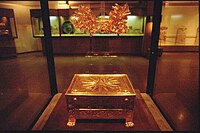

The Greeks have inhabited the Macedonia region since ancient times. The emergence of Macedonia from a small kingdom on the periphery of classical Greece to a kingdom that dominated the entire Greek world, occurred during the reign of Philip II . The son of Philip, Alexander of Macedon (356-323 BC), soon managed to extend the power of the Macedonians not only to the main Greek city-states, but also to the Persian Empire , including Egypt and the lands east to India [5] . The adoption of the rule of conquered territories by Alexander, at the same time, was accompanied by the spread of Greek culture, language and education throughout the territory of his vast empire. Although the empire split into several Greek kingdoms shortly after his death, his conquests left a lasting legacy, not least thanks to the new Greek-speaking cities founded throughout the former Persian Empire, portending the Hellenistic period of history. During the division of the empire of Alexander among the diadochos, Macedonia proper went to Antipater , but soon the region came under the control of the Antigonides dynasty , only a few years later, in 294 BC. e. Ancient Macedonian , whether it was a Greek dialect or a related language to Greek [6] , was gradually replaced by the Attic Greek dialect, which has been in use since the time of Philip II and later transformed into Koyne [7]
After the Roman conquest of the Balkan Peninsula, the Macedonians were an integral part of the population of the Roman province of Macedonia . Under Roman control and later, as part of the Byzantine Empire , there was an influx of many other nationalities in the region ( Armenians , Slavs , Arumins, and later Turks ), who settled in the region where the ancient ancient Macedonians lived. The region since ancient times also had a significant population of Romaniota Jews . In the late Byzantine period, a large part of Central Macedonia was ruled by the state of the Crusader Latins, centered in Thessaloniki , until it came under the control of Theodore Comnenus Ducas and his descendants, and then reintroduced into the Byzantine Empire. The territory of Western Macedonia subsequently became the subject of a dispute between the Byzantine Empire, Despotatus of Epirus , the rulers of Thessaly , the Serbian kingdom and the Bulgarian kingdom [8]
After the Ottoman conquests and towards the end of the Ottoman period, the term Macedonia began to refer to the region in the north of the Greek peninsula, different from the Byzantine theme of Macedonia . In Ottoman Macedonia, Albanians , Greeks , Jews , Bulgarians and Turks lived side by side, but in different communities, while in Western Macedonia there was a significant population of Greek Muslims , such as Wallahades [9] . Thessaloniki remained the largest city in Macedonia, where most of the Macedonians lived [9] [10]
Macedonians' Contribution to the Greek Revolution
The Greek revolution was undertaken by the Greeks, with the goal of creating an independent Greek state, at a time when most of Greece was part of the Ottoman Empire . The revolution was originally planned and organized by secret organizations, the most famous of which Filiki Eteria , acted in Greece and other regions of Europe outside the Ottoman Empire. The Greeks of Macedonians were actively involved in those early revolutionary movements; among the first was Grigorios Zalikis , a writer who founded the Greek-speaking hotel , the forerunner of Filiki Eteria. Even after the end of the Greek national revolution, several uprisings took place in Macedonia and all of them aimed at reuniting the region with the Greek kingdom [11]
The Greek revolution in Macedonia began from the Halkidiki peninsula , where the population was almost entirely Greek [12] On May 28, 1821, Yusuf Bey Thessaloniki, alarmed by the danger of a general uprising, demanded that he be held hostage by the Greek Macedonians. At a time when his troops began to approach the city of Polygyros , the local rebels and monks of Athos rebelled and killed the Turkish governor and their guards, forcing the Ottoman to retreat to Thessaloniki. Yusuf Bey avenged by beheading Bishop Meletius , executing 3 noble Macedonians and throwing many others in the dungeons in Thessaloniki [13] [14] [15] The Ottomans also turned Muslims and Jews against the Greeks, claiming that the Greeks intend to exterminate the entire non-Christian population. The first success of the Greek forces under the command of Emanuel Pappas , who assumed the title of General of Macedonia, was the liberation of Halkidiki and the threat of Thessaloniki, but in June the Greek forces retreated from Basilik and were eventually driven out of Halkidiki, after which the Greek population of the Kassandra peninsula was massacred [16 ] . In letters from this period, Pappas referred to himself and signed as “Leader and Protector of Macedonia”. Today, Pappas is considered a Greek national hero along with nameless Macedonians who fought under his command [17] . The revolution on the Halkidiki peninsula ended on December 27 with the subjugation of Mount Athos to the Ottomans [18]
Military operations and uprisings in Macedonia continued for some time. The most famous of them was the uprising in Naous , in which Karatassos Anastasios , Gatsos Angelis and Teodosiu Zafirakis became famous. But it was precisely the defeat of Pappas that was the turning point in the suppression of the Macedonian uprising during the Greek War of Independence [19] While the Greek Revolution led to the creation of an independent modern Greek state in the south, which received international recognition in 1832, the Greek resistance movement continued in the territories remaining under Ottoman control, including Macedonia, as well as Thessaly , Epirus and Crete [20] . The Crimean War in 1854 triggered a series of uprisings in Ottoman-controlled Greek lands, including Western Macedonia , the Halkidiki Peninsula, Olympus and Pieria [21] . One of the first instigators of the uprising was Dimitrios Karatassos, the son of Anastasios Karatassos, better known as Karatassos, Tsamis or the Old Man Tsamis [22] [23] [24] [25] Greek uprisings of the Macedonians were supported by the Greek king Otto , who considered the liberation of Macedonia and others Greek lands, hoping for the support of Russia. However, the uprising failed, worsening Greek-Turkish relations in subsequent years [26] .
The uprising of 1878 was prepared by both the Greek government and the leaders of the Macedonian revolutionaries, and took place in southern Macedonia. A large number of people from the Greek and Vlach communities of Macedonia took part in the uprising [11] In the same year, the Principality of Bulgaria was created, which, together with the church exarchate created by the Ottoman authorities, began to conduct propaganda among the Slavic-speaking population of Macedonia, organize Bulgarian schools and, with the support of the Ottoman authorities, to take control of the local churches, previously owned by the Patriarchate of Constantinople ; Bulgarian actions provoked a response from other groups of the population. Greek, Serbian, and Romanian schools were also established in various parts of Macedonia. After the defeat of Greece in the strange, Greek-Turkish war of 1897, Bulgarian intervention in Macedonian affairs began to increase and the Bulgarian armed couple invaded the region, terrorizing the population who had Greek identity and faithful to the Patriarchate of Constantinople [27]
Early 20th Century
On the eve of the 20th century, the Macedonian Greeks were a minority within the multinational region of Macedonia . Their number decreased with distance from the coast. They lived together with the Slavic-speaking population, most of whom identified themselves as Bulgarians , and other nationalities such as Jews , Turks , Wallachians and Albanians . However, ethnic Greeks were the predominant population in the southern region of the region, which makes up the bulk of modern Greek Macedonia . The activities of the VMRO organization and the influence of the Bulgarian Exarchate on the Bulgarian population of the region led to the Ilindensky uprising , which was suppressed by Ottoman forces. These events prompted Greece to assist the Macedonians to confront both the Ottoman and Bulgarian forces. Greece sent officers of the Greek army, who formed on the spot irregular detachments of Macedonians and other Greek volunteers, which led to the Fight for Macedonia in the period 1904-1908. The fight was stopped after the Young Turkish revolution [29] [29] [30] [31] According to the 1904 census conducted by Hussein Hilmi Pasha for the Ottoman authorities, the Greeks were the predominant population in the Thessaloniki and Monastira vilayets, but in the Kosovo vilayet the Bulgarian population prevailed [32] . During the Balkan Wars , Thessaloniki became the main award city for the warring parties, Greece , Bulgaria and Serbia . Greece laid claim to the southern region, which corresponded to the territory of Ancient Macedonia proper, relating to Greek history , and had a strong Greek presence [30] . As a result of the Balkan Wars, Greece received from the decaying Ottoman Empire most of the vilayets of Thessaloniki and Monastir, which today make up Greek Macedonia. After World War I and the agreement between Greece and Bulgaria on the mutual exchange of populations in 1919, the departure of the Bulgarians and the arrival of the Greek population from Bulgaria strengthened the Greek element in the region of Greek Macedonia, which acquired a high degree of ethnic homogeneity. During the violent Greco-Turkish population exchange imposed by Kemalist Turkey on 1923, there was a massive departure of Muslims from Macedonia, with the simultaneous arrival of Greek refugees from Asia Minor and East Thrace . According to statistics from the League of Nations in 1926, Greeks accounted for 88.8% of the total population of Greek Macedonia, Slavic-speaking population 5.1%, and the rest were mostly Muslim and Jewish [32]
The Macedonians fought along with the regular Greek army during the Fight for Macedonia and the Second Balkan War , making numerous sacrifices from the local population and opposing Bulgarian expansionism [33] [34] Monuments were erected in Macedonia , Macedonians and other Greek fighters who took part in wars, and those who died to liberate Macedonia from Ottoman rule [35] [36] Some of the Macedonians, who played an important role in the war, later became politicians in the modern Greek state. The most famous of them were the writer and diplomat Dragumis, Ion and his father Dragumis, Stefanos , who became the Prime Minister of Greece in 1910. The Dragumis family, who came from Vogatiko, in the Kastoria region, had a long history of participation in the Greek revolutions, starting with Marcos Dragumis, who was a member of Filiki Eteria . Heroic stories from the Fight for Macedonia were described in many novels by the Greek writer Delta, Penelope , from the narratives collected in 1932–1935 by her secretary Antigoni Bella-Trepsiadi, who herself was the daughter of Macedonomy [37] . Ion Dragumis also wrote about his personal memories from the Fight for Macedonia in his books.
World War II
During the triple, German-Italian-Bulgarian occupation of Greece during World War II, Macedonia suffered thousands of victims in connection with the anti-partisan activities of the German occupation forces and the policy of ethnic cleansing of the Bulgarian authorities. The Bulgarian army entered Greece on April 20, 1941 following in the footsteps of the Wehrmacht and ultimately occupied all of northeastern Greece east of the Strimonas River ( East Macedonia and Thrace ), except for the zone in the Evros region, along the border with Turkey, which remained under German control. Unlike Germany and Italy, Bulgaria officially annexed the territories occupied on May 14, 1941, which had long been the object of Bulgarian irredentism [38]
In Greek Macedonia, the policy of Bulgaria was the destruction and expulsion [39] of the population with the aim of forcibly Bulgarianizing as many Greeks as possible and expelling or killing the rest [40] A massive campaign was launched from the very beginning of the occupation, as a result of which all Greek officials (mayors, judges , lawyers and gendarmes) were deported. Bulgarians closed Greek schools and expelled teachers, replaced Greek priests with Bulgarian, and sharply suppressed the use of the Greek language: the names of cities and localities were replaced with traditional forms in Bulgarian [38] , and even tombstones with Greek inscriptions were processed [41]
A large number of Greeks were expelled, while others were denied the right to work through a licensing system that prohibited trade or profession without permission. Forced labor was introduced and Bulgarian occupation authorities confiscated Greek property and donated it to the Bulgarian colonists. [41] By the end of 1941, more than 100,000 Greeks had been expelled or fled from the Bulgarian occupation zone to the German zone [42] [43] . Bulgarian colonists were encouraged to settle in Macedonia by providing government loans and incentives, including the provision of houses and land confiscated from local residents.
Under these conditions, on September 28, 1941, an uprising broke out, known in history as the Drama uprising. The uprising began in the city of Drama and quickly spread throughout Macedonia. In Drama , Doxato, Horisti and many other cities and villages, clashes began with the occupying forces. On September 29, Bulgarian troops entered Drama and other rebel cities to crush the rebellion. They arrested all men from 18 to 45 years old, and executed more than three thousand people in the city of Drama alone. Approximately 15 thousand Greeks were killed by the Bulgarian occupation army in the next few weeks and in rural areas the population of entire villages was shot and the villages themselves looted [41]
Mass killings caused the exodus of the Greeks from the Bulgarian to the German zone of occupation. Bulgarian repression continued after the September uprising, increasing the flow of refugees. The villages behind the shelter of the "partisans" who were actually surviving residents from the earlier destroyed villages were destroyed. The terror and famine became so serious that the Athenian Quisling government began to consider plans to evacuate the entire population to the German occupation zone [44] The great famine in Greece , which erupted in 1941, and claimed the lives of about 300 thousand people in the occupied country, canceled these plans, leaving the Bulgarian population the occupation zone in these conditions for another 3 years. In May 1943, the deportation of Jews from the Bulgarian occupation zone began, which resulted in their extermination in Nazi concentration camps [45] . In the same year, the Bulgarian army expanded its occupation zone to Central Macedonia, but under German control, although this region was not officially annexed by Bulgaria.
Two of the leaders of the Greek Resistance were Macedonians. Euripidis Bakirdzis , a veteran of the Balkan Wars, was the commander of the Macedonian forces ELAS during the German-Italian-Bulgarian occupation of Greece. He became the first chairman of the Political Committee of National Liberation; also referred to as the “Government of the Mountains”; independent of the royal emigration government. Bakirdzis was replaced in this post by lawyer Alexandros Svolos (from the Macedonian minority of Arumina). Svolos participated in the Lebanon Conference in 1944, when the organization was dissolved during the formation of the Government of National Unity, which was headed by Papandreou, Georgios (Sr.) , and in which Svolos later became Minister.
Later, during the Civil War in Greece , the Macedonia region was badly damaged due to the battles between the Royal Armed Forces of Greece and the Republican Army of Greece .
Identity
Origin
Historical documents confirm the Greek presence in Macedonia since antiquity. Today, due to the history of the region, there are also small linguistic communities of the Arumans and Slavs , who use their dialects in some cases, but identify themselves as ethnic Greeks. After the 1923 Greek-Turkish population exchange and the departure of Muslims, some Greek refugees from Asia Minor , Pontus and East Thrace settled in the Macedonia region [46]
Culture
The Macedonians have their own, special, cultural heritage, which is classified as a subgroup of national Greek culture . They admire, along with the ancient Macedonians (among whom Alexander the Great occupies a special place), the fighters for Macedonia as their main characters, unlike the southern Greeks, who mainly venerate the southern heroes of the Greek Revolution of 1821-1829. According to the late 19th century folklorist Frederick G. Abbott [47] :
| Everything that has an aftertaste of antiquity is attributed by the Macedonian peasants to the two great kings of this country. Their songs and traditions, which they are rightly proud of, are often described as going "from the time of Philip and Alexander - and Heracles ", a comprehensive period to which all the remains of the past are reckoned with indiscriminate impartiality. |
The use of the Macedonian flag is common among the population of Macedonia. The flag depicts the Vergina star as their regional symbol, while the “ Famous Macedonia ” is an unofficial anthem and military march [48] They even have folk dances that bear the name of the region, the dance of Macedonia and the dance of Macedonikos Antikristόs .
Engravings of traditional Greek Macedonian costumes. | ||
The vast majority of Greeks of the Macedonians speak a variant of the Greek language called Macedonian (Μακεδονίτικα-Macedonite). It belongs to the group of northern dialects of the Greek language, with phonological and several syntactic differences from today's standard Greek that is spoken in southern Greece. One of these differences is that the Macedonian dialect uses the accusative instead of the genitive , to indicate an indirect object [49] The Macedonians also have a characteristic, more severe pronunciation, which makes it easy to identify the speaker that he is from Macedonia [50] . There is also a small Slavic-speaking minority in the region (mainly in the region of Western Macedonia), which for the most part identifies itself as the Greeks of Macedonians.
Declarations
The strongly expressed sense of Macedonian identity among the Greeks of the Macedonians has a significant consequence in the context of the attempt of the former Yugoslav Republic to usurp the Macedonian heritage and identity in recent decades [51] This provoked a reaction to the use of the concepts of Macedonians and Macedonian with non-Greek meanings, as the former used them The socialist Republic of Macedonia , during the period of socialist Yugoslavia , and continues to use the current Republic of Macedonia . The debate about the moral right to use the name of Macedonia and its derivatives leads to the Macedonian question of the late 19th - early 20th centuries. Initially, this question arose as an attempt to create an identity in Serbian Macedonia different from the Bulgarian one. The Greeks of the Macedonians opposed these concepts from the very beginning, fearing that the creation of these concepts would be followed by territorial claims, as noted by US Secretary of State Edward Stettinius in 1944, under President Roosevelt [52] :
This government considers the talk about the “Macedonian nation”, “the Macedonian Fatherland”, or “the Macedonian national identity” an unreasonable demagogy that does not represent the corresponding ethnic and political reality, and sees in them possible aggressive intentions against Greece.
The dispute caused friction between Yugoslavia, Bulgaria and Greece in the 1980s [53]
The dispute gained international status after the collapse of Yugoslavia , when the concern of the Greeks of the Macedonians grew to extremes. On February 14, 1992, about 1 million Macedonians took to the streets of the Macedonian capital, the city of Thessaloniki , demonstrating their protest against the use of the name Macedonia in the name of the new, newly created Republic of Macedonia, under the slogan “Greek Macedonia [54] After the recognition of the Republic of Macedonia by the government USA, another rally was held in Thessaloniki on March 31, 1994, while two other large rallies organized by the Macedonian Greek community in Australia were held in Melbourne in 1992 and 1994, each of which was participation of about 100,000 people [55]
Clear self-identification as Macedonians is a typical approach and a matter of national pride for Greeks originating from Macedonia [56] Answering questions regarding the dispute about the name of Macedonia, the Prime Minister of Greece, Karamanlis, Kostas - in a characteristic statement in this regard at a meeting of the European Council in Strasbourg in January 2007 - emphasized “I myself am a Macedonian, just as another 2.5 million Greeks are Macedonians” [57] [58] . Both, Kostas Karamanlis and his uncle, the former Prime Minister of Greece Karamanlis, Konstantinos , are Macedonian Greeks and come from the Macedonian region of Serre (nom . ) . As president of Greece, Konstantinos Karamanlis Sr. also expressed his strong feelings regarding the Macedonian regional identity, especially in an emotional statement made in 1992 [59]
Diaspora
Australia has been a popular destination for waves of Macedonian emigrants throughout the 20th century. Their immigration was similar to the rest (the Greek diaspora , which suffered from the socioeconomic and political situation in their homeland, and was mainly recorded between 1924-1974. Migrants from Western Macedonia were the first to arrive in Australia and dominated the waves of emigration until 1954. Macedonian families from the regions of Florina and Kastoria settled in rural areas, while the people of Kozani settled mainly in Melbourne . Only after 1954, immigrants from Central and Eastern Macedonia began to arrive in Austria Vasilios Kyriazis Blades from the village of Vitos, Noma Kozani, is considered the first Macedonian settler to arrive in Australia and land in Melbourne in 1915; upon arrival, he called other people from his village and the neighboring village of Pentalofos to settle in Melbourne, while several families from other regions also settled in Australia, bringing hundreds of people with them in the decades to come [60]
The geographical distribution of the Macedonians before World War II was different from the distribution of other Greek emigrants in Australia. While Greeks from the islands settled mainly in the eastern states of the country, large groups of Macedonians were concentrated in western Australia. In the early years of their settlement, the Macedonians were scattered throughout the Australian rural areas close to the metropolitan centers, working as gardeners, agricultural workers, and lumberjacks; a significant change in the structure of their employment occurred after 1946, when they began to bring their families from Greece [60] The process of urbanization of the Macedonians began after the Great Depression in Australia , when job offers increased in cities, which led to the resettlement of Macedonians in large cities, especially in Melbourne, Perth and Sydney , where they formed their communities and regional institutions. While most of the settlers were Native Macedonians, there were also a small number of Pontians who came from the Macedonian region, who however did not have the same regional identity and formed other organizations other than Macedonians [61]
After World War II, an increasing number of people from Macedonia came to Australia, many of them were refugees due to the Civil War in Greece . These new waves of immigrants led to the expansion of communities and more than 60 Macedonian organizations were created in the country, the most famous of which is the “Pan-Macedonian Federation of Australia”, under whose auspices all other organizations operate. In addition to its regional character, the “Federation” also serves as the voice of the Greek Macedonian communities in Australia and took an active part in demonstrations against the usurpation of the name of Macedonia [61] . Its headquarters is located in Melbourne, where in 1961 the non-commercial organization Pan-Macedonian Association of Melbourne and Victoria was established [62] . At the same time, the Federation is also active in the states of New South Wales , Queensland , South Australia and Western Australia [63] According to 1988 estimates, about 55,000 Macedonians live in Australia [64]
Other large Greek Macedonian communities are found in the United States , Canada and the United Kingdom . Among the main institutions created by these communities and closely related to them are: The Pan-Macedonian Association of the United States , founded in 1947 in New York by Greek Americans originating from Macedonia. Their goal was to bring together all the Macedonian communities of the United States, to work to collect and disseminate information about the land and population of Macedonia, the organization of lectures, scientific discussions, art exhibitions, educational and charity events. At the same time, they created a unit in the library of New York University , with books on Macedonian history and culture. In addition, they contributed to social welfare and educational progress for Macedonian residents [65] [66] The Pan-Macedonian Association of Canada is a branch of the Canadian Greek Association of Macedonian descent [67]
The Macedonian Society of Great Britain , founded in London in 1989 by Macedonian immigrants, promotes Macedonian history, culture and heritage, organizes lectures and presentations, as well as social events and gatherings among Englishmen of Greek descent [68] .
The Pan-Hellenic Macedonian Front , a Greek political party founded in 2009 by politician S. Papatemelis and professor K. Zuraris, who ran for the 2009 European Parliament elections, is affiliated with many Macedonian diaspora organizations [69]
Famous Modern Macedonians
- Christopoulos, Athanasios , poet.
- Kleantis, Stamatis , architect.
- Riadis, Emilios , composer.
- Zorbas, Georgios , the prototype of Alexis Zorbas, the hero of the world famous novel " Greek Zorb " Nikos Kazantzakis and the film of the same name (1964) filmed from this novel by Michalis Kakoyanis .
- Fasoulas, Panagiotis and Diamantidis, Dimitris , famous Greek basketball players who became European champions with the Greek national basketball team in the European Championships 1987 and 2005 . Fasoulas subsequently became mayor of Piraeus , while Diamantidis was proclaimed Basketball Player of the Year in Europe in 2007. Other basketball players such as Yannis Ioannidis (player and coach), Hatsivrettas, Nikos , Tsarsaris, Kostas , Zisis, Nikos and Fedon Matfeu are considered the Patriarchs of Greek basketball.
- Zagorakis, Theodoros , captain of the Greek national team who won the 2004 European Championship , and other players of the 2004 team such as Cartas, Vassilios , Dellas, Trayanos , Lakis, Vasilis , Cafes, Pantelis , Dabizas, Nikolaos , Vrizas, Sizis , Samaras, Yorgos ( on the paternal side) and Haristeas, Angelos .
- A number of Greek Olympic medalists: Rubanis, Georgios ( Olympic Games in 1956 in Melbourne , bronze medal), Patulidu, Paraskevi ( Barcelona 1992 , gold medal), Melissanidis, Ioannis ( Atlanta 1996 , gold medal), Tabakos, Dimostenis ( Athens 2004 , gold medal), Nikolaidis, Alexandros (Athens 2004, silver medal) and Mistakidu, Elisabeth (Athens 2004, silver medal).
- Karamanlis, Konstantinos , former president and prime minister of Greece, as well as his nephew Karamanlis, Costas who was also prime minister.
- Sardzetakis, Christ , former President of Greece .
- Dragumis, Stefanos and his son Dragumis, Ion , who made a huge contribution to the Fight for Macedonia , were politicians of Macedonian descent.
- Karayan, Herbert von (surname of the ancestors of Karajannis) (1908-1989), an Austrian symphonic and opera conductor originating from the paternal line from the Greco-Macedonians who had emigrated from Kozani to Chemnitz three centuries earlier [72] and then to Vienna, where they subsequently occupied key academic, medical and administrative positions [70] [71]
- Vasilikos, Vasilis , writer.
- Dalianidis, Giannis, Hadzihristos, Kostas , Laskari, Zoe , Wutsas, Kostas : famous actors of Greek cinema.
- Tatopoulos, Patrick , French film producer - of Greek Macedonian descent on the paternal side.
- Chiotis, Manolis , one of the best bouzouki soloists.
- Savvopoulos, Dionysis , composer, poet and singer.
- Wandi, Despina , singer.
Macedonian Gallery
Antiquity
Statue of Alexander the Great, municipality of Pella
Statue of Philip II, Thessaloniki
Ptolemy I Soter
Bazileus Kassander
Lysimachus , officer and corps of Alexander the Great
Seleucus I Nicator founder of Antioch
Demetrius I Poliorket
Attal II , Antalya
Perseus of Macedonia , the last king of Ancient Macedonia
Cleopatra
Byzantine and Ottoman era
|
Greek Revolution
Polisoidis, Anastasios
Paycos, Andronicos
Papafis, Ioannis
Atanasiou, Vasilios
Skandalidis, Ioannis
Perrevos, Christoforos
Sotiriou, Zisis
Vellios, Konstantinos
Patriarch Chrysanthus
Karatassos, Anastasios
Caratassos, Tsamis
Gatzos, Angelis
Casomoulis, Nikolaos
Georgios Theoharis
Ziakas, Theodoros
Lassanis, Georgios
Cleantis, Stamatis
See also
- Macedonia (Greece)
Notes
- ↑ See Peter Mackridge, 'Ourselves and Others: The Development of a Greek Macedonian Cultural Identity since 1912', Oxford & New York, 1997.
- ↑ Georg Autenrieth, A Homeric Dictionary, μακεδνός . Perseus.tufts.edu. Date of treatment May 5, 2009.
- ↑ Johann Baptist Hofmann. Etymologisches Wörterbuch des Griechischen. - R. Oldenbourg, 1950.
- ↑ Oxford English Dictionary , sv 'Macedon'
- ↑ History of India (inaccessible link) . Date of treatment May 4, 2012. Archived on May 13, 2012.
- ↑ Joseph, Brian D. Ancient Greek . Ohio State University. Date of treatment November 2, 2009.
- ↑ Bugh, Glenn Richard. The Cambridge companion to the Hellenistic world . - Cambridge University Press, 2006. - P. 186–187. - ISBN 0-521-82879-1 .
- ↑ See M. Nicol, 'The Last Centuries of Byzantium'.
- ↑ 1 2 Hupchick, Dennis P. Conflict and chaos in Eastern Europe . - Palgrave Macmillan, 1995. - P. 125. - ISBN 0-312-12116-4 .
- ↑ Vakalopoulos, Apostolos. History of Macedonia 1354-1833. - Vanias Press, 1984.
- ↑ 1 2 Mackridge, Peter A. Ourselves and others / Peter A. Mackridge, Eleni Yannakakis. - Berg Publishers, 1997. - P. 7. - ISBN 1-85973-138-4 .
- ↑ Finlay, George. History of the Greek revolution . - W. Blackwood and sons, 1861 .-- P. 248.
- ↑ Αποστολική Διακονία
- ↑ Απόστολος Ε. Βακαλόπουλος, Επίλεκτες Βασικές Ιστορικές Πηγές της Ελληνικής Επαναστάσεως, Εκδόσεις Βάνιας 1990, τόμος Ά 28, 29
- ↑ Finlay, George. History of the Greek revolution . - W. Blackwood and sons, 1861 .-- P. 251.
- ↑ Finlay, George. History of the Greek revolution . - W. Blackwood and sons, 1861 .-- P. 252.
- ↑ Vakalopoulos, Apostolos. Emmanouil Papas: Leader and Defender of Macedonia, The History and the Archive of His Family. - 1981.
- ↑ Finlay, George. History of the Greek revolution . - W. Blackwood and sons, 1861 .-- P. 254.
- ↑ Finlay, George. History of the Greek revolution . - W. Blackwood and sons, 1861 .-- P. 255.
- ↑ Todorov, Vărban N. Greek federalism during the nineteenth century: ideas and projects . - East European Quarterly, 1995. - P. 29–32. - ISBN 0-88033-305-7 .
- ↑ [pg. 29-30 Ι., Θεσσαλονίκη: [χ.ο.], 1981
- ↑ Κωνσταντήνος Α. Βακαλόπουλος, Επίτομη Ιστορία της Μακεδονίας, Τουρκοκρατία, Κυριακίδη -Θεσσαλονίκη 1988, σελ.116-119
- ↑ Στέφανος Π. Παπαγεωργίου, Απο το Γένος στο Έθνος 1821-1862, ISBN 960-02-1769-6 , σελ.470]
- ↑ Institute of Balkan Studies. Balkan studies: biannual publication of the Institute for Balkan Studies . - Balkan studies: biannual publication of the Institute for Balkan Studies, 1976 .-- P. 49.
- ↑ Institute of Balkan Studies. Balkan studies: biannual publication of the Institute for Balkan Studies . - Balkan studies: biannual publication of the Institute for Balkan Studies, 1976 .-- P. 49.
- ↑ Bergstrom Haldi, Stacy. Why wars widen: a theory of predation and balancing . - Routledge, 2003. - P. 117–118. - ISBN 0-7146-5307-1 .
- ↑ Mackridge, Peter A. Ourselves and others / Peter A. Mackridge, Eleni Yannakakis. - Berg Publishers, 1997. - P. 8. - ISBN 1-85973-138-4 .
- ↑ Σέρβια (Greek) (neopr.) ? . Kozani Prefecture (August 2, 2007). Date of treatment October 17, 2009. Archived August 31, 2009.
- ↑ 1 2 Douglas Dakin, The Unification of Greece 1770-1923, ISBN 960-250-150-2
- ↑ 1 2 Gillespie, Richard. Mediterranean politics . - Fairleigh Dickinson Univ Press, 1994 .-- P. 88. - ISBN 0-8386-3609-8 .
- ↑ Mackridge, Peter A. Ourselves and others / Peter A. Mackridge, Eleni Yannakakis. - Berg Publishers, 1997. - P. 9. - ISBN 1-85973-138-4 .
- ↑ 1 2 Gillespie, Richard. Mediterranean politics . - Fairleigh Dickinson Univ Press, 1994 .-- P. 89. - ISBN 0-8386-3609-8 .
- ↑ Ιστορία και Πολιτισμός του Νομού Κοζάνης (Greek) (neopr.) ? . ΚΕΠΕ Κοζάνης. Date of treatment October 17, 2009.
- ↑ Ημερίδα για τον Βουρινό στο πλαίσιο της εκατονταετούς επετείου από το Μακεδονικό Αγώνα (Greek) (neopr.) ? . General Secretariat of Macedonia – Thrace (September 20, 2004). - " Minister for Macedonia – Thrace addresses the public on occasion of the 100 year anniversary of Macedonian struggle: " The revolt in Bourinos was the verst organized resistance act of the Macedonian Hellenism against the Bulgarian imperialism and the once pan-slavic danger. " ". Date of treatment October 17, 2009.
- ↑ Museum of Macedonian Struggle . Historical – Folklore and Natural History Museum of Kozani. Date of treatment October 17, 2009.
- ↑ Philippos Dragoumis-Series II . American School of Classical Studies at Athens . Date of appeal May 26, 2009.
- ↑ Nikolaeva Todorova, Marii︠a︡. Balkan identities: nation and memory . - C. Hurst & Co. Publishers, 2004 .-- P. 215. - ISBN 1-85065-715-7 .
- ↑ 1 2 Mazower, Mark. After the war was over . - Princeton University Press, 2000. - P. 276. - ISBN 0-691-05842-3 .
- ↑ Miller, Marshall Lee. Bulgaria during the Second World War . - Stanford University Press, 1975. - P. 130. - ISBN 0-691-05842-3 .
- ↑ Miller, Marshall Lee. Bulgaria during the Second World War . - Stanford University Press, 1975 .-- P. 126. - ISBN 0-691-05842-3 .
- ↑ 1 2 3 Miller, Marshall Lee. Bulgaria during the Second World War . - Stanford University Press, 1975. - P. 127. - ISBN 0-691-05842-3 .
- ↑ Mazower, Mark. After the war was over . - Princeton University Press, 2000. - P. 20. - ISBN 0-691-05842-3 .
- ↑ Shrader, Charles R. The withered vine . - Greenwood Publishing Group, 1999. - P. 19. - ISBN 0-275-96544-9 .
- ↑ Miller, Marshall Lee. Bulgaria during the Second World War . - Stanford University Press, 1975. - P. 128. - ISBN 0-691-05842-3 .
- ↑ The Holocaust in Greece, 1941-1944 (Part 1) . Balkanalysis.com (November 29, 2005). Date of treatment October 22, 2009.
- ↑ Educational Institute of Greece (in Greek)
- ↑ Frederick, Abbott G. Macedonian Folklore . - BiblioBazaar, 2009. - P. 279. - ISBN 1-110-36458-X .
- ↑ Danforth, Loring M. The Macedonian Conflict . - Princeton University Press, 1997. - P. 83. - ISBN 0-691-04356-6 .
- ↑ Alexiadou, Artemis. Studies in Greek syntax / Artemis Alexiadou, Geoffrey C. Horrocks, Melita Stavrou. - Springer, 1999. - P. 99. - ISBN 0-7923-5290-4 .
- ↑ Roudometof, Victor. Collective memory, national identity, and ethnic conflict . - Greenwood Publishing Group, 2002. - P. 76. - ISBN 0-275-97648-3 .
- ↑ Mackridge, Peter A. Ourselves and others / Peter A. Mackridge, Eleni Yannakakis. - Berg Publishers, 1997. - P. 1. - ISBN 1-85973-138-4 .
- ↑ Quote: ... This Government considers talk of "Macedonian Nation", "Macedonian Fatherland", or "Macedonian National Consciousness" to be unjustified demagoguery representing no ethnic or political reality, and sees in its present revival a possible cloak for aggressive intentions against Greece . See the whole quote here .
- ↑ The Yugoslavs Criticize Greece and Bulgaria over Macedonia . Open Society Archives (August 1, 1983). Date of treatment September 28, 2009. Archived August 5, 2009.
- ↑ Roudometof, Victor. Collective memory, national identity, and ethnic conflict . - Greenwood Publishing Group, 2002. - P. 32. - ISBN 0-275-97648-3 .
- ↑ Macedonia enlarged . neurope.eu (October 6, 2008). Date of treatment October 2, 2009. Archived on October 8, 2008.
- ↑ Demetrius Andreas Floudas: FYROM's dispute with Greece revisited . Interstice. Date of treatment October 3, 2009.
- ↑ Interview of Foreign Ministry spokesman Mr. G. Koumoutsakos with Bulgarian news agency FOCUS (unavailable link) . Ministry of Foreign Affairs of Greece (February 16, 2007). Date of treatment October 3, 2009. Archived March 2, 2012.
- ↑ Karamanlis outlines Greek positions on issues affecting SE Europe during Council of Europe address (unavailable link) . Embassy of Greece in Washington DC (January 24, 2007). Date of treatment October 3, 2009. Archived June 5, 2011.
- ↑ Σέρρες: Εκδηλώσεις για τα 10 χρόνια από το θάνατο του Κωνσταντίνου гαραμανλή (Greek) (neopr.) ? . Makedonia newspaper (May 25, 2008). - "There is no other but one Macedonia, and this is Greek." Date of treatment October 3, 2009.
- ↑ 1 2 Jupp, James. The Australian people . - Cambridge University Press, 2001. - P. 417. - ISBN 0-521-80789-1 .
- ↑ 1 2 Jupp, James. The Australian people . - Cambridge University Press, 2001 .-- P. 418. - ISBN 0-521-80789-1 .
- ↑ Home page . Pan-Macedonian Association of Melbourne and Victoria. Date of treatment October 11, 2009.
- ↑ Pan-Macedonian Federation of Australia . AusGreekNet.com. Date of treatment October 11, 2009.
- ↑ Danforth, Loring M. The Macedonian Conflict . - Princeton University Press, 1997. - P. 86. - ISBN 0-691-04356-6 .
- ↑ About us (inaccessible link) . Pan-Macedonian Association USA. Date of treatment October 14, 2009. Archived July 21, 2009.
- ↑ Pan-Macedonian Association Meets with UN Mediator Matthew Nimitz in New York . Hellenic Communication Service. Date of treatment October 14, 2009.
- ↑ Our association . Pan-Macedonian Association of Canada. Date of treatment October 14, 2009.
- ↑ Home page . The Macedonian Society of Great Britain. Date of treatment October 14, 2009.
- ↑ Το "Πανελλήνιο Μακεδονικό Μέτωπο" ανακοίνωσαν Παπαθεμελής και Ζουράρις (Greek) (neopr.) ? . in.gr (May 6, 2009). Date of treatment October 14, 2009.
- ↑ 1 2 Kater, Michael H. The twisted muse: musicians and their music in the Third Reich . - Oxford University Press, 1997. - P. 56. - “Karajan was born in 1908 in Austrian Salzburg, the son of a well-to-do physician of partially Greek-Macedonian ancestry whose forebears had been ennobled while in the service of the Saxon kings. ". - ISBN 9780195096200 .
- ↑ 1 2 Cramer, Alfred W. Musicians and Composers of the 20th Century-Volume 3. - Salem Press, 2009. - P. 758. - “The Life Herbert Ritter von Karajan (fahn KAHR-eh- yahn) was born to Ernst and Martha von Karajan, an upper-class family of Greek-Macedonian origin. ". - ISBN 9781587655159 .
- ↑ Paul Robinson, Bruce Surtees. Karajan. - Macdonald and Janes, 1976. - P. 6. - “Herbert von Karajan was born in Salzburg April 5, 1908. Though an Austrian by birth, the Karajan family was actually Greek, the original surname being Karajanis or" Black John ". The family had migrated from Greece to Chemnitz, Germany, and from there to Austria about four generations before Herbert. ”
- ↑ Merry, Bruce. Encyclopedia of modern Greek literature . - Greenwood Publishing Group, 2004. - P. 239. - ISBN 0-313-30813-6 .