“Saint John” ( eng. Saint Joan , also translated as “ Saint Joan ”) is one of the most famous plays of Bernard Shaw , written in 1923 and first put on the scene in December of that year. The main character of the play is Joan of Arc . The play takes place in the 15th century, during the Hundred Years War , when the appearance and bold actions of Joan of Arc changed the course of the war in favor of the French. The main theme of the play is the author’s reflections on the role of the great personality in history and in the progress of mankind. Critics consider Jeanne the best and most vivid way in the entire dramaturgy of the Show, combining "greatness and simplicity, comic and tragic, spiritual independence and elemental force of personality" [1] .
| Saint John | |
|---|---|
| Saint Joan. A chronicle play in 6 Scenes and an Epilogue | |
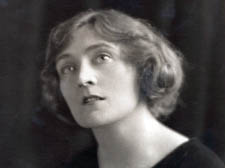 Sybil Thorndike as Joan (1927) | |
| Genre | historical and philosophical drama |
| Author | Bernard Show |
| Original language | English |
| Date of writing | 1923 |
| Date of first publication | 1924 |
| Previous | "Back to Methuselah" |
| Following | "Applecart" |
| Electronic version | |
The play was a resounding success, in London for the first year withstood 244 performances. In her various productions, such famous actresses as Sybil Thorndike , Genevieve Bugot , Ann-Mary Duff , Katherine Cornell , Sarah Miles , Joan Plauraite , Lynn Redgrave , Imogen Stubbs , Imelda Staunton , Frances de la Tour , Uta Hagen , Wendy Hagen , 2] .
In 1957, the play was filmed , starring the 19-year-old Gene Seeberg .
In 2008, the play was awarded the Laurence Olivier Prize in the nomination "Best Renewed Performance" [3] .
History of writing and staging
Judging by the letters, the idea of the play-chronicle about the life and struggle of the Virgin of Orleans appeared at the Show during a trip to France in 1913. Although there is a version that the plan was born earlier, as a polemical antithesis to Mark Twain’s novel “ Personal Memories of Joan of Arc ” (1896). Among the motives conceived was the slogan "religion without a church." World War II forced to postpone the implementation of this plan. For some time, Shaw considered the idea of writing a play about the life of the Prophet Muhammad , which fit in the same motif in a natural way, but quickly realized that the parliamentary censorship commission would not allow such a production [4] . In May 1920, Pope Benedict XV signed the decision to canonize Joan of Arc as a Catholic saint, and this prompted the Show to resume work on the play about Joan [5] .
The main work on the text took place in 1923. Semi-serious Shaw assured that the play was written by Jeanne herself, and he only processed it for the stage [6] [7] . The show explained: “Others made an adventure novel out of Jeanne. I told without embellishment how the matter was ... The scene of the court was made according to the documents of a genuine court. Here everything belongs to the real Jeanne - both words and deeds ” [4] .
The first performance of the play took place on December 28, 1923 at the American Theater of Garrick on Broadway [8] . The Americans asked the author to shorten the play so that it ends before midnight; The show in response telegraphed: "Start early" [4] . The London public saw the premiere of the play on March 26, 1924 at the New Theater. Jeanne was played by Sybil Thorndike , for whom Shaw wrote this role. Thorndike is considered the best performer of the heroine of the Show, by royal decree she was promoted to the Ladies Commander of the Order of the British Empire for her role as Jeanne [2] .
During the year, the play was staged in almost all European countries. The German translator of the play Tribic wrote in his Chronicle of Life that the premiere of Saint John at the Berlin Theater was crowned with “the greatest theatrical success he had ever seen” [9] . Triumph was widespread; no other play brought Shaw such a big income [4] .
In 1925, the Show was awarded the Nobel Prize in literature with the following justification: "For creativity marked by idealism and humanism, for sparkling satire, which is often combined with exceptional poetic beauty." The show joked in response that it considers this difference “a sign of gratitude for the sense of relief that the world experienced this year when it did not print anything.” The show refused the cash prize, and it was used to translate a number of works by Swedish authors into English [9] .
The play has been staged repeatedly in the USSR and in Russia:
- 1924: Petersburg, Alexandrinsky Theater (then renamed the State Drama Theater), titled The Virgin of Orleans, staged by V. Rappoport [10] ;
- 1924: Moscow, Tairov Chamber Theater , staged by A. Ya. Tairov , starring Alisa Koonen [11] ;
- 1958: Moscow State Theater named after Lenin Komsomol , entitled "Saint Jeanne", directed by V. S. Kantsel [12] . In the main role - E. A. Fadeeva .
The play was also staged in the theaters of Sverdlovsk, Kharkov and other cities [2] .
Key Actors
Most of the characters in the play are historical figures.
- Joan of Arc named Virgo.
- Robert de Bodricourt , commandant of the Vaukuler fortress.
- Bertrand de Poulangy, the head of the guard of Vauculera.
- Charles VII , Dauphin , later King of France.
- Archbishop of Reims.
- Senor La Tremuy, adviser to the king.
- Gilles de Re , nicknamed "Bluebeard."
- La Gere , captain.
- Jean de Dunois , nicknamed the "Bastard of Orleans", French commander, ally of Jeanne.
- Pierre Cauchon , Bishop of Beauvais .
- Count Warwick , English military commander.
- John de Stogamber, English chaplain .
- Brother John Lemeter, Inquisitor .
- Canon John d'Estive.
- Canon de Courcelles.
- Brother Martin Ladwin, monk.
Story
The first picture [13] . France, March 1429. The British dominate the country, a small part of the territory is defended by supporters of the French Dauphin (Crown Prince) Charles . A peasant girl named Jeanne appears in Vokuler fortress and demands a meeting with Robert de Bodricourt, the commandant of the fortress. The commandant refused and told her to go back to her father. The stubborn Jeanne remained in Vaukulera and, possessing an irresistible gift of persuasion, forced the garrison of the fortress to take her side. The next day, the hens in the fortress stopped rushing, and the cows milked. The indignant de Bodricourt ordered Jeanne to be brought to him, but soon, unable to resist her perseverance and the persuasion of the garrison, he ordered to give everything that she required: a horse, armor and several soldiers to travel to the Dauphin Karl. After that, the local housekeeper runs into the room with a cry: “Hens rush like crazy! Five dozen eggs! ”De Bodricourt flinches, crosses himself, and whispers in his whitened lips:“ Lord have mercy! Verily she was sent by God! ”
The second picture [14] . After 11 days, Jeanne arrived in Chinon , where the Dauphin Carl was. By this time, rumors of the Virgin, sent by God to save France, had spread widely. Jeanne was put to the test - during the reception, Carl was replaced by Gilles de Re , however, Jeanne confidently recognized the real Dauphin in the crowd. Then they have a long conversation in private, during which Jeanne manages to breathe hope and determination into a weak-willed prince. Carl announces the courtyard, which gives Joan the command of the French army.
The third picture [15] . The neighborhood besieged by the British Orleans, May 29, 1429. To approach the city and lift the siege, French troops need a west wind, which will allow ships to go against the Loire . Commander Jean de Dunois meets Jeanne and explains to her the state of affairs. The wind suddenly changes to the west. Dunois kneels down and hands Jeanne his rod with the words "I am your soldier." An army shouting "For God and the Virgin!" Rushes to save Orleans.
The fourth picture [16] . A few months later. Orleans is liberated, the French win one victory after another, displacing the British, whose commander John Talbot was captured ( battle of Pat ). In the English camp, the warlord Count Warwick and the bishop of Beauvais Pierre Cauchon are conferring . The first considers Jeanne a dangerous enemy of England, the second - a stubborn heretic and enemy of the church. Cauchon explains: “What will our world turn into if any illiterate man or any shepherdess begins dumping all the wisdom, all experience, all knowledge accumulated by the Church, if she rejects the leadership of scientists, respectable, pious people, imagining her monstrous pride inspired by the devil, what receives inspiration directly from God? It will be a world filled with blood, a world where devastation is rampant, where everyone does what he wants; it will be a wreck, a return to barbarism. ” Cauchon also condemns national patriotism as anti-Christian teaching. As a result, both decide to deal with Jeanne and charge a huge price for her capture - sixteen thousand pounds.
The fifth picture [17] . Prince Karl was crowned in Reims . The people enthusiastically welcome Jeanne, the courtiers hate her. Dunois explains to Jeanne the reason: “Do the old commanders, who survived from the mind of confusion and dumbasses, love the lucky young captains who rob them of their command? Do sophisticated ambitious politicians have affection for the upstart that sits in their place? Is it really pleasant for archbishops when someone wipes them from the altar, even if it’s a saint? ”Joan is torn between two desires: to return to her native village, considering her mission completed, or go to liberate Paris. The courtiers and the king himself make it clear that they would prefer the first option. The Archbishop accuses the Virgin of Orleans of sinful pride and disobedience to the church. Jeanne sadly admits that she was left alone, but decides to continue the fight.
Scene Six [18] . In the battle of Compiegne, Jeanne was captured by the Burgundians, who then sold it to the British. She is charged with witchcraft and a heresy. On May 30, 1431, the Inquisition process began in Rouen . To begin with, Jeanne was subjected to grueling interrogations; she answered openly to all questions that did not concern her personal communication with God and his messengers. Of these answers, 12 indictment points were put together. Jeanne's answers at the court are filled with courage and calm dignity. She refused to promise that she would fully trust the church and its decrees; this caused Cauchon's remark: "You said enough to send ten heretics to the fire." Threatening torture and a bonfire, the judges eventually force the captive to sign a penitential renunciation, but when she learns that instead of a bonfire she will receive only a life-long monastery prison, Jeanne breaks the text of the renunciation. The virgin is taken to execution. Before her death, Jeanne asked to give her a cross; some soldier tied two sticks crosswise and handed it to her. The chaplain, who was present at the execution, called himself Judas, worthy of the gallows.
The epilogue [19] is framed as the dream of King Charles 25 years after the execution of Jeanne. All the characters gather at the King’s bed, a double court is being decided - the trial of history over Jeanne and the trial of her judges. The rehabilitation process has just ended, having removed all the charges from Jeanne, her judges were found "guilty of deliberate deceit, hypocrisy, bribery and spite." Cauchon’s spirit complains that he was anathematized and dug up from the grave and thrown into the gutter - although he was “fair, merciful, faithful to his convictions and could not do otherwise.” There is a spirit of a soldier who gave Jeanne a cross before his death - once a year he is released for this from hell for a day. The soldier reports that in hell the chosen company is "emperors, yes popes, yes kings, and even different to become the same." The chaplain’s spirit says that he repented and turned to good after the execution of the Virgin, although before that he actively contributed to her condemnation, to which Cauchon remarks: “So, in every century the new Christ must die in agony in order to save those who have no imagination? "Count Warwick appears, apologizes to Jeanne and explains:" Your burning was a purely political measure. Personally, I definitely had nothing against you. ” The last, with a general laugh, appears a man in a suit of 1920 and read out the decree on reckoning Jeanne as a saint of the Catholic Church.
All those present, including the king, kneel before Joan and glorify her feat. But after her question: “Do you want me to rise from the dead and return to you alive?” Everyone gets up in fear. The king cynically observes: “Even if you could bring her back to life, in six months she would have been burned again.” The rest recognize that humanity is not ready to accept the saints and live with them. The bell strikes midnight, the spirits, except Joan, disappear, the king falls asleep. Jeanne in desperate prayer calls on God to bring the time for the correction of mankind closer.
Textology
In “St. John”, the Show touches on themes traditional for his work - the path of mankind to social and moral progress, the role of a great person in this process, ahead of his time. Similar topics were, for example, in Caesar and Cleopatra , but Saint John is more emotional and bitterness. In the symbolic epilogue, everyone renounces the heroine: “Forgive us, Jeanne. We are not yet righteous enough to live with you. ” Jeanne’s last words complete the play and form its main moral: “Oh God, you created this beautiful land, but when will it become worthy to receive your saints? How long, O Lord, how long? ” [20]
Different authors portrayed Jeanne in different ways - as a national leader, God's prophetess, random choice of fate, etc. The show completely removes all mysticism (in the first act it explicitly mockingly describes the “miracle with hens”), and Jeanne’s visions and her otherworldly “voices” the author regards as the mystical shell of common sense of Jeanne herself. The romance has also been largely removed; for Friedrich Schiller and Mark Twain, Jeanne is fabulously beautiful; for Shaw, she is ugly, rude, and hot-tempered. In the preface to the play, Shaw ridicules the romantically embellished image of Jeanne by Schiller and Twain; in Shaw, it is just as practical and rational as Caesar from “Caesar and Cleopatra”, and achieves his goals in the same way - appealing to a sober mind and natural feelings of others [21] .
Depriving Jeanne of artificial virtues, Shaw at the same time does not hide his deep sympathy for her. Joan of Shaw is distinguished primarily by an exceptional sense of inner freedom. In the course of her struggle, Jeanne, without hesitation, shows disrespect to noble persons, violates many feudal-religious traditions; she was especially accused of wearing men's clothing and the belief that God directs her directly, bypassing the ministers of the church (the Show once called Jeanne “the first Protestant” [4] ). The inner conviction of her innocence, the best qualities of a born national leader not only helped her to win, but also multiplied the number of enemies and envious people, and ultimately contributed to her death. The show emphasizes this aspect as the general regularity of all times [21] , in one of the letters he stated that the tragedy of Jeanne “is as great as the tragedy of Prometheus ” [22] .
Thus, the author points out that the tragic end of Joan’s mission was not caused by the machinations of villains (inquisitors, English and others), he is a sad historical regularity, a consequence of the imperfection of society and human nature. The sentence of Jeanne was not reprisal, it was fully consistent with the laws of that time - because these laws themselves were unfair [23] . Unlike many other chronicles of the life of Joan of Arc, the Show does not declare any of the characters a villain and gives everyone the opportunity to explain the motives for their actions, dictated, in his opinion, by a sincere personal understanding of the essence of good and public good [24] . The symbolic epilogue of the play provides readers or viewers with an occasion to reflect on how inevitable the tragedy of the prophet, in the past and in the present [23] .
To make the connection with modernity clearer, the Show deliberately allows for a number of anachronisms : in the characters' speech, there are expressions characteristic of the 19th-20th centuries. At the same time, this creates an additional satirical effect [25] .
The biographer Emrys Hughes drew attention to the brilliantly constructed art of polyphony by the author, including comic and tragic [9] .Sybil Thorndike , the first English performer of the role of Jeanne, also remembered about this , for which Shaw arranged an author's reading of the text of the play: “How he read! So the great performer feels for the way to every note with a feeling. It was real music, each character is a special instrument, and he played all at once. I cannot forget this great symphony ” [4] .
Add-ons for the film
The show wrote the script for the film adaptation of “St. John”, but the film was not made during the life of the playwright. In 1927, there was only a short fragment from the fifth picture, a scene in the Reims Cathedral [26] .
At the beginning of the script there is an additional scene: Jeanne sits on a pasture near her native village, scorched by the war, and looks at a peasant's house nearby, smoking nearby. The ringing of bells, Jeanne rises from her place, having made a decision, and sets off on a journey to Vokuler [27] .
Next is added the scene of the battle of Orleans. The head of the English Church, Cardinal Winchester, who is only mentioned in passing in the play, in the script instructs Stogamber to end Joan. Some of the dialogues are redone to enhance the dynamism of the action [28] .
Criticism
The biographer Emrys Hughes called the play a masterpiece: “The show very accurately followed historical documents in this play and not only showed a deep understanding of time, human feelings and characters in it, but also gave a magnificent picture of the era as a whole” [9] . Another biographer, Hesket Pearson, writes [4] :
Joan of Arc is a great man, for she remained true to herself. But Shaw’s play, a great play, wasn’t at all because he “penetrated it through the medieval atmosphere” - any middle-class historian would have done it — but because it is a triumphant personality whose spiritual power could not be broken by all the machinery of power.
The critic Eric Bentley accused the author of distorting historical realities and poisonously remarked that, probably, Shaw first wrote plays, and only then read history books [29] . Another critic, John Mackinnon Robertson, was indignant at Shaw's way of showing events “ to put things both ways ” [30] . Robertson was supported by Thomas Eliot , according to whom, "truth and falsehood for the Show does not mean the same as for ordinary people." Eliot also stated that Jeanne Shaw is the forerunner of English suffragists [31] [30] .
Thomas Mann called the play “the warmest and poetic and touching, most tragic, in the highest sense of the word, Shaw's work - a creation of truly brilliant justice, quite worthy of its world fame, in which the pure mind of the esprit fort [freethinker] grown from the eighteenth and nineteenth centuries head before the shrine. ” [32]
The Soviet critic Pyotr Balashov wrote that in describing the character of Jeanne “the writer’s humanism, his poetic vision of the world, the ability to highlight the shades of the whimsical gamut of the feelings of his heroes and reveal the logic of unexpected, apparently paradoxical turns in their consciousness and actions” are most pronounced [33] .
According to the Soviet critic N. Ya. Dyakonova , “In none of his plays, either early or late, the Show did not build such a complex image ... did not achieve such an interaction not only between her and secondary characters, but also between the individual traits of the heroine and its ideological and historical function ” [34] . N. Ya. Dyakonova notes the strong influence of the Shaw drama on the later authors of historical plays - Brecht , Dürrenmatt , Osborne , Anui and others [35] .
Russian translations
- “St. John”, Olga Petrovna Kholmskaya - in the six-volume “The Complete Collection of Bernard Shaw's plays” [36] and in the two-volume “Selected Pieces” [37] .
- "Saint Jeanne", E. M. Golysheva and B. R. Izakov [38] .
Notes
- ↑ Dyakonova N. Ya., Commentaries on Volume 5, 1980 , p. 695.
- ↑ 1 2 3 Dyakonova N. Ya., Comments on Volume 5, 1980 , p. 696.
- ↑ Olivier winners 2008 (2008). Date of treatment May 27, 2014. Archived April 2, 2013.
- ↑ 1 2 3 4 5 6 7 Hesket Pearson, 1997 , Chapter “Apotheosis”.
- ↑ Dyakonova N. Ya., Commentaries on Volume 5, 1980 , p. 686.
- ↑ Dyakonova N. Ya., Commentaries on Volume 5, 1980 , p. 692-693.
- ↑ Henderson A. Bernard Shaw. Playboy and prophet. NY — London: D. Appleton and company, 1932, p. 543.
- ↑ Harben, Niloufer. Twentieth-century English history plays: from Shaw to Bond. - P. 31. - ISBN 0-389-20734-9 .
- ↑ 1 2 3 4 Emrys Hughes, 1968 , Chapter 17.
- ↑ Leningrad State Academic Drama Theater named after A.S. Pushkin . Date of treatment November 3, 2014.
- ↑ Archive of chamber theater performances, 1920s . Date of treatment November 3, 2014.
- ↑ Moscow Lenin Komsomol Theater (Unavailable link) . Date of treatment November 3, 2014. Archived November 3, 2014.
- ↑ Scene I . Date of treatment October 7, 2014.
- ↑ Scene II . Date of treatment October 7, 2014.
- ↑ Scene III . Date of treatment October 7, 2014.
- ↑ Scene IV . Date of treatment October 7, 2014.
- ↑ Scene V . Date of treatment October 7, 2014.
- ↑ Scene VI . Date of treatment October 7, 2014.
- ↑ Epilogue . Date of treatment October 7, 2014.
- ↑ Dyakonova N. Ya., Commentaries on Volume 5, 1980 , p. 692. In the original: “ O God that madest this beautiful earth, when will it be ready to accept thy saints? How long, O Lord, how long? ".
- ↑ 1 2 Dyakonova N. Ya., Comments on Volume 5, 1980 , p. 686-689.
- ↑ A. Henderson, 1925 , p. 48.
- ↑ 1 2 Dyakonova N. Ya., Comments on Volume 5, 1980 , p. 691.
- ↑ A tragedy without villains , The Guardian (July 14, 2007). Date of treatment May 27, 2014.
- ↑ Dyakonova N. Ya., Commentaries on Volume 5, 1980 , p. 693.
- ↑ Balashov P., 1982 , p. 278.
- ↑ Balashov P., 1982 , p. 291.
- ↑ Balashov P., 1982 , p. 292-294.
- ↑ Eric Bentley. Bernard Shaw. - New York, 1957.- P. 159.
- ↑ 1 2 Dayananda Pathak. George Bernard Shaw: His Religion and Values . - Nataraj Books, 1985. - P. 114. - ISBN 978-9993907756 .
- ↑ Eliot, TS A Commentary // The Criterion 3. - October 1924. - No. 1-5 .
- ↑ Thomas Mann. Collected works. - M .: Goslitizdat, 1961. - T. 10. - S. 450-451.
- ↑ Balashov P., 1982 , p. 224.
- ↑ Dyakonova N. Ya., Commentaries on Volume 5, 1980 , p. 690
- ↑ Dyakonova N. Ya., Commentaries on Volume 5, 1980 , p. 694.
- ↑ Bernard Shaw. A complete collection of plays in six volumes. - M .: Art, 1980 .-- T. 5.
- ↑ Bernard Shaw. Selected works in two volumes. - M .: Goslitizdat, 1956 .-- T. 2 .-- 668 p.
- ↑ Show B. Pygmalion. Plays / Transl. from English B. Izakova, E. Golysheva, V. Babkova. - St. Petersburg: ABC classic, 2006 .-- 447 p. - (Classic). - ISBN 5-91181-074-3 .
Literature
- Balashov P. The art world of Bernard Shaw. - M .: Fiction, 1982.
- Denninghouse F. Theatrical vocation of Bernard Shaw. - M .: Progress, 1978.
- Dyakonova N. Ya. Comments on "St. John" // Bernard Shaw . A complete collection of plays in six volumes. - M .: Art, 1980. - V. 5. - S. 686-696.
- Morozov M.M.Dramaturgy of the Bernard Show // Shakespeare, Burns, Show. - M .: Art, 1967.
- Pearson, Hesket. Bernard Show. - Rostov-on-Don: Phoenix, 1997 .-- 544 p. - (Mark on history). - ISBN 5-222-00176-8 .
- Romm A.S. George Bernard Shaw: 1856-1950. - M. — L .: Art, 1965. - 249 p. - (Classics of foreign drama).
- Hughes, Emrys. Bernard Show. - M .: Young Guard, 1968 .-- 288 p. - (The life of wonderful people).
- The show, Bernard. Preface to “St. John” // Complete collection of plays in six volumes. - M .: Art, 1980. - V. 5. - S. 311-360.
- Henderson, Archibald. Table Talk of GBS: Conversations on Things in General Between George Bernard Shaw and His Biographer. - London: Harper & Brothers, 1925. - ISBN 978-1135364069 .
Links
- Gallery of images of Joan of Arc in the cinema and theater . Among them is Gene Seeberg . Date of treatment December 6, 2014.