Lugovoi, Georgy Ivanovich (1900-2001) - the oldest photographer in St. Petersburg and, according to the newspaper Izvestia, the oldest photojournalist in the world [1] . During the years of World War II - photo correspondent of the division newspaper "For the Motherland!" He was born in the last year of the 19th century, lived the entire twentieth century and died in the first year of the third millennium. Georgy Lugovoi recorded the most important events of the 20th century on the camera, including the Red Army parade on February 23, 1919 on Palace Square in Petrograd and the defense of Leningrad during the Great Patriotic War. He photographed Kliment Voroshilov, Sergey Kirov, Nikita Khrushchev, Yuri Gagarin, Raj Kapoor, Immu Sumak, Yves Montana, Alexei Maresyev, Alexey Stakhanov [2] . In 1999, by decision of the Union of Journalists of St. Petersburg and the Leningrad Region, he was awarded a special prize “Golden Pen” in the nomination “Photographer of the Century” [3] .
| Georgy Ivanovich Lugovoi | |
|---|---|
 | |
| Date of Birth | April 27, 1900 |
| Place of Birth | |
| Date of death | June 29, 2001 (101 years old) |
| Place of death | |
| Citizenship |  Russian Empire , Russian Empire ,  USSR , Russia USSR , Russia |
| Occupation | photographer , military photojournalist |
| Awards and prizes |
|
| Autograph | 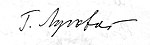 |


Content
Biography
Born April 27, 1900 in the family of the St. Petersburg merchant Ivan Lugovoi, who had five haberdashery stores. The family lived in a five-room apartment above their central store on the corner of Nevsky Prospekt and Uprising Square. In 1910, his father gave George the Kodak camera, from which his photographic biography began.
After the revolution, he worked as a disinfector in Petrograd dugouts and prisons. Hiding his non-proletarian origin, he entered the film and photo technical school, after which he worked at the UNION-PHOTO and PRESS-CLISH-PHOTO agencies - the forerunners of TASS. Lugovoi recalled this time as the most difficult thing for the photographer:
“It was especially difficult to shoot in the first years of work as a reporter. Photographic plates are very low sensitive. And therefore, in addition to Photocore, there is also a bulky tripod and a black cloak in the arsenal to bring sharpness to the frosted glass. So try to make a report with this daunting design. Sergei Mironovich or Kliment Efremovich will not wait. And no outbreaks ... " [2]
In 1942, despite his unapproachable age, he achieved conscription to the front. He was a photographer for the For the Motherland! Division of the 85th Red Banner Rifle Pavlovsk Division. During the blockade he took out photographic materials, exchanging them for bread [4] . The production of photographs took place under the strictest control of the employees of the Special Department; after the next editorial assignment, the negative was confiscated.
On February 24, 1945, with the support of a group of fighters, he entered the location of 141 rifle regiment, which was “in difficult combat conditions”, and photographed the soldiers admitted to the ranks of the CPSU (b), after which he returned safely. For this feat was awarded the medal "For Courage". [5] .
He was also awarded the medal "For the Defense of Leningrad" and "For Military Merit" [6] .
He left oral recollections of the unprecedented fact of the voluntary surrender of the 122nd infantry division of the Wehrmacht, developed by the two parliamentarians of the 141 rifle regiment of the Red Army, a few days before the signing of the Act of German surrender [7] .
After the war, he worked as a photojournalist for the Smena youth newspaper for 20 years, and after retiring, he collaborated with this publication as much as a freelance writer. Photographed until his very advanced age, until his hands began to tremble.
All his life after the revolution he lived in a Leningrad communal apartment. Until the last days I had a phenomenal memory: I recalled any event or fact with the smallest details: where I was shooting, what, on which camera and even what aperture and shutter speed I used. He died on June 29, 2001 in St. Petersburg.
Creative heritage
The negatives of G. I. Lugovoi are stored in the Central State Archive of Cinema and Photo Documents of St. Petersburg [8] , the Museum of the History of St. Petersburg [9] and the State Museum of Political History of Russia (Kshesinskaya Mansion) [10] .
G. I. Lugovoi left several thick notebooks of his memoirs, which are waiting for their publisher [11] .
Bibliography
- Bardin S. M. ... And the civilians put on their greatcoats. M .: "Soviet Russia", 1974. p.249.
- Lugovoi G.I. in the encyclopedia "Blockade of Leningrad", p.295: Melua A.I. "Blockade of Leningrad" (edited by S. G. Gumen); - M.; SPb. : publishing house "Humanism", 1999.
- Voloshina Victoria. “In our century, they didn’t do it like that. Izvestia 29.04. 2001.
- Markin Pavel. Century exposure. "Change", 08/07/2001.
- Chetverikov O. With the light hand of a reporter. “On Guard of the Motherland”, No. 103, 05/05/1990.
Notes
- ↑ "In our century, they didn’t take it like that." Newspaper Izvestia (Moscow) 04/29/2001 (inaccessible link)
- ↑ 1 2 Markin Pavel. Century exposure. “Change”, 08/07/2001
- ↑ Golden Pen Competition - Special and Extra-Nominal Prizes
- ↑ Chetverikov O. From the light hand of a reporter. “On Guard of the Motherland”, No. 103, 05/05/1990.
- ↑ Award sheet of Lugovoi G.I. (inaccessible link) . Date of treatment October 29, 2015. Archived March 13, 2012.
- ↑ Award sheet of Lugovoi G.I. (inaccessible link) . Date of treatment October 29, 2015. Archived March 13, 2012.
- ↑ Bardin S.M. ... And civilians put on their greatcoats
- ↑ Central State Archive of Film and Photo Documents of St. Petersburg
- ↑ According to the site of the Museum of the History of St. Petersburg , in the negatives section “a special place is occupied by the collection of negatives of the oldest Leningrad photographer G.I. Lugovoi, which depicts palace and park ensembles, groups of citizens”.
- ↑ State Museum of the Political History of Russia (official site)
- ↑ Markin Pavel. Century exposure. "Change", 08/07/2001.