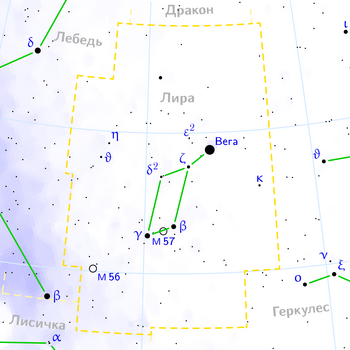
Lyra ( Guja . Лат , lat. Lyra , Lyr ) - a small constellation of the northern hemisphere, lying between Hercules and Swan .
| Lyra | |
|---|---|
  | |
| Lat. title | Lyra (to the genus. n .: Lyrae ) |
| Abbreviation | Lyr |
| Symbol | Lyra |
| Right ascension | 18 h 10 m to 19 h 24 m |
| Declination | from + 25 ° 30 ′ to + 47 ° 30 ′ |
| Area | 286 sq. M. degrees ( 52 place ) |
| The brightest stars ( value <3 m ) |
|
| Meteor showers |
|
| Nearby constellations |
|
| The constellation is visible in latitudes from + 90 ° to −42 °. | |
Content
- 1 Stars
- 2 Observation conditions
- 3 History
- 4 Lira in different cultures
- 5 See also
- 6 notes
- 7 Literature
- 8 References
Stars
The brightest star - Vega (α Lyra) - has a visible stellar magnitude of +0.03 m and is the second brightest star (after Arcturus ) in the northern hemisphere. Vega forms one of the corners of the Summer Triangle .
One of the interesting stars is Sheliak (β Lyra), which is an eclipsing variable star . The pulsating variable star RR Lyrae has given the name to the class of variable stars. Epsilon Lyra is a multiple star with four components.
Also in the constellation Lyra is the Nebula Ring (M57).
Observation conditions
In the middle latitudes of Russia, the constellation is visible all year round, but the best observation conditions are from May to October. It partially hides behind the horizon in winter (and completely in the south of Russia), but is visible immediately after sunset or before dawn. In the south of the former USSR, the constellation culminates in the zenith.
History
The ancient constellation. Included in the catalog of the starry sky Claudius Ptolemy " Almagest ". Lyra is a favorite musical instrument in Ancient Greece, and, obviously, that's why the myths are called by a number of owners of its prototype: Arion , Orpheus and Apollo , who received it from Hermes .
Vega translated from Arabic - "falling kite." It was believed that this was a kite, which Zeus sent to abduct the body of the Tartarian nymph Kamp near Briareus , when he was going to bring her insides as a sacred sacrifice. In ancient atlases, Lyra is often depicted in the claws of a kite.
Lear in various cultures
Lyra played a special role in the Inca mythology and astronomy , where it was called Urquchillay [1] .
The constellation Lyra is mentioned in the movie Planet Ka-Pax . Prot claims that he came in the light beam precisely from this constellation, the planet Ka-Pak.
In one of the fragments of the story “ Noon, XXII Century ”, the Strugatsky brothers talk about the flight of two planetary planes “Taimyr” and “Ermak” in the direction of the constellation Lyra . It was the First Interstellar Expedition, which began on November 7, 2017. The return of Taimyr in 2119 is also described in detail.
See also
- List of stars of the constellation Lyra
- Kepler-438 b
- Kepler-442 b
Notes
- ↑ Sources of the Incas, 2013 .
Literature
- Kuprienko S.A. Sources of the XVI-XVII centuries on the history of the Incas: chronicles, documents, letters / Ed. S.A. Kuprienko .. - K .: Vidavets Kuprіnko S.A., 2013 .-- 418 p. - ISBN 978-617-7085-03-3 .