A cube ( other Greek: κύβος [1] ) (sometimes a hexahedron [2] [3] or a regular hexahedron [4] [5] ) is a regular polyhedron , each face of which is a square . A special case of a parallelepiped and a prism .
| Cube | |||
|---|---|---|---|
 ( rotating model ) | |||
| Type of | regular polyhedron | ||
| Combinatorics | |||
| Items |
| ||
| Facets | squares | ||
| Vertex configuration | 4.4.4 | ||
| Dual polyhedron | regular octahedron | ||
Vertex figure
| |||
Scan
| |||
| Classification | |||
| Designations | |||
| Shlefly Symbol |
| ||
| 3 | 2 4 | |||
| Dynkin diagram |     | ||
| Symmetry group | |||
| Rotation group | |||
| Quantitative data | |||
| Rib length | |||
| Surface area | |||
| Volume | |||
| Dihedral angle | 90 ° | ||
| Solid angle at the top | |||


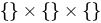


In various disciplines, the meanings of the term are used that are related to certain properties of the geometric prototype. In particular, in analytics ( OLAP analysis ), the so-called analytical multidimensional cubes are used , which make it possible to visually compare data from various tables.
Cube Properties
- The four sections of the cube are regular hexagons - these sections pass through the center of the cube perpendicular to its four main diagonals.
- A tetrahedron can be entered into a cube in two ways. In both cases, the four vertices of the tetrahedron will be aligned with the four vertices of the cube, and all six edges of the tetrahedron will belong to the faces of the cube. In the first case, all the vertices of the tetrahedron belong to the faces of the trihedral angle, the vertex of which coincides with one of the vertices of the cube. In the second case, the pairwise crossing edges of the tetrahedron belong to the pairwise opposite faces of the cube. Such a tetrahedron is correct, and its volume is 1/3 of the volume of the cube.
- An octahedron can be entered into the cube, moreover, all six vertices of the octahedron will be aligned with the centers of the six faces of the cube.
- The cube can be inscribed in the octahedron , and all eight vertices of the cube will be located at the centers of the eight faces of the octahedron.
- An icosahedron can be entered into the cube, while six mutually parallel edges of the icosahedron will be located on six faces of the cube, respectively, and the remaining 24 edges will be inside the cube. All twelve vertices of the icosahedron will lie on the six faces of the cube.
- The diagonal of a cube is the segment connecting two vertices symmetrical about the center of the cube. Length diagonals of a cube with an edge found by the formula
Notes
- ↑ Ancient Greek-Russian Dictionary of Butler's κύβος (Inaccessible link) . Date of treatment October 7, 2018. Archived December 28, 2014.
- ↑ Handbook of Elementary Mathematics / Vygodsky M. I .. - M .: AST, Astrel, 2006. - P. 383-384.
- ↑ English-Russian Dictionary of Mathematical Terms / Ed. P.S. Aleksandrova. - 2nd, corrected and add. ed .. - M .: Mir, 1994 .-- S. 129. - 416 p. - ISBN 5-03-002952-4 .
- ↑ Hexahedron // Mathematical Encyclopedia / I.M. Vinogradov. - 1977.- T. 1.
- ↑ Encyclopedia of Elementary Mathematics. Book 4 (geometry) / P.S. Aleksandrov, A.I. Markushevich, A. Ya. Khinchin. - GIFML , 1963 .-- S. 426.
See also
- Dice
- Rubik's Cube
- Doubling Cube
- N-dimensional cube ( hypercube )
- Marching cubes
- Cubes of catfish