Giacomo Girolamo Kazanova [* 1] ( Italian. Giacomo Girolamo Casanova ), Chevalier de Sengalt [* 2] ( April 2, 1725 , Venice - June 4, 1798 , Dux Castle , Bohemia ) - famous Italian adventurer , traveler and writer , author of detailed autobiography " The story of my life " ( Fr. Histoire de ma vie ) [1] . Thanks to this book, he was so famous for his numerous love affairs that his very name became a household name and is now used in the sense of “female deceiver”. According to his memoirs, Casanova met with European monarchs, popes , cardinals and such prominent figures of the Enlightenment as Voltaire , Mozart and Goethe . He spent his last years in Bohemia , being the supervisor of the library in the castle of Count Waldstein ; it was there that he wrote the story of his life.
| Giacomo Casanova | ||
|---|---|---|
| Giacomo casanova | ||
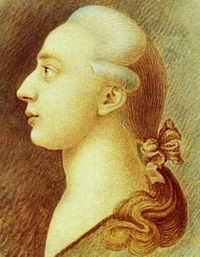 | ||
| Birth name | ||
| Date of Birth | April 2, 1725 | |
| Place of Birth | Venice | |
| Date of death | June 4, 1798 (73 years) | |
| Place of death | Duchtsov Castle , Czech Republic | |
| A country | ||
| Occupation | , , , , , , , , , | |
| Father | Gaetano Giuseppe Casanova (1697-1733) | |
| Mother | Zanetta Faroussi (1708–1776) | |
| Children | and | |
| Awards and prizes |
1760 | |

Biography
Early years
Giacomo Girolamo Casanova was born in Venice on Easter on April 2, 1725 in a house on Della Commedia Street (now Malipiero Street), not far from the church of Sts. Samuel, where he was baptized. He was the firstborn in the family of actor and dancer Gaetano Giuseppe Casanova (1697-1733) and actress Zanette Faroussi (1708-1776). He had five brothers and sisters: Francesco Giuseppe (1727–1803), Giovanni Battista (1730–1795), Faustina Maddalena (1731–1736), Maria Maddalena Anthony Stella (1732–1800) and Gaetano Alvizo (1734–1783). At that time, the Republic of Venice was considered the European “capital of pleasure”, since its rulers, being political and religious conservatives, were still tolerant of social vices and encouraged tourism. Venice was considered a must-see destination in the Grand Tour , performed by young aristocrats, especially the British. The famous Carnival , gambling houses and beautiful courtesans had a great attraction. This situation raised Casanova and made him one of the most famous Venetians of the XVIII century.
In childhood, Casanova was raised by his grandmother, Marcie Baldisser, while his mother toured with the theater in Europe. Father died when Giacomo was eight years old. As a child, Casanova suffered from nosebleeds, and Marcia turned to the witch for help: “Leaving the gondola, we entered the barn, where we found an old woman sitting on a straw mattress with five or six cats” [2] . Although the ointment applied by her was ineffective, the boy was delighted with the mystery of witchcraft [3] . Perhaps to cure bleeding, the cause of which, according to the doctors, was the increased air density of Venice, on his ninth birthday, Giacomo was sent to a boarding house located in Padua , farther away from the coast. This event was a bitter memory for Casanova, who took it as a neglect of his parents. “So they got rid of me,” he complains. [4]
The conditions in the hostel were terrible, so the boy asked him to take care of Abbot Gozzi, his first teacher, who taught him the sciences and the violin. In 1734, Giacomo moved to the priest and lived with him and his family in 1737 [5] . Gozzi’s house became the place where Casanova, at the age of eleven, had first contact with the opposite sex when Bettina, Gozzi’s younger sister, fondled with him: Bettina was “beautiful, cheerful, enthusiastic about reading novels ... I immediately liked the girl, although I didn’t quite understand why It was she who gradually sparked in my heart the first sparks of that feeling, which later became my main passion ” [6] . Bettina later married, but Casanova retained all her life of affection for her and the Gozzi family [7] .
Casanova early showed a keen and inquisitive mind, a giant craving for knowledge. In November 1737, when he was only twelve years old, he entered the University of Padua and graduated from it at the age of seventeen, in June 1742, receiving a degree in law, “to which ... he felt an irresistible disgust” [8] . His trustee hoped that he would become a church lawyer [9] . Kazanova also studied ethics, chemistry, mathematics, and, moreover, showed a genuine interest in medicine: “It would be better for me to be allowed to do what I wanted and become a doctor for whom professional charlatanism is even more suitable than in legal practice” [ 8] . He often prescribed his own medications for himself and his friends [10] . While studying, Casanova started gambling and quickly became indebted, as a result of which he was called to Venice, where he had an unpleasant conversation with his grandmother; but the habit of the game is firmly rooted in it.
Upon his return to Venice, Casanova began his career as a church lawyer, working for lawyer Manzoni, and after taking the veil, he was ordained novice to the Patriarch of Venice (January 1741) [5] . Continuing his university studies, he traveled to and from Padua. By that time, he had already become a real dandy : he was black-eyed, dark and high, powdered, scented and carefully curled with long black hair [* 3] . He quickly acquired a patron (as he did throughout his life), the 76-year-old Venetian senator Alviso Gasparo Malipiero, the owner of Palazzo Malipiero (near the house of Casanova in Venice) [13] . The senator, who rotated in the highest circles, taught Casanova how to behave in society and understand good food and wine. But when Casanova was caught flirting with actress Theresa Imer, which Malipiero himself wanted to seduce, the latter drove both of them from his home [7] . Casanova’s growing inquisitiveness towards women led him to his first sexual experience with two sisters, Nanette and Maria Savorian, fourteen and sixteen years old, who were distant relatives of the Grimani family. Casanova declared that his life calling was finally determined after that first experience [14] .
Beginning of adult life
Scandals overshadowed Casanova’s short career in church. After the death of his grandmother (March 18, 1743), Casanova briefly entered the seminary of sv. Cyprian in Murano , but already in April 1743 debts for the first time brought him to prison - the fort of sv. Andrew . The mother attempted to secure a place for him under Bishop Bernardo de Bernardis, but Casanova rejected this proposal almost immediately after visiting the Diocese of Calabria [15] . Instead, he settled in Rome as secretary of influential Cardinal (January 1744). At a meeting with his father, Giacomo boldly asked the high priest for permission to read "forbidden books" and to be freed from the requirement to eat fish in fasting, saying that such food causes eye inflammation in him. Casanova also helped another cardinal by composing love letters. But when Casanova became the “scapegoat” in a scandal involving a couple of unfortunate lovers, Cardinal Aquaviva dismissed Casanova, thanking him for his good deed, but thereby interrupting his church career forever [16] .
In search of a new field of activity, Casanova bought a patent officer of the Republic of Venice . First of all, he took care of looking appropriate:
Realizing that now I’m unlikely to succeed in the church field, I decided to try on the clothes of a soldier ... I requested a good tailor ... he brought me everything I needed to become an embodied follower of Mars ... My uniform was white, with a blue front and silver and gold epaulets ... I bought a long sword, and with my graceful cane in my hand, in a smart hat with a black cockade, with sideburns and a false tail, I set out to impress the whole city [17]
In August 1744, he joined the officers of the Venetian regiment of Corfu Island , from where he made a short trip to Constantinople [18] , allegedly with the aim of delivering a letter from his former owner, Cardinal [19] . He found his promotion too slow, duties boring, and managed to spend most of his salary playing pharaoh . In October 1745, Casanova interrupted his military career and returned to Venice.
At the age of twenty-one, he decided to become a professional player, but after losing all the money left over from the sale of an officer’s position, he turned to his old benefactor Alviso Grimani for help in search of work. Casanova begins his “third career”, already , as a violinist, “a servant of the highest art who is admired by those who succeeded and who are despised by mediocrity”. He recalled: “My occupation was not noble, but I did not care. Calling all prejudices, I soon acquired all the habits of my descended fellow musicians ” [20] . He and some of his colleagues "often spent ... nights, being in different quarters of the city, inventing the most scandalous draws and executing them ... having fun, untie the gondolas moored from private houses, which were then swept away by the flow." They also sent on the false calls of midwives and doctors [21] .
Fortuna again smiled at Casanova, dissatisfied with his fate as a musician, after he had saved the life of Venetian Senator Giovanni di Matteo Bragadin, who had been hit when he was returning from a wedding ball in the same gondola with Casanova. They immediately stopped to let the senator bleed. Then, already in the senator's palace, the doctor repeated the bloodletting and put mercury ointment on the patient's chest (at that time, mercury , despite its toxic properties, was considered a universal medicine). This led to a high fever , and Bragadin began to choke because of the swollen trachea. A priest had already been called, since death seemed inevitable. However, Casanova took the initiative in his hands, changing the course of treatment, and ordering, despite the protests of the doctor who was present, remove the mercury ointment from the senator’s chest and wash it with cold water. The senator recovered from the disease thanks to rest and healthy food [22] . Since, at a young age, Giacomo owned medical knowledge, the senator and his two friends decided that such a wise young man should have occult knowledge (all three were Kabbalists ). The senator adopted Casanova and became his lifelong patron [23] .
Casanova wrote in his memoirs:
I accepted the most commendable, noble, and the only natural way of living. I decided to put myself in a position in which I would not need to deprive myself of basic necessities. And no one could judge better what exactly was necessary for me than me ... No one in Venice could understand how there could be a close connection between me and three respected people: they are so sublime, and I, such mundane, they, the most strict in their morals, and I, leading a dissolute way of life [24] .
The next three years (from December 1745) Casanova spent under the auspices of the senator, formally listed as his referent. He lived like a nobleman, dressed beautifully and, what was natural for him, spent most of his time in gambling and immoral acts [25] . His patron was overly tolerant, but he warned Giacomo that eventually he would pay for such licentiousness; but he only "made fun of his terrible prophecies, without changing his way of life." However, the senator's adopted son still had to leave Venice because of even greater scandals. Casanova decided to take revenge on his foe by playing him, and for this he dug out the corpse of a recently buried man - but the victim of the rally was incurably paralyzed. In another case, one girl tricked her with rape and appealed to the authorities [26] . Later, Casanova was acquitted due to lack of evidence of his guilt, but by that time he had already escaped from Venice: he was charged with theft, blasphemy, and black magic (January 1749).
Leaving for Parma, Casanova began a three-month romance with a French woman, whom he called Henrietta. Apparently, it was the strongest love he had ever experienced: this lady united in herself beauty, intelligence, and good education. According to him, “those who believe that a woman cannot make a man happy twenty-four hours a day have never known Henrietta. The joy that filled my soul was much more during the day when I talked to her than at night when she was in my arms. Being very well read and possessing innate taste, Henrietta correctly judged everything ” [27] . She also shrewdly judged Casanova. The famous explorer of Casanova J. Raves Childs wrote:
Probably no woman captured Casanova so much as Henrietta; few women had such a deep understanding of it. She penetrated his outer shell at the very beginning of their connection, resisting the temptation to unite her fate with his. She solved his changeable nature, the lack of a noble origin and the unreliability of his finances. Before leaving, she shoved five hundred louisers into his pocket — a sign of her assessment of Casanova [28] .
Grand Tour
The whole of 1749, Casanova spent wandering in Italy ( Milan , Mantua , Cesena , Parma ). In despair and despair, he returned to the Republic of Venice, but, having won the big score card, he revived and went to the Grand Tour , reaching Paris in 1750 [29] . Along the way, following from one city to another, he became involved in amorous adventures, reminiscent of opera plots [30] . In Lyon, he became a member of the Masonic society , which attracted him with its secret rituals. The society attracted people with intelligence and influence, which later turned out to be very useful for Casanova: he received valuable contacts and access to hidden knowledge [31] . He also joined the Order of the Rose and the Cross .
Casanova stayed in Paris for two years, spending most of his time in the theater and learning French. He tied up with representatives of the Parisian aristocracy. But soon his numerous love affairs were noticed by the police (just as it was in almost every city he visited) [32] .
Casanova translated the Korouzak tragedy “ Zoroaster ” from French into Italian [33] , and in February 1752 they set it up at the Royal Theater of Dresden (Italian troupe ). In Dresden, he met his mother, brother and sister [34] . From autumn 1752 to May 1753, Giacomo traveled through Germany and Austria. At this time, he composed his own comedies "Thessalyn, or Harlequin on the Sabbath" and "Molukkeid" (in three acts, now lost). The latter was played at the Royal Theater of Dresden on February 22, 1753 and is well received by the public. He did not like the more strict moral atmosphere of Vienna and Prague . In 1753, he returned to Venice, where he resumed his antics, making a lot of enemies and drawing the attention of the Inquisition . His police record turned into a growing list of blasphemy, seduction, fights and quarrels in public places [35] . State spy Giovanni Manuchchi was brought in to find out about Casanova’s attitude to Kabbalism, his involvement in Freemasonry, and the existence of forbidden books in his library [36] . Senator Bragadin, himself a former inquisitor, urged his adopted son to leave immediately to avoid the most serious consequences [37] .
Prison and escape
The next day, July 26, 1755 (at the age of thirty), Casanova was arrested: “The Tribunal, having learned of serious crimes committed by J. Casanova publicly against the holy faith, decided to arrest him and put him in Piombi ( Lead Prison )” [ 38] [39] . This prison consisted of seven cells on the top floor of the eastern wing of the Doge’s Palace and was intended for high-profile prisoners and political criminals. It got its name from the lead plates that covered the roof of the palace. Casanova was sentenced without trial to five years of imprisonment in this prison, of which there had never been a single escape [40] . According to the memoirs of Casanova, substantial evidence of his guilt was that he was found the book Zohar ("Zekor-ben") and other books on magic [41] .
He was in solitary confinement, carrying clothes, a mattress, a table and a chair, in the “worst of all cells” [11] , where he suffered terribly from darkness, summer heat and “millions of fleas”. Soon he was placed with other prisoners, and after five months and the personal petition of Count Bragadin, he was given a warm winter bed and a monthly allowance for the purchase of books and good food. While walking through the prison loft, he found a piece of black marble and an iron bar, which he was able to carry to his cell. He hid the rod inside the chair. Temporarily being without cellmates, Casanova for two weeks sharpened this rod on the stone and turned it into a peak ( esponton ). Then he began to peck the wooden floor under his bed, knowing that his cell was directly above the inquisitor's office [42] . Casanova conceived an escape during the carnival, when none of the employees should have been in the office below him. But just three days before the scheduled date, despite his protests and assurances that he was completely happy where he had been all this time, Casanova was transferred to a larger, light-colored camera with a window. Here is what he wrote later about how I felt at the same time: “I was sitting in the chairs, as if struck by thunder, and immovable like a statue, realizing that all my works were dust, but I have nothing to repent of. Hope was taken away from me, and I could not give myself any other relief than to not think about what would happen next with me ” [43] .
Overcoming his despair, Casanova developed a new escape plan. He secretly contacted the prisoner from a nearby cell, Balbi's father (apostate priest), and arranged for help with him. Casanova succeeded in transmitting Balbi to the peak hidden in the Bible, on which the fooled jailer put a pasta dish. Balbi's father made an opening in the ceiling of his cell, climbed up and made a hole in the ceiling of Casanova's chamber. To neutralize his new cellmate spy, Casanova took advantage of his superstitions and thereby forced him to silence [44] . When Balbi made a hole in the ceiling of his cell, Casanova climbed through it, leaving a note with a quote from the 117th Psalm (on the Vulgate): “I will not die, but I will live and proclaim the works of the Lord” [45] .
The spy stayed inside, too frightened by the consequences if caught with the rest. Casanova and Balbi climbed through the lead plates onto the roof of the Doge’s Palace, enveloped in thick fog. Since the roof was too high above the nearest canal, the fugitives entered the building through a dormer window, breaking the grate above it and breaking it. On the roof, they found a long staircase, and with the help of a rope, which Casanova pre-made of sheets, descended into a room, the floor of which was seven and a half meters below. Here they rested until the next morning, and then changed their clothes, broke the lock on the exit door, walked past the galleries and rooms along the corridor of the palace and descended the stairs. Below, they convinced the guards that they had been mistakenly closed in the palace after the end of the working day, and left through the last door. It was six in the morning on November 1, 1756, when they took a gondola and sailed to the mainland [46] . In the end, Casanova arrived in Paris. It happened on January 5, 1757, on the very day when Robert-Francois Damien made an unsuccessful attempt on Louis XV [47] . Later, Casanova saw and described the cruel execution of the attacker [48] .
Skeptics argue that the escape of Casanova was incredible, and that he received freedom by bribing with the help of his patron. However, in the state archives some confirmations of the adventurer’s story remained, including information on the repair of the ceiling of the chambers. Thirty years later, Casanova wrote The Story of My Escape [49] , which became very popular and translated into many languages. He repeated the description of this event in his memoirs. Characteristic is Casanova’s judgment about this feat:
Thus, the Lord prepared everything necessary for me to escape, which was supposed to be, if not a miracle, then an event worthy of wonder. I admit, I am proud to have escaped; but my pride comes not from the fact that I managed to do this - there is a large amount of luck here, but from the fact that I considered it feasible and had the courage to bring my plan into execution [42] .
Back in Paris
He knew that his stay in Paris could be delayed, and therefore he began to act according to circumstances: “I saw that in order to succeed, I had to put all my talents, physical and spiritual, to reduce acquaintance with high-ranking and influential people, always control myself, to adopt the opinions of those who, as I see it, will have to like it ” [50] . Casanova became a mature man, and this time in Paris he was already more prudent and cautious, although at times he still relied on his decisive actions and quick thinking. His first task was to find a new patron. Such was his old friend de Bernie , now French foreign minister . De Bernie advised Casanova to find ways to raise money for the state to succeed quickly. Very soon, Giacomo became one of the managers of the first state lottery and the best seller of her tickets (the first edition of the lottery took place on April 18, 1758). This company immediately brought him significant benefits [51] . Having the money, he became acquainted with the high society and started new novels. With his occult he fooled many noble gentlemen, especially the marquise Jeanne d'Urfe: an excellent memory allowed him to introduce himself as a connoisseur of numerology . From the point of view of Casanova, “fooling a fool is a matter worthy of an intelligent person” [52] .
Casanova declared himself a Rosicrucian and an alchemist , which earned him popularity among the most prominent figures of the time, including the Marquis de Pompadour , Count Saint-Germain , Dalambert, and Jean-Jacques Rousseau . Alchemy , and in particular the search for the philosopher's stone , was so popular among the aristocracy that the demand for Casanova with his notorious knowledge was great, and he earned a good deal of it [53] . However, he met a competitor in the person of Count Saint-Germain: “This unusual man, a born deceiver, without any embarrassment, as something that goes without saying, he said he was three hundred years old, and he owns a panacea for all diseases, that nature has there are no secrets from him, and he knows how to smelt diamonds and from ten to twelve small ones make one big, of the same weight and, moreover, of the purest water. ” [54]
De Bernie decided to send Casanova to Dunkirk with a spy mission (August-September 1757). Giacomo was well paid for his short work, which prompted him to make one of the few comments against the old regime and the class on which his own well-being depended. Looking back at the past, he remarked: “All French ministers are the same. They squandered money from other people's pockets to enrich themselves, and their power was unlimited: people from the lower classes were considered nothing, and the inevitable results of this were state debts and a breakdown of finances. A revolution was necessary. ” [55]
With the beginning of the Seven Years War , Giacomo was again turned to for help in replenishing the treasury. He was entrusted with the mission of selling government bonds in Amsterdam , since the Netherlands at that time was the financial center of Europe [56] . He managed to sell bonds at a discount of only eight percent (October - December 1758) [57] , and his earnings allowed him to establish a silk manufactory for the next year [58] . The French government even promised him a title and pension if he accepted French citizenship and started working for the Ministry of Finance, but Casanova declined this flattering offer - perhaps because it would prevent his passion for travel [59] . Casanova reached the apogee of his fate, but could not hold on to it.He poorly managed his business, got into debt, trying to save him, and spent most of his fortune in continuous communication with the workers of his manufactory, whom he called his “ harem ” [60] .
За долги Казанова был снова арестован и на этот раз заключён в тюрьму , но был освобожден из неё спустя четыре дня благодаря заступничеству маркизы д'Юрфе. К несчастью Джакомо, его покровитель де Берни к тому времени был уволен Людовиком XV , и враги Казановы стали преследовать его. Стремясь отдалиться от этих неприятностей, авантюрист продал остатки своего имущества и добился своей второй отсылки со шпионскими целями в Голландию , куда и отбыл 1 декабря 1759 года [61] .
В бегах
Однако на этот раз его миссия провалилась, и он бежал в Кёльн , а затем (весной 1760 года) в Штутгарт , где удача окончательно отвернулась от него. Он был вновь арестован за долги, но смог сбежать в Швейцарию . Устав от своей распутной жизни, Казанова посетил монастырь в Айнзидельне , где задумался о возможности изменить свою долю и стать скромным высокообразованным монахом. Он вернулся в гостиницу, чтобы поразмышлять о своих намерениях, но там встретил новый объект вожделения, и все его благие помыслы о монашеской жизни тотчас улетучились, уступив место привычным инстинктам [62] . Продолжив странствия, он посетил Альбрехта фон Галлера [63] и Вольтера [64] (последнего дважды), затем побывал в Марселе , Генуе , Флоренции , Риме , Неаполе , Модене и Турине , затевая по пути любовные авантюры [65] .
В 1760 году Казанова начал называть себя «шевалье де Сенгальт» [* 4] — именем, которым он будет всё чаще пользоваться до конца жизни. Иногда он представлялся графом де Фарусси (по девичьей фамилии матери), а с тех пор как папа Климент XIII наградил его орденом Золотой шпоры и званием папского протонотария , на его груди красовался впечатляющего вида крест на ленте [66] .
В 1762 году, вернувшись в Париж, он затеял свою самую возмутительную аферу — убедить свою старую жертву маркизу д'Юрфе в том, что он сможет при помощи оккультных сил превратить её в юношу. Однако этот план не принёс Казанове ожидаемой прибыли, а маркиза д'Юрфе окончательно разуверилась в нём [67] [68] .
В июне 1763 года Казанова отправился в Англию , надеясь продать её властям идею государственной лотереи. Об англичанах он пишет так: «эти люди имеют особенное свойство, присущее всей нации, которое заставляет их считать себя превыше всех остальных. Эта вера является общей для всех наций, каждая из которых считает себя наилучшей. И все они правы» [69] . Опираясь на свои связи и потратив бо́льшую часть драгоценностей, украденных им у маркизы д'Юрфе, он добился аудиенции у короля Георга III . «Обрабатывая» политических деятелей, Казанова, как обычно, не забывал и об амурных похождениях. Не говоря как следует по-английски, но желая найти женщин для своих удовольствий, он поместил в газету объявление о том, что «порядочный человек» снимет квартиру. Он опросил многих молодых женщин, пока не остановился на «госпоже Полине», которая его устроила. Вскоре Казанова поселился в её квартире и соблазнил хозяйку. Многочисленные интимные связи наградили его венерическим заболеванием , и в марте 1764 года, будучи обвинённым в мошенничестве, Джакомо, разорённый и больной, покинул Англию [70] [71] .
Казанова уехал в Бельгию , где оправился от болезни и пришёл в себя. В последующие три года он странствовал по Европе, проехав около 4500 миль в карете по плохим дорогам и добравшись до Москвы и Санкт-Петербурга (в среднем карета могла преодолевать до 30 миль в сутки). И вновь его главной целью было продать свою схему лотереи правительствам других стран, повторив тот большой успех, который эта затея имела во Франции. Но встреча с Фридрихом Великим (август 1764 г.) ничего ему не принесла [72] , так же, как и посещение других немецких земель. В 1765 году полезные знакомства и уверенность в успехе задуманного привели Казанову в Россию , к Екатерине Великой , но императрица категорически отклонила идею лотереи [73] .
В 1766 г. его изгнали из Варшавы после дуэли на пистолетах (5 марта 1766 г.) с полковником графом Браницким [74] , спровоцированной приятельницей обоих, первой танцовщицей варшавского театра Бинетти из-за её соперничества с другой танцовщицей, королевской фавориткой Катериной Катаи Томатис . Оба дуэлянта были ранены, Казанова — в левую руку. Рука зажила сама после того, как Казанова отверг рекомендации докторов ампутировать её [75] . Куда бы он ни приезжал, ему так и не удавалось найти покупателя своей лотереи. В 1767 году его заставили покинуть Вену (за шулерство ). В том же году, возвратившись на несколько месяцев в Париж, он ударился в азартные игры, но и эта поездка закончилась плачевно: в ноябре он был изгнан из Франции личным приказом Людовика XV (главным образом, из-за его аферы с маркизой д'Юрфе) [76] . Теперь, когда дурная слава о его безрассудном поведении прошла по Европе, ему уже сложно было преодолеть её и добиться успеха. Поэтому он направился в Испанию , где о нём почти не знали. Он попробовал применить свой обычный подход, полагаясь на свои знакомства (в основном, среди масонов), выпивая и обедая с высокопоставленными лицами и в конце концов пытаясь получить аудиенцию у монарха, в данном случае, у короля Карла III . Но так ничего и не добившись, он был вынужден безуспешно колесить по Испании ( 1768 ). В Барселоне его едва не убили, и он оказался в тюрьме на шесть недель. Там он написал «Опровержение „Истории Венецианского государства“ Амело де ла Уссе » [77] . Потерпев неудачу в своем испанском турне, он возвращается во Францию, а затем и в Италию ( 1769 ) [78] .
Возвращение в Венецию
Казанова жил в нескольких городах Италии. Он вспоминал: «В начале апреля 1770 года я задумал попытать счастья и отправиться в Ливорно , чтобы предложить свои услуги графу Алексею Орлову , командовавшему эскадрой, которая направлялась в Константинополь» [80] . Но граф Орлов отказался от его помощи, и Джакомо уехал в Рим.
В Риме Казанова должен был подготовить своё возвращение в Венецию. Ожидая, пока его сторонники добудут для него разрешение на въезд, Казанова начал переводить на итальянский язык « Илиаду » [81] , писать книгу «История смуты в Польше» [82] и комедию. Его принимают в литературных академиях — Аркадианской и (1771). В декабре 1771 года его выслали во Флоренцию , откуда он перебрался в Триест . Чтобы снискать расположение венецианских властей, Казанова занялся коммерческим шпионажем в их пользу. Однако, выждав несколько месяцев, но так и не получив разрешения на въезд, он написал напрямую инквизиторам. Наконец, долгожданное разрешение было прислано, и, разрыдавшись от волнения, Джакомо прочёл: «Мы, государственные инквизиторы, по известным нам причинам даём Джакомо Казанове свободу … наделяя его правом приезжать, уезжать, останавливаться и возвращаться, иметь связи где ему будет угодно без разрешения и помех. Такова наша воля». Казанове было позволено вернуться в Венецию в сентябре 1774 года, после восемнадцати лет изгнания [83] .
Поначалу он был сердечно принят и стал знаменитостью. Даже инквизиторы пожелали узнать, как ему удалось сбежать из их тюрьмы. Из трёх его покровителей только Дандоло был ещё жив, и Казанова был приглашён поселиться у него. Он получал небольшое пособие от Дандоло и надеялся жить продажей своих сочинений, но этого оказалось недостаточно. И он скрепя сердце продолжил заниматься шпионажем в пользу правительства Венеции. Его доклады оплачивались сдельно и касались вопросов религии, морали и коммерции; по большей части они основывались на слухах и сплетнях, полученных от знакомых [84] . Он был разочарован, поскольку не видел для себя заманчивых финансовых перспектив, и для него были открыты лишь немногие двери — так же, как и в прошлом.
Когда Джакомо исполнилось сорок девять, в его облике проявились черты, говорящие о годах безрассудной жизни и тысячах пройденных им миль. Оспины, ввалившиеся щёки и крючковатый нос становились всё более заметными. Его развязные манеры стали более сдержанными. Князь Шарль-Жозеф де Линь , друг Казановы (и дядя его будущего работодателя), так описал его в период около 1784 года [85] :
Он был бы красив, когда бы не был уродлив: высок, сложен как Геркулес, лицо смуглое; в живых глазах, полных ума, всегда сквозит обида, тревога или злость, и оттого-то он кажется свирепым. Его проще разгневать, чем развеселить, он редко смеется, но любит смешить; его речи занимательны и забавны, в них есть что-то от паяца Арлекина и от Фигаро.
Оригинальный текст (фр.)Ce serait un bien bel homme s'il n'était pas laid ; il est grand, bâti en Hercule, mais a un teint africain ; des yeux vifs, pleins d'esprit à la vérité, mais qui annoncent toujours la susceptibilité, l'inquiétude ou la rancune, lui donnent un peu l'air féroce, plus facile à être mis en colère qu'en gaieté. Il rit peu, mais il fait rire. Il a une manière de dire les choses qui tient de l'Arlequin balourd et du Figaro, ce qui le rend très plaisant [86] .
Венеция переменилась для Казановы. Теперь у него было мало денег для азартных игр, мало сто́ящих женщин, желающих его, мало знакомых, чтобы оживлять его скучные дни. До него дошли известия о смерти матери (в Дрездене в ноябре 1776 года). Ещё более горькие чувства он испытал, когда навестил умирающую Беттину Гоцци: женщина, которая когда-то познакомила его с интимными ласками, теперь скончалась у него на руках. Его « Илиада » [81] была издана в трёх томах (1775—1778), но для ограниченного числа подписчиков, и принесла мало денег. Казанова затеял публичный диспут с Вольтером о религии, опубликовав «Размышления над „Похвальными письмами г-ну Вольтеру“» [87] . Когда он спросил: «Предположим, Вам удастся разрушить суеверие. Чем Вы его замените?» — Вольтер ответил: «Как это мне нравится! Когда я освобожу человечество от свирепого чудовища, пожирающего его, неужели меня спросят о том, чем я заменю его?» С точки зрения Казановы, если Вольтер «был истинным философом, ему следовало бы хранить молчание об этом предмете… народ должен пребывать в невежестве для сохранения общего спокойствия в стране» [88] .
В 1779 году Казанова встретил Франческу Бускини, необразованную швею, которая стала его сожительницей, домохозяйкой, и беззаветно полюбила его [89] . В том же году инквизиторы назначили ему постоянную заработную плату, дав задание исследовать торговлю между Папской областью и Венецией. Его прочие затеи, связанные с публикацией своих произведений и театральными постановками, потерпели неудачу — в основном, из-за нехватки средств. Что хуже, в январе 1783 года Казанове снова пришлось покинуть Венецию, поскольку его предупредили, что над ним нависла угроза официального изгнания или заключения в тюрьму [90] из-за сочинённой им желчной сатиры [91] , высмеивающей венецианских патрициев (главным образом, Карло Гримани, который поступил непорядочно по отношению к Джакомо [90] ). Это произведение содержит единственное публичное признание автора в том, что его настоящим отцом, возможно, был венецианский патриций (считающийся отцом его обидчика Карло [90] ) [92] .
Вынужденный возобновить свои странствия, Казанова прибыл в Париж, и в ноябре 1783 года, во время доклада, посвящённого воздухоплаванию , встретился с Бенджамином Франклином [93] . С февраля 1784 по апрель 1785 года Казанова служил секретарём Себастьяна Фоскарини, венецианского посла в Вене. Он также познакомился с Лоренцо да Понте , либреттистом Моцарта , который написал о Казанове: «этот необычный человек никогда не любил оказываться в неловком положении» [94] . Записи Казановы свидетельствуют о том, что, возможно, он давал Да Понте советы, касающиеся либретто оперы Моцарта « Дон Жуан » [95] .
Последние годы в Богемии
В 1785 году, после смерти Фоскарини, Казанова начал подыскивать себе другое место. Несколько месяцев спустя он стал смотрителем библиотеки графа Йозефа Карла фон Вальдштейна , камергера императора, в замке Дукс в Богемии ( Духцовский замок , Чехия ). Граф, будучи сам франкмасоном, каббалистом и заядлым путешественником, привязался к Казанове, когда они встретились годом ранее в резиденции посла Фоскарини. Хотя служба у графа Вальдштейна обеспечила Казанове безопасность и хороший заработок, он описывает свои последние годы как принесшие скуку и разочарование, хотя они оказались самыми продуктивными для его творчества [96] . Его здоровье сильно ухудшилось, и он находил жизнь среди крестьян лишённой вдохновения. Он мог только время от времени ездить в Вену и Дрезден для отдыха. Хотя Казанова был в хороших отношениях с работодателем, тот был значительно моложе его и имел свои прихоти. Граф часто игнорировал его за столом и не знакомил с важными гостями. Более того, Казанова, вспыльчивый чужак, вызывал к себе сильную неприязнь со стороны других обитателей замка. Казалось, единственными друзьями Джакомо были его собственные фокстерьеры . В отчаянии Казанова задумался было о самоубийстве, но затем решил жить, чтобы записать свои мемуары, чем он и занимался до самой смерти [96] [97] .
В 1797 г. до Казановы дошли сведения о том, что Республика Венеция прекратила своё существование и захвачена Наполеоном Бонапартом . Но было слишком поздно возвращаться домой. Казанова умер 4 июня 1798 года, в возрасте семидесяти трёх лет. Как передают, его последними словами были: «Я жил как философ и умираю христианином» [98] .
Family
Мать Казановы, Дзанетта Мария Казанова, урождённая Фарусси (1708—1776), была актрисой. Братья Джакомо Казановы — Франческо (1727—1802 (1803?)) и Джованни Баттиста (1732—1795) стали известными деятелями искусств. Франческо был художником-пейзажистом, а Джованни Баттиста занимался портретной живописью и археологией; его книга о древнем искусстве была переведена на немецкий. Младший брат, Гаэтано Алвизо Казанова (1734—1783), был священником в Генуе. Танцовщица Дрезденского театра Мария Магдалина Казанова (1732—1800), жена придворного музыканта Петера Августа, приходилась сестрой Казанове.
Creativity
Memoirs
Одиночество и скука последних лет жизни позволили Казанове, не отвлекаясь, сосредоточиться над своими мемуарами, озаглавленными «История моей жизни» ( фр. Histoire de ma vie [1] ) — не будь этого произведения, его известность была бы намного меньшей, если бы память о нём не исчезла совсем. Ещё в преддверии 1780 года он задумал написать свои воспоминания. В 1789 году он серьёзно приступил к этому труду как к «единственному лекарству, чтобы не сойти с ума и не умереть с тоски». Первый черновик был закончен к июлю 1792 года, и он правил его последующие шесть лет. Он выставляет дни своего одиночества счастливым временем, записывая в своём труде: «Я не могу найти более приятного времяпрепровождения, нежели беседовать с самим собой о своих собственных занятиях, выбирая из них то, что может позабавить мою почтенную аудиторию» [52] . Его воспоминания доходят только до лета 1774 года [99] . Ко времени его смерти рукопись всё ещё была в работе. Его письмо, датированное 1792 годом, свидетельствует о том, что он сомневался, стоит ли публиковать её, поскольку находил историю своей жизни жалкой и осознавал, что может нажить врагов, рассказывая правду о своих приключениях. Но всё же он решил продолжить работу, используя инициалы вместо полных имён и смягчив наиболее откровенные эпизоды. Он писал на французском вместо итальянского: «французский язык более распространён, нежели мой собственный» [100] .
Мемуары открываются так:
Я начинаю, сообщая своему читателю, что судьба уже воздала мне по заслугам за всё то хорошее или плохое, что я совершал в течение своей жизни, и потому я вправе считать себя свободным… Вопреки возвышенным моральным началам, неотвратимо порождённым божественными принципами, укоренёнными в моём сердце, всю жизнь я оставался рабом своих чувств. Я испытывал наслаждение от того, что сбивался с пути, я постоянно жил неправильно, и единственным моим утешением было лишь то, что я осознавал свои прегрешения… Мои безрассудства суть безрассудства юности. Вы увидите, что я смеюсь над ними, и если вы доброжелательны, то позабавитесь над ними вместе со мной [101] .
Казанова писал о цели своей книги:
Я надеюсь на дружеские чувства, уважение и благодарность моих читателей. Они будут мне благодарны, если чтение этих мемуаров станет поучительным и доставит им удовольствие. Они будут уважать меня, если, воздав мне по справедливости, найдут, что я имею более добродетелей, нежели грехов; и я заслужу их дружбу, как только они увидят, с какой искренностью и честностью я отдаю себя на их суд, ничего о себе не скрывая [102] .
Он также сообщает читателям, что рассказывает далеко не обо всех своих приключениях: «Я опустил те из них, которые могли задеть людей, принимавших в них участие, так как они предстали бы не в лучшем свете. Тем не менее, найдутся такие, кто посчитает, что я порой бестактен; и я прошу прощения за это» [103] . В последней главе текст неожиданно прерывается, намекая на неописанные события: «Через три года я встретил её в Падуе и там возобновил знакомство с её дочерью куда более нежным образом» [104] .
Мемуары занимают приблизительно 3 500 страниц в десяти томах (первый редактор текста Жан Лафорг разделил их на двенадцать томов) [* 5] . Несмотря на то, что хронология событий временами страдает беспорядочностью и неточностью, а ряд историй — преувеличением, всё же основная канва сюжета и многие подробности подтверждаются в трудах современников. Казанова хорошо воспроизводит диалоги и подробно пишет обо всех классах общества [105] . Казанова по большей части откровенно признаётся в своих грехах, намерениях и мотивах, он с юмором относится к своим успехам и провалам [106] . Его признания, как правило, свободны от сожалений или раскаяния. Казанова прославляет чувственные удовольствия, особенно музыку, еду и женщин. «Я всегда любил остро приправленную пищу… Что касается женщин, я всегда находил, что та, в которую я был влюблён, хорошо пахла, и чем больше она потела, тем более сладким мне это казалось» [107] . Он упоминает не менее чем о ста двадцати связях с женщинами и девушками и несколько раз вскользь намекает на отношения с мужчинами [108] [109] . Он описывает свои дуэли и конфликты с негодяями и официальными лицами, свои заключения и побеги, интриги и махинации, муки и вздохи удовольствия. Он убедителен, когда говорит: «Я могу сказать vixi (я пожил)» [110] .
Рукопись мемуаров хранилась у родственников Казановы, пока не была продана издательству Ф. А. Брокгауза . Впервые она была опубликована в сильно сокращённом немецком переводе в 1822—1828 годах, а затем на французском языке в обработке Ж. Лафорга . В редакции Лафорга были значительно сокращены описания сексуальных похождений (в частности, из текста выброшены все гомосексуальные эпизоды), а также изменена политическая окраска мемуаров — из католика и убеждённого оппонента революции, каким Казанова был в действительности, он превратился в политического и религиозного вольнодумца. Во время Второй мировой войны рукопись пережила бомбардировку Лейпцига союзниками. Мемуары были переведены приблизительно на двадцать языков. Полный французский оригинал был издан лишь в 1960 году, а спустя ещё полвека Национальная библиотека Франции выкупила рукопись и начала переводить её в цифровой вид [111] .
Другие сочинения
Джакомо Казанова является автором более двадцати сочинений, включая комедию «Молюккеида» [112] , трёхтомную «Историю смуты в Польше» [82] , пятитомный утопический роман «Икозамерон» [113] — одно из самых ранних научно-фантастических произведений — а также ряда переводов, в том числе «Илиады» [81] Гомера (1775—1778). Интерес представляют письма авантюриста и предложенные Казановой оригинальные решения сложных геометрических задач [114] [115] .
Отношения с женщинами
Для Казановы и современных ему сибаритов из высшего света любовь и интимные отношения чаще всего были случайными, не обременёнными той серьёзностью, которая была свойственна романтизму XIX века [116] . Заигрывания, любовные утехи, кратковременные связи были делом обычным для представителей благородного сословия, которые вступали в брак скорее ради полезных связей, нежели из-за любви.
Будучи многогранной и сложной, личность Казановы находилась под властью чувственных страстей, как он сам повествует: «Потворствование всему, что давало наслаждение моим чувствам, всегда было главным делом моей жизни; я никогда не находил более важного занятия. Чувствуя, что я был рождён для противоположного пола, я всегда любил его и делал всё, что мог, чтобы быть любимым им» [107] . Он упоминает, что иногда использовал «предохранительные колпачки» , предварительно проверяя их целостность надуванием, для предотвращения беременности своих любовниц.
Идеальная связь для Казановы включала в себя не только интимные отношения, но и сложные интриги, героев и злодеев, и галантное расставание. Существовала схема, которую он часто повторял:
- Действие первое : он находил привлекательную женщину, страдающую от грубого или ревнивого любовника;
- Действие второе: Казанова избавляет её от затруднения;
- Действие третье: она выказывает свою благодарность; он соблазняет её; завязывается недолгий бурный роман;
- Действие четвертое: чувствуя наступающее охлаждение любовного пыла или скуку, он признаётся в своей несостоятельности и устраивает замужество любовницы или сводит её с богатым мужчиной, покидая за этим сцену [117] .
Как замечает Уильям Болито в «Двенадцати против Бога», секрет успеха Казановы у женщин «не содержал в себе ничего более эзотерического , чем [предложить] то, что требует каждая уважающая себя женщина: всё что он имел, всё чем он был, с ослепительным подарком в виде крупной денежной суммы (чтобы компенсировать отсутствие законности) вместо пожизненного содержания» [118] .
Казанова поучает: «Нет такой честной женщины с неиспорченным сердцем, какую мужчина не завоевал бы наверняка, пользуясь её благодарностью. Это один из самых верных и быстрых способов» [119] [* 6] . Алкоголь и насилие не были для него пристойными средствами соблазнения [121] . Наоборот, внимательность, небольшие любезности и услуги должны быть употреблены для смягчения женского сердца, но «мужчина, говорящий о своей любви словами, есть дурак». Вербальная коммуникация необходима — «без слов удовольствие от любви сокращается не менее чем на две трети» — но слова любви должны подразумеваться, а не напыщенно объявляться [119] .
Взаимное согласие важно, по мнению Казановы, но он избегал лёгких побед или слишком сложных ситуаций, считая их неподходящими для своих целей [121] . Он стремился быть идеальным спутником: остроумным, очаровательным, надёжным, любезным, — в Действии первом, прежде чем переместиться в спальню в Действии третьем. Казанова заявляет, что он не вёл себя подобно хищнику: «В мои правила никогда не входило направлять свои атаки против неискушённых или тех, чьи предрассудки скорее всего оказались бы препятствием». Однако завоёванные им женщины по большей части имели непрочное положение или были эмоционально уязвимыми [122] .
Казанова ценил ум женщины: «В конце концов, красивая, но глупая женщина оставляет своего любовника без развлечений после того, как он физически насладился её привлекательностью». Однако его отношение к образованным женщинам было типичным для того времени: «Для женщины обучение неуместно; оно ставит под удар основные качества её пола… ни одно научное открытие не было сделано женщинами… (это) требует энергичности, которой нет у женского пола. Но в простом рассуждении и в тонкости чувств мы должны отдать должное женщинам» [27] .
Во вступительной статье к русскому изданию мемуаров Казановы А. Ф. Строев пишет:
…"донжуанский список" Казановы может поразить воображение только очень примерного семьянина: 122 женщины за тридцать девять лет. Конечно, подобные списки у Стендаля и у Пушкина покороче, и в знаменитых романах тех лет, к которым пристало клеймо «эротические» (как, например, к увлекательнейшему « Фобласу » Луве де Кувре , 1787—1790), героинь поменьше, но так ли это много — три любовных приключения в год? [123]
Казанова и азартные игры
Азартные игры были обычным средством досуга в общественно-политических кругах, в которых вращался Казанова. В своих мемуарах он рассуждает о многих азартных играх XVIII столетия , включая лотерею , фараон , бассет, пикет, приму, , вист , бириби [124] , и о страсти к ним со стороны аристократии и духовенства [125] . К шулерам относились с большей терпимостью, нежели в настоящее время, и они редко подвергались публичному порицанию. Большинство игроков остерегалось шулеров и их трюков. Всевозможные мошенничества были в ходу, и Казанова забавлялся ими [126] .
Casanova played throughout his adult life, winning and losing large sums of money. He was trained by professionals, and he was "taught to those wise maxims, without which gambling crushes those who play in them." He could not always refuse to cheat, and at times he even teamed up with professional players to make money. Casanova states that he was "calm and smiling when he lost, and was not greedy when he won." However, sometimes in a strange way he was deceiving himself, and then his behavior was violent, even to the challenges of a duel [127] . Casanova admits that he lacked endurance to become a professional player: “I was deprived of sufficient prudence to stop when fate was against me, and did not control myself when I won” [128] . He also didn’t like to be professional: “Professional players cannot testify in any way that I was from their hellish clique” [128] . Although Casanova sometimes prudently used the game for his own purposes - to quickly get money, to flirt, make connections, act as a gallant cavalier, or to put himself an aristocrat before the high society, he could also play with maniacal passion and without calculation, especially being in the euphoria of a new love affair. “Why did I play when I was so keenly aware of the loss? Greed made me play. I enjoyed spending money, and my heart was bleeding when this money was not won into cards. ”
Reputation and authority of Casanova
Contemporaries considered Giacomo an outstanding personality, a highly intellectual and inquisitive person. Casanova was one of the outstanding chroniclers of his era. He was a true adventurer who crossed Europe from end to end in search of luck, an adventurer who met his most distinguished people of the 18th century to fulfill his intentions. A servant of those in power, and at the same time a bearer of aesthetics and morality new to his age, he was a member of secret societies and sought the truth beyond the framework of traditional ideas. Being a religious, earnest Catholic, he believed in prayer: “Despair kills; prayer dispels him; after prayer, a person believes and acts. ” But just as in prayer, he believed in free will and mind, and clearly did not agree with the statement that the craving for pleasure would not let him go to heaven [129] .
Born in the family of actors, Giacomo had a passion for the theater and theatrical life full of improvisations. But with all his talents, he often set off in pursuit of entertainment and bodily pleasures, often deviating from a stable job and making himself trouble where he could succeed if he acted prudently. His true vocation was to live, relying on his resourcefulness, nerves of steel, luck, charm, and money received as a token of gratitude or through deception [130] .
Prince Charles-Joseph de Lin , who understood Casanova well and was familiar with most of the prominent people of his era, considered him the most interesting person he had ever met: "there was nothing in the world that he could not do." Completing the portrait of an adventurer, de Lin testified [131] :
The only things about which he knew nothing were those in which he considered himself a connoisseur: the rules of dance, the French language, good taste, the structure of the world, the rules of good form. Only his comedies are not funny; only his philosophical writings lack philosophy — all others are filled with it; there is always something weighty, new, piquant, deep. He is a storehouse of knowledge, but quotes Homer and Horace to nausea. His mind and his sharpness are like Attic salt. He is sensual and generous, but grieve at least something - and he becomes unpleasant, vindictive and disgusting ... He does not believe in anything, but only in the incredible, being superstitious in everything. Fortunately, he has the honor and tact ... He loves. He is eager to get everything ... He is proud because he doesn’t represent anything ... Never tell him that you know the story he is going to tell you - pretend to hear it for the first time ... Never forget to pay your respects to him, otherwise for this trifle, you risk to make yourself an enemy. - Charles Joseph de Ligne. Mémoires et mélanges historiques et littéraires, t. 4 - Paris, 1828 [132] .
Original text (fr.)Il n'y a que les choses qu'il prétend savoir qu'il ne sait pas: les règles de la danse, de la langue française, du goût, de l'usage du monde et savoir-vivre. Il n'y a que ses comédies qui ne soient pas comiques; n a que s que que ou ou ou t t t t t t t t t t t t il ya toujours du trait, du neuf, du piquant et du profond. C'est un puits de science; mais il cite si souvent Homère et Horace, que c'est de quoi en dégoûter. Sa tournure d'esprit et ses saillies un extrait de sel attique. Il est sensible et reconnaissant; mais pour peu qu'on lui déplaise, il est méchant, hargneux et détestable ... Il ne croit à rien, excepté ce qui est le moins croyable, étant superstitieux sur tout plein d'objets. Heureusement qu'il a de l'honneur et de la délicatesse ... Il aime. Il convoite tout ... Il est fier, parce qu'il n'est rien et qu'il n'a rien ... ne lui dites jamais qui vous savez l'histoire qu'il va vous conter; ayez l'air de l'entendre pour la premiere fois ... Ne manquez pas de lui faire la révérence, car un vien en fera un ennemi ...
It is difficult to imagine a person more multifaceted than Giacomo Casanova: lawyer and cleric, military and violinist, crook and pimp, gourmet and business man, diplomat and spy, politician and doctor, mathematician, philosopher and kabbalist, playwright and writer. His creative legacy includes more than twenty works, including plays and essays, as well as many letters.
The image of Casanova in culture
Casanova is primarily associated with ideas about his love affairs. His name, which has become a household name, is on a par with such literary characters as Don Juan or “contemporaries” of Casanova - Lovelace and Foblas . Indeed, the memoirs of Casanova, which correspond to the philosophy of libertinism , do not bypass the sexual side of his odyssey, while distorting some facts: for example, studies have shown that Casanova’s repeated hints of incest with his own daughters are chronologically improbable [133] . However, the real personality of Casanova is far from being reduced to his erotic escapades, she is much more complicated and interesting. In a whole series of studies at the end of the 20th century, an attempt was made to draw a more holistic image of Casanova, an educated, intelligent, observant and resourceful adventurer.
The extraordinary success of “The Story of My Life ”, due to the abundance of adventures and amorous adventures unfolding against the background of a panoramic display of the widest layers of European society of the 18th century , turned the figure of Casanova into one of the legends of world culture. Stendal , G. Heine , A. de Musset , E. Delacroix , Sainte-Beuve were delighted with his memoirs. Fyodor M. Dostoevsky , who published in his journal “Time” [* 7] the story of the escape from Piombi , in the editorial introduction called Casanova one of the most remarkable personalities of his century and praised his writing gift and strength of mind: “This is a story about human triumph will over obstacles nonconquerable . "
In fiction
- The characters of such literary works as “ The Queen of Spades ” by A. S. Pushkin (1833) and “ Uncle's Dream ” by F. M. Dostoevsky (1859) talk about the notes of Casanova.
- R. Auldington ’s novels, plays by A. Schnitzler , M. Tsvetaeva , V. Korkiy and A. Lavrin (“Casanova: Lessons of Love”), an essay by S. Zweig , R. Vayan , F. Marceau , a book by F. Sollers are devoted to the famous adventurer. Casanova the Magnificent (1998).
In the theater
- Casanova - the hero of the operetta J. Strauss Jr. , the opera Domenica Argento .
In the cinema
- - Ivan Mozzhukhin
- Munchhausen (1943) - Gustav Waldau
- (1948) - Vittorio Gassman
- Childhood, vocation and first experiences of Giacomo Casanova, Venetian (1969) - Leonard Whiting
- - Frank Finley
- Casanova Federico Fellini (film, 1976) - Donald Sutherland
- Casanova (film, 1981) (FRG) - Walter Koeninger / Walter Koeninger
- New World (film, 1982) - Marcello Mastroianni
- Mí Prazané mi rozumeji (1991, Czechoslovakia) - Milos Kopetsky
- Signs of Love (2006) - Maxim Sukhanov
- Casanova (film, 1987) - Richard Chamberlain
- The Return of Casanova (1992) - Alain Delon
- - Stefano Accorsi
- Casanova (2005 film) - Heath Ledger
- Casanova (TV series, 2005) - David Tennant as Young and Peter O'Toole as Old Casanova.
- Very New Year's Cinema, or Night at the Museum (2007) - Ostap Stupka .
In music
- The song "Casanova in Hell" from the album Fundamental group Pet Shop Boys (2006).
- Casanova's musical composition, in eight scenes for cello and brass band, written by the Dutch composer , won the first prize at the international competition of composers in Corsica in August 1999 [134] .
- In the Soviet and Russian pop and rock culture - perhaps, not without the influence of the Fellini film - songs about Casanova of the group “ Nautilus Pompilius ” ( Casanova (song) ), V. Kuzmina , V. Leontyeva , M. Shcherbakova [* 8] , O. Arefyeva and S. Kalugina .
Notes
- Comments
- ↑ In Russian and Soviet historiography (in particular, in the 2nd and 3rd editions of TSB ), his name is sometimes incorrectly referred to as Giovanni Giacomo.
- ↑ Noble title, which he appropriated to himself.
- ↑ Casanova describes his height in this way: “ Ayant la taille de cinq pieds et neuf pouces ” ( “I was 5 feet 9 inches tall” ) [11] . The word pieds, he means French royal foot , equal to 12.8 modern inches , or 32.48 cm. Pouce , or French inch, was slightly larger than the modern inch - about 2.766995 cm . Consequently, Casanova’s height was 186.8 cm. The same height was indicated in his Polish passport of 1757 - 6 feet (Kraków’s foot was 29.8 cm) and 3.25 inches (Staropolsky inch was 2.48 cm). He was about 16 cm above the average European of that time [12] .
- ↑ Or "Chevalier de Sengalt".
- ↑ An abbreviated translation into English includes approximately 1200 pages.
- ↑ This thought echoes the opinion of another female lover, Henry Miller : “After flattering praise ... she herself can fall into his arms. Only out of gratitude. A woman, sincerely grateful for the attention paid to her, almost always pays for herself with her body ” [120] .
- ↑ 1861, No. 1
- ↑ "Whether flour, or boredom ..."
- Sources
- ↑ 1 2 Casanova. Histoire de ma vie, 1794 .
- ↑ Casanova, 2006 , p. 29.
- ↑ Childs, 1988 , p. five.
- ↑ Masters, 1969 , p. 13.
- ↑ 1 2 Casanova, 1990 , p. 661.
- ↑ Casanova, 2006 , p. 40
- ↑ 1 2 Childs, 1988 , p. 7
- ↑ 1 2 Casanova, 2006 , p. 64.
- ↑ Masters, 1969 , p. 15.
- ↑ Childs, 1988 , p. 6
- ↑ 1 2 Casanova, 1990 , p. 245.
- ↑ Baten & Szołtysek, 2012 .
- ↑ Masters, 1969 , pp. 15-16.
- ↑ Masters, 1969 , p. nineteen.
- ↑ Masters, 1969 , p. 32.
- ↑ Masters, 1969 , p. 34
- ↑ Casanova, 2006 , p. 223.
- ↑ Casanova, 1990 , p. 31–58.
- ↑ Childs, 1988 , p. eight.
- ↑ Casanova, 2006 , p. 226.
- ↑ Casanova, 2006 , p. 237.
- ↑ Casanova, 2006 , pp. 242–243.
- ↑ Masters, 1969 , p. 54.
- ↑ Casanova, 2006 , p. 247.
- ↑ Childs, 1988 , p. 41
- ↑ Masters, 1969 , p. 63.
- ↑ 1 2 Casanova, 2006 , p. 299.
- ↑ Childs, 1988 , p. 46.
- ↑ Casanova, 1990 , p. 99
- ↑ Casanova, 1990 , p. 87
- ↑ Casanova, 1990 , p. 94.
- ↑ Masters, 1969 , p. 83
- ↑ Casanova, 1752 .
- ↑ Casanova, 1990 , pp. 178–180.
- ↑ Masters, 1969 , p. 100.
- ↑ Casanova, 1990 , p. 234.
- ↑ Casanova, 1990 , p. 240
- ↑ Childs, 1988 , p. 72.
- ↑ Casanova, 1990 , p. 241.
- ↑ Masters, 1969 , p. 102
- ↑ Casanova, 1990 , p. 242.
- ↑ 1 2 Casanova, 1990 , p. 270
- ↑ Casanova, 1990 , p. 290.
- ↑ Casanova, 1990 , p. 321.
- ↑ Casanova, 1990 , p. 328.
- ↑ Casanova, 1990 , p. 341
- ↑ Masters, 1969 , p. 111.
- ↑ Casanova, 1990 , p. 376-377.
- ↑ Casanova. Histoire de ma fuite ..., 1787 .
- ↑ Casanova, 1990 , p. 347.
- ↑ Casanova, 1990 , p. 360.
- ↑ 1 2 Casanova, 2006 , p. sixteen.
- ↑ Childs, 1988 , p. 83
- ↑ Casanova, 1990 , p. 408.
- ↑ Childs, 1988 , p. 81.
- ↑ Masters, 1969 , p. 132.
- ↑ Casanova, 1990 , p. 415.
- ↑ Casanova, 1990 , p. 424.
- ↑ Childs, 1988 , p. 89
- ↑ Casanova, 1990 , p. 426.
- ↑ Casanova, 1990 , p. 439–440.
- ↑ Masters, 1969 , p. 151.
- ↑ Casanova, 1990 , p. 443.
- ↑ Casanova, 1990 , p. 457.
- ↑ Masters, 1969 , p. 157–158.
- ↑ Masters, 1969 , p. 158.
- ↑ Casanova, 1990 , p. 478-501.
- ↑ Masters, 1969 , pp. 191-192.
- ↑ Casanova, 2006 , p. 843
- ↑ Masters, 1969 , p. 203.
- ↑ Masters, 1969 , p. 220
- ↑ Casanova, 1990 , p. 528.
- ↑ Casanova, 1990 , p. 589.
- ↑ Casanova. Il duello, 1780 .
- ↑ Casanova, 1990 , p. 606-621.
- ↑ Masters, 1969 , p. 232.
- ↑ Casanova. Confutazione della Storia, 1769 .
- ↑ Masters, 1969 , pp. 242–243.
- ↑ Bignami, 1994 .
- ↑ Casanova, 1990 , p. 651.
- ↑ 1 2 3 Casanova. Dell'Iliade di Omero ..., 1775 .
- ↑ 1 2 Casanova. Istoria delle turbolenze della Polonia, 1774-1775 .
- ↑ Masters, 1969 , p. 255.
- ↑ Masters, 1969 , pp. 257–258.
- ↑ Masters, 1969 , p. 257.
- ↑ de Ligne, 1998 , p. 9.
- ↑ Casanova. Struttino del libro ..., 1779 .
- ↑ Childs, 1988 , p. 273.
- ↑ Masters, 1969 , p. 260
- ↑ 1 2 3 Kelly, 2010 , Act V, Scene III. And again Venice. 1774-1782.
- ↑ Casanova. Né amori né donne ..., 1782 .
- ↑ Masters, 1969 , p. 263.
- ↑ Childs, 1988 , p. 281.
- ↑ Childs, 1988 , p. 283.
- ↑ Childs, 1988 , p. 284.
- ↑ 1 2 Masters, 1969 , p. 272.
- ↑ Masters, 1969 , p. 276.
- ↑ Masters, 1969 , p. 284.
- ↑ Casanova, 2006 , p. 1127.
- ↑ Casanova, 2006 , p. 1178.
- ↑ Casanova, 2006 , pp. 15-16.
- ↑ Casanova, 2006 , p. 22
- ↑ Casanova, 2006 , p. 23.
- ↑ Casanova, 2006 , p. 1171.
- ↑ Casanova, 2006 , p. xxi.
- ↑ Casanova, 2006 , p. xxii.
- ↑ 1 2 Casanova, 2006 , p. 20.
- ↑ Casanova, 2006 , p. xix.
- ↑ Masters, 1969 , p. 288.
- ↑ Casanova, 2006 , p. 17
- ↑ Gallica Bibliothèque numérique .
- ↑ Casanova. La Moluccheide, 1753 .
- ↑ Casanova. Icosaméron, 1788 .
- ↑ Casanova. Solution du probleme deliaque, 1790 .
- ↑ Casanova. Corollaire à la duplication de l'Hexaèdre, 1790 .
- ↑ Childs, 1988 , p. 12.
- ↑ Childs, 1988 , p. 61.
- ↑ Bolitho, 1957 , p. 56.
- ↑ 1 2 Childs, 1988 , p. 13.
- ↑ Miller, 2004 , p. 717.
- ↑ 1 2 Childs, 1988 , p. 14.
- ↑ Masters, 1969 , p. 289.
- ↑ Casanova, 1990 , p. 9.
- ↑ Biribi // Military Encyclopedia : [in 18 t.] / Ed. VF Novitsky [et al.]. - SPb. ; [ M. ]: Type. t-islands I. D. Sytin , 1911-1915.
- ↑ Childs, 1988 , p. 263.
- ↑ Childs, 1988 , p. 266.
- ↑ Childs, 1988 , p. 268.
- ↑ 1 2 Childs, 1988 , p. 264.
- ↑ Casanova, 2006 , p. 15.
- ↑ Masters, 1969 , p. 287.
- ↑ Masters, 1969 , pp. 290-291.
- ↑ de Ligne, 1998 , pp. 9-10.
- ↑ Stroyev, 1998 .
- ↑ Philarmonic Winds .
Bibliography
- Works by Giacomo Casanova
- Casanova G. Zoroastro, tragedia tradotta dal France, da rappresentarsi nel Regio Elettoral Teatro di Dresda, dalla compagnia de 'comici italiani in attuale servizio di Sua Maestà nel carnevale dell'anno MDCCLII . - Dresden, 1752. (ital.) (“Zoroaster, tragedy translated from French, staged at the Royal Theater of Dresden by a troupe of Italian actors, in the service of His Majesty, in the carnival of 1752”).
- Casanova G. La Moluccheide, o sia i gemelli rivali. - Dresden, 1753. (ital.) ("Molyukkeid, or about rivals twins").
- Casanova G. Confutazione della Storia del Governo Veneto d'Amelot de la Houssaie. - Amsterdam (Lugano), 1769. (ital.) (“Denial of the“ History of the Venetian state ”d'Amelo de la Ussé”).
- Casanova G. Lana caprina. Epistola di un licantropo. - Bologna, 1772. (ital.) ("Stupid. Message of one lycanthrope").
- Casanova G. Istoria delle turbolenze della Polonia. - Gorizia, 1774-1775. - Vol. 1-3. (ital.) (“The History of the Troubles in Poland”).
- Casanova G. Dell'Iliade di Omero tradotta in ottava rima. - Venezia, 1775. (ital.) ( Rus. Iliad Homer, translated by the Tuscan octave ).
- Casanova G. Scrutinio del libro “Eloges de M. de Voltaire par différents auteurs. - Venezia, 1779. (ital.) (“Reflections on the“ Letter of Commendation to Mr. Voltaire ”).
- Casanova G. Il duello. - Venezia, 1780. (ital.) ("Duel") - the story of the duel with Branitsky .
- Casanova G. Lettere della nobil donna Silvia Belegno alla nobildonzella Laura Gussoni. - Venezia, 1780. (ital.) (“Letters of the noble lady Sylvia Belenio, in girlhood Laura Gussoni”) - translation from French into Italian of Ms. Rikkokonni’s novel “Letters of Milady Juliet Ketlesby”, 1759.
- Casanova G. Opuscoli miscellanei. - Venezia, 1780. (ital.) (“Literary mixture”) - collection, 7 issues.
- Casanova G. Le messager de Thalie. - Venezia, 1781. (fr.) ("Vestnik Talia") - a magazine in French, 11 issues.
- Casanova G. Di aneddoti viniziani militari ed amorosi del secolo decimoquarto sotto i dogadi di Giovanni Gradenigo e di Giovanni Dolfin. - Venezia, 1782. (ital.) (“Anecdotes of the Venetian military and love that happened in the fourteenth century during the reign of Doge Giovanni Gradenigo and Giovanni Dolphin”) - translated from French into Italian by Ms. da Tansin's “Siege of Calais”, 1739.
- Casanova G. Né amori né donne ovvero la stalla ripulita. - Venezia, 1782. (ital.) (“Neither love nor women, or the Peeled Stables”) is a caustic pamphlet against the Venetian nobility, which led Casanova to repeated disgrace.
- Casanova J. Lettre historico-critique sur un fait connu, dependent d'une cause peu connu…. - Hambourg (Dessau), 1784. (Fr.) (“Historical-critical message about a well-known event that resulted from one little-known circumstance”) - an essay in French about the conflict between Venice and Holland.
- Casanova J. Expositionne raisonée du différent, qui subsiste entre le deux Républiques de Venise, et d'Hollande. - Vienna, 1784. (Fr.) (“A systematic statement of disagreements between the two Republics, the Venetian and the Dutch”).
- Casanova J. Supplément à l'Exposition raisonnée. - Vienna, 1785. (Fr.) (“Addition to the systematic presentation ...”) - continuation of the previous work.
- Auteur anonyme. Soliloque d'un penseur. — Prague: Jean Ferdinande noble de Shonfeld imprimeur et libraire, 1786. (фр.) («Разговор мыслителя с самим собой») — анонимный трактат, в котором Казанова нападает на Сен-Жермена и Калиостро .
- Casanova J. Histoire de ma fuite des prisons de la République de Venise qu'on appelle les Plombs. Ecrite a Dux en Boheme l'année 1787. — Leipzig: de Shonfeld, 1787. (фр.) («История моего побега из тюрем Венецианской республики, что прозываются Пьомби»).
- Casanova J. Icosaméron ou L'Histoire d'Édouard, et d'Élisabeth qui passèrent quatre vingts un ans chez les Mégamicres, habitants aborigènes du Protocosme dans l'intérieur de notre globe, traduite de l'anglois par Jacques Casanova de Seingalt Vénitien Docteur ès loix Bibliothécaire de Monsieur le comte de Waldstein seigneur de Dux Chambellan . — Prague: de SMJRA A Prague à l'imprimerie de l'école normale, 1788. (фр.) («Икозамерон или История Эдуарда и Елизаветы, которые провели восемьдесят один год у Мегамикров, исконных обитетелей Протокосма внутри нашей планеты, переведено с английского Жаком Казановой де Сенгальтом, доктором из Венеции, библиотекарем г-на графа Валдьштейна, владельца замка Дукс»).
- Casanova J. Solution du probleme deliaque démontrée par Jacques Casanova de Seingalt, Bibliothécaire de Monsieur le Comte de Waldstein, seigneur de Dux en Boheme e c. . — Dresden: De l'imprimerie de CC Meinhold, 1790. (фр.) («Решение Делосской задачи , доказанное Жаком Казановой де Сенгальтом, библиотекарем г-на графа Вальдштейна, владельца Дукса в Богемии»).
- Casanova J. Corollaire à la duplication de l'Hexaèdre donné à Dux en Bohème, par Jacques Casanova de Seingalt . — Dresden, 1790. (фр.) («Следствие из удвоения шестигранника , выполненное в Дуксе, Богемия, Жаком Казановой де Сенгальтом»).
- Casanova J. Démonstration géometrique de la duplication du cube. Corollaire second. — Dresden, 1790. (фр.) («Геометрическая демонстрация удвоения куба . Следствие второе»).
- Casanova J. Le Polémoscope ou la Calomnie démasquée par la présence d'esprit. — 1791. («Полемоскоп, или Клевета, присутствием ума разоблачённая») — трагикомедия в трёх действиях.
- Casanova J. Histoire de ma vie . — 1794. (фр.) («История моей жизни»), полный вариант впервые опубликован в 1960 г. издательствами «Брокгауз» ( Висбаден ) и «Плон» ( Париж ).
- Casanova J. A Leonard Snetlage, Docteur en droit de l'Université de Göttingen, Jacques Casanova, docteur en droit de l'Universitè de Padoue. — 1797. (фр.) («Леонарду Снетлаге, доктору права Гёттингенского университета от Жака Казановы, доктора права Падуанского университета ») — памфлет против неологизмов, порождённых Французской революцией.
- Переводы мемуаров Дж. Казановы
- Казанова Дж. Мемуары. — СПб.: изд. Губинского, 1887, — 376 с.
- Казанова Дж. Воспоминания. / Пер. М. Слонима. — Берлин, Нева, 1923.
- Казанова Дж. История моей жизни = Casanova J. Histoire de ma vie. — М. : Московский рабочий, 1990. — 734 с. - 200 000 copies — ISBN 5-239-00590-7 . (Перевод с франц. яз. И. К. Стаф, А. Ф. Строева)
- Казанова Дж. История моей жизни = Casanova J. Histoire de ma vie. — М. : СП "Вся Москва", 1991. — 734 с. - 200 000 copies — ISBN 5-7110-0144-2 . (Перевод с франц. яз. И. К. Стаф, А. Ф. Строева)
- Казанова Дж. Мемуары. — М.: КРПА "Олимп", 1991. — 464 с., 100 000 экз.
- Казанова Дж. Мемуары. / Пер. М. Петровского и С. Шервинского. — М.: Книга, 1991. — 304 с., 200 000 экз.
- Казанова Дж. Любовные и другие приключения Джакомо Казановы кавалера де Сенгальта, венецианца, описанные им самим. В 2-х томах. /Пер. Д. Соловьева. — Л.: Васильевский остров, 1991. — 100 000 экз.
- Казанова Дж. Мемуары. / Подготовка текста С. В. Кознова. — Саратов, изд. С. Кознова, 1991. — 208 с., 50 000 экз.
- Казанова Дж. Воспоминания./ Пер. М. Ломако. — Кишинев, Sigma, 1991. — 542 с., 200 000 экз.
- Казанова Дж. Записки венецианца Казановы о пребывании его в России 1765-1766. — М.: Панорама, 1991. — 32 с., 100 000 экз.
- Казанова Дж. История моей жизни . — М. : Захаров, 2009. — 560+560 с. — 2 000 экз. — ISBN 978-5-8159-0895-6 . (Перевод с франц. яз. Л. Стаф, А. Строева, Е. Храмова, Ю. Соловьёва — 2 книги)
- Casanova, Giacomo. History of My Life. — N. Y. : Everyman's Library, 2006. — ISBN 0-307-26557-9 . (eng.)
- Литература о Дж. Казанове
- Генри Ш. Джиакомо Казанова и Екатерина II (По неизданным документам) , 1 // Исторический вестник. — 1885. — Т. 21 , № 8 . — С. 298—308 .
- Генри Ш. Джиакомо Казанова и Екатерина II (По неизданным документам) , 2 // Исторический вестник. — 1885. — Т. 21 , № 9 . — С. 510—540 .
- Келли И. Казанова. — М. : АСТ, Астрель, Полиграфиздат, 2010. — 448 с. — (Историческая библиотека). — 2 000 экз. — ISBN 978-5-17-065490-1 .
- Строев А. Ф. Те, кто поправляет фортуну: авантюристы Просвещения. — М. : НЛО, 1998. — 400 с. — ISBN 5-86793-036-X . (Научное приложение. Вып. XIV)
- Цвейг С. Казанова // Три певца своей жизни: Казанова, Стендаль, Толстой. — М. : Республика, 1992. — 368 с. - 100 000 copies — ISBN 5-250-02059-3 , 5-250-02048-8. (Перевод с нем. яз. П. Бернштейн , В. Зоргенфрея )
- Ярхо Г. И. Предисловие // Казанова Дж. Мемуары. — М. : Книга , 1991. — С. 5—21. — 302 с. — ISBN 5-212-00593-0 .
- Bignami, Giuseppe. Aggiornamenti e proposte sull'iconografia casanoviana (итал.) // L'intermédiaire des casanovistes. — 1994. — V. 11 . — P. 17-23.
- Bolitho, William. Twelve Against the Gods. — N. Y. : Viking Press, 1957. (англ.)
- Childs, J. Rives. Casanova: A New Perspective. — N. Y. : Paragon House, 1988. — ISBN 978-0-913729-69-4 . (eng.)
- Gervaso, Roberto. Casanova. — Warsaw : Państwowy Instytut Wydawniczy, 1990. — ISBN 83-06-01955-5 . (polish)
- Kelly, Ian. Casanova: Actor, Lover, Priest, Spy. — L. : Tarcher, 2011. — ISBN 978-1-58542-844-1 . (eng.)
- Prince de Ligne . Aventuros // Fragment sur Casanova = ( Charles Joseph de Ligne. Mémoires et mélanges historiques et littéraires. Paris, 1828, t. 4 ). — Paris: Allia, 1998. — Vol. 5. — 81 p. — (Bibliotheca Casanoviana). (fr.)
- Masters, John. Casanova. — L. : Joseph, 1969. — ISBN 978-0-7181-0570-9 . (eng.)
- Parker, Derek. Casanova. — L. : Sutton Publishing, 2002. — ISBN 0-7509-3182-5 . (eng.)
- Other
- Миллер Г. Нексус // Плексус. Нексус . — М. : АСТ, Транзиткнига, 2004. — 848 с. - 5 000 copies — ISBN 5-17-019909-0 , 5-9578-0410-X.
- Baten J., Szołtysek M. The Human Capital of Central-Eastern and Eastern Europe in European Perspective (англ.) // Working Papers. - 2012.
Links
- Иллюстрации Сальвадора Дали к рассказам Джакомо Казановы . Сальвадор Дали: XX век глазами гения . dali-genius.ru. Дата обращения 29 ноября 2012. Архивировано 1 декабря 2012 года.
- Casanova Giacomo Girolamo. Historie de ma vie (фр.) (недоступная ссылка) . Gallica. Biblioteque numerique. Fonds Casanova . Bibliothèque nationale de France (gallica.bnf.fr). — Мемуары Казановы (отсканированная рукопись) . Дата обращения 1 декабря 2012. Архивировано 4 декабря 2012 года.
- Casanova for Cello and Wind Orchestra (англ.) . Synopsis: Casanova . The Philarmonic Winds (philharmonicwinds.org). Дата обращения 11 декабря 2012. Архивировано 16 декабря 2012 года.
- casanova.su Клуб поклонников творчества Казановы