"Glory" is a whaling base , in 1946-1959 - the flagship of the Soviet Antarctic whaling flotilla. Built in the UK for the Norwegian whaling company in 1929, floated under the flags of Britain and Panama, in 1938 was acquired by Germany. In 1946, it was transferred to the USSR due to reparations. In 1966, it was relocated from Odessa to Vladivostok, and in 1970 it was sold to Japan for scrap metal.
| "Vikingen" (1929-1938) Wikinger (1938-1945) Empire Venture (1945-1946) “Glory” (in 1946-1970) Fuji Maru (in 1971) | |
|---|---|
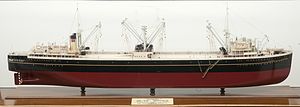 Model stored at the Whaling Museum, Sandefjord, Norway | |
| Flag | 1929-1934: |
| Class and type of vessel | whaling base |
| Port of registry | 1929-1934:  Newcastle Newcastle1934-1938:  Panama Panama1938-1945:  Hamburg Hamburg1945-1946: London1947-1965:  Odessa Odessa1966-1970: Vladivostok |
| IMO Number | M-2023 |
| Call sign | USFA |
| Operator | 1929-1937: Viking Whaling Co. Ltd. |
| Manufacturer | Swan Hunter & Wigham Richardson Ltd. ( Newcastle upon Tyne ) |
| Launched | 1929 year |
| Commissioned | August 31, 1929 |
| Withdrawn from the fleet | Scrapped in 1971 |
| Main characteristics | |
| Displacement | 28 715 t |
| Length | 149.3 m |
| Width | 21.5 m |
| Draft | 10.5 m |
| Engines | two triple expansion steam engines |
| Power | 2 × 2150 l. with. |
| Mover | two screws (110 rpm) |
| Speed | 12 knots |
| Crew | 366 people |
| Register tonnage | 14 772 reg. t |
Before the transfer of the USSR
The Vikingen whale base was built at the British shipyard Swan Hunter by order of the Norwegian whaling magnate Johan Karsten Rasmussen (1878-1966). In addition to the base itself, 5 numbered whalers-hunters were built, 35.4 m long, 7.4 m wide with a steam engine of 850 liters. with., allowing to develop speed up to 12.5 knots. In addition, in 1935 the flotilla was re-equipped with hunters No. VI — VIII, having a length of 40 m and a 1300-horsepower machine.
Viking Whaling Co. was founded in January 1929 to operate the flotilla . Ltd. whose shares are listed on the London Stock Exchange. The first two seasons in the Antarctic turned out to be profitable, which was facilitated by the use of tankers that deliver water, fuel and supplies to the flotilla, and take whale oil and other fishery products. However, due to the consequences of the global economic crisis in 1931, the main consumer of whaling products, Unilever , was unable to pay for the extracted raw materials; Norwegian producers refused to hunt in the Antarctic waters during the 1931-1932 season.
In 1934, due to ongoing financial problems, Viking Whaling Co. Ltd. was reregistered in Panama, whaling flotilla was also assigned there. All this time, the Norwegians served on the Vikingen. Due to the fact that in 1932 the first restrictions on whale fishing were adopted, the base was mainly used as a tanker. The unsuccessful season of 1937-1938 led to the decision to sell the whaling fleet to Germany, which was increasing its presence in the whaling industry. The sale of Vikingen also saved Rasmussen's company from bankruptcy.
In 1938, the base was transferred to Germany, and the payment was made not by money, but by orders for the construction of tankers. The vessel was renamed Vikinger and partially modernized, whalers were updated, there were 8 in total, but sometimes their number reached 12. The whaling season of 1939-1940 was especially successful.
In 1945, the whaling flotilla was captured by the Allies in Kiel and again came under British control. The vessel was renamed Empire Venture and transferred to the Kerguelen Sealing & Whaling Company . During the whaling expedition of 1945-1946, all available whalers were used, both Norwegian and German, in that season three British fishing fleets operated in the Southern Ocean.
In the USSR
In October 1946, in Liverpool, the whaling flotilla was transferred to the USSR at the expense of German reparations, the transfer was executed by A. N. Solyanik . On December 22 of that year, the Soviet flag was hoisted above the whaling flotilla, and it was renamed “Glory”. In Gibraltar, the command was taken by V. I. Voronin , a veteran of Sibiryakova and Chelyuskin ; The main specialists were hired Norwegians: harpooners, fat producers, masters of cutting whale carcasses. The Slava whaling flotilla set off on the first Antarctic expedition - for the first time in the history of the Russian fishing fleet. On January 28, 1947, the Glory flotilla (the Slava-4 whaler hunter, harpooner Olsen, a Norwegian) got the first whale, a 20 m long finale . On October 4, 1947, A.N. Solyanik was appointed captain-director of the whaling flotilla Glory ”, despite the protests of the Norwegian side, and remained until 1959.
Starting from the third Putin season, only Soviet specialists worked at Glory, a small part of which was recruited in the Far East, the rest were prepared directly during the flights. The main base of the flotilla was Odessa , fresh supplies, water and fuel were usually taken in Cape Town , later in Montevideo . In the first voyage, 384 whales were caught, in the second - 820, and in the third it exceeded one thousand whales. The 17th flight became a record one - more than 2000 whales. Starting from the 11th flight, a search helicopter was used .
In 1956, diesel-electric whalers of the Mirny type ( project 393 ) were developed in the USSR, which developed a maximum speed of up to 17.2 knots. Now the whales, even the most frisky - saivals and minke whales - were completely available for fishing. In the 1960s, up to 12 different types of whalers could be attached to the “Glory”.
In 1959, the modern whale base “ Soviet Ukraine ” was put into operation, which had a much larger size and technical equipment. As new whaling fleets were commissioned ( Yuri Dolgoruky , Soviet Russia , the Far East, Vladivostok), Glory turned out to be morally and physically obsolete. In 1965, the flotilla left Odessa for the last Antarctic voyage, from which it returned to Vladivostok. Based in the Far East, Glory has worked four more seasons in the North Pacific. During the period 1947-1970, the flotilla obtained 59,136 whales - more than any other Soviet fishing team.
The worn out base was sold to Japan in 1970 and received the name Fuji-maru. In 1971, the new owner transferred the ship to Kaohsiung ( Taiwan ) for cutting into scrap metal.
Literature
- Julia V. Iwaschenko, Phillip J. Clapham, Robert L. Brownfell Jr .: Soviet Illegal Whaling: The Devil and the Details (PDF; 5.1 MB)
- Roger W. Jordan: The World's Merchant Fleets , Naval Institut Press, Annapolis (2006), ISBN 1-59114-959-2
- Joh. N. Tønnessen, Arne Odd Johnsen: The History of Modern Whaling , University of California Press (1982), ISBN 0-520-03973-4