Dracaena Godsefa ( Latin: Dracaena surculosa , syn. Dracaena godseffiana hort. Ex Baker ) is a shrub , a species of the genus Dracaena ( Dracaena ) of the Asparagaceae family . Popular houseplant.
| Dracaena Godsef |
 |
| Scientific classification |
|---|
| Grade: | Monocotyledonous [1] |
|
| International scientific name |
|---|
Dracaena surculosa Lindl. (1828) |
|
Content
In nature, the plant is common in western tropical Africa .
A shrub [2] , which in nature reaches a height of eight meters. Indoor Drazenu Godsef is grown in height up to 1 m above the pot. The roots are reddish-brown, usually more or less tuberous .
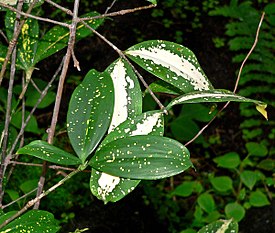
The stems are erect, thin, reed, with leaves uncharacteristic for dracaena, having the shape of an ellipse with pointed ends. Leaves of 3-5 leaves are located in false whorls [2] , at the top they are green, in many varieties there are spots of different colors on them - light green, yellow, cream or white, depending on the variety. The leaves are up to 16 cm long and about 5 cm wide.
The flowers at Dracena Godsef have a pleasant smell, they are usually yellow in color with a greenish tint, at the tops they are collected in axillary or apical racemose inflorescences . Dracaena Godsefa blooms very rarely in room conditions; she needs specific favorable conditions in which she blooms even on windows facing north.
Dracaena Godsefa is a popular indoor and greenhouse plant [2] . According to scientists at the University of Georgia , this type of dracaena grows well in low light conditions, is not picky about the temperature (suitable air temperature is normal for humans) and does not require heavy watering. However, according to scientists, dracaena needs enough dry air, and even able to moisten it.
The best conditions for keeping Godsef dracaena are a warm small greenhouse with a temperature of 20-23 degrees Celsius in the summer and a temperature of 16. The soil should be a mixture of land with humus- rich peat with an acidity of 6.0. But this dracaena grows well in a bright place in the room - on the window, or even in the corner. A prerequisite for maintenance is the absence of direct sunlight, otherwise the plant may get burns. In order not to stop growing, the plant must be fertilized once every two weeks. Fertilizers and the water in which they are bred should contain a minimum amount of fluorine and chlorine , since these elements can destroy the plant.
The plant is transplanted in the spring. Propagated by cuttings at home.
- ↑ For the conventionality of indicating the class of monocotyledons as a superior taxon for the plant group described in this article, see the APG Systems section of the Monocotyledonous article .
- ↑ 1 2 3 Ivanina, 1982 , p. 175.
- Ivanina L. I. The Dracaenaceae family (Dracaenaceae) // Plant Life : in 6 volumes / ch. ed. A. L. Takhtadzhyan . - M .: Enlightenment , 1982. - T. 6: Flowering plants / ed. A. L. Takhtadzhyana. - S. 169-177. - 543 p. - 300,000 copies.
