Solomon Schechter ( Hebrew שניאור זלמן שכטר , Schneur Zalman Schechter) is a rabbi , scholar and teacher , president of the Jewish Theological Seminary of America , one of the key figures of conservative Judaism , a researcher of Cairo geniza .
| Solomon Schechter | |
|---|---|
| Heb. שניאור זלמן שכטר | |
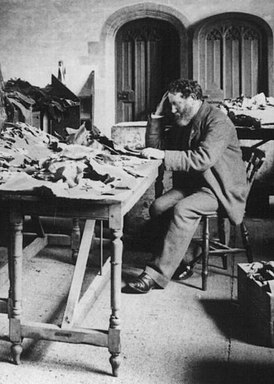 Shekhter for the study of the Cairo geniza | |
| Date of Birth | |
| Place of Birth | |
| Date of death | |
| A place of death | |
| A country | |
| Scientific field | Hebrew , Judaica , Jewish Theology |
| Place of work | |
| Alma mater | University of Vienna, University of Berlin |
Content
- 1 Biography
- 2 Views
- 3 Legacy
- 4 Bibliography
- 5 notes
- 6 Literature
- 7 References
Biography
Born in Focsani (now Romania) in a family of Chabad followers. Shekhter received his initial education from his father, who was a sheikhet .
From the age of ten he studied at the yeshiva in Piatra Neamt , and from the age of thirteen he studied with one of the main Talmudic scholars, Rabbi from Lviv . In 1865, at the age of 18, he went to study at the Jewish Theological Seminary in Vienna, under Meir Friedman, in 19 became a rabbi. He studied philosophy and grammar at the University of Vienna , and then, in 1879, continued his studies at the University of Berlin [4] . In Berlin, he met Claude Montefiore , a relative of Sir Moses Montefiore , who invited him to the UK, where he went in 1881. He continued his studies at Oxford University , and also studied Jewish texts found in the collection of the British Museum .
In 1887, at the age of 40, he married Matilda Roth from Breslau , whom he met during a research activity at the British Museum in London. The couple had three children .
In 1890, after the death of , he began to teach the Talmud and rabbinic literature at the University of Cambridge . Jewish University students at Cambridge University still hold annual readings in memory of Solomon Schechter.
At the same time, he traveled to Italy to search the largest libraries of collections of Jewish manuscripts. Research results were published in the journal Jewish Quarterly Review .
Shekhter’s research in Cairo Geniza , a collection of more than 100,000 pages of rare Jewish religious manuscripts and medieval Jewish texts preserved in the Egyptian synagogue Even Ezra in old Cairo, brought Shekhter the greatest fame in the academic community. They revolutionized the study of medieval Judaism. The first Jewish researcher to recognize the great importance of the Cairo geniza, as well as the first to talk about the existence of , was , and both of them later scrupulously studied Shekhter.
Schechter initially sent an unsorted collection of manuscripts to the Bodley Library of Oxford University, but in May 1896 two sisters, Agnes Lewis and Margaret Gibson, showed him several pages from the Cairo geniza containing Ben-Syrah in Hebrew, which for centuries was known only in Greek and Latin translations. Through correspondence, it became known that there were nine more pages from the same manuscript at Archibald Seis at Oxford University. Shekhter went to Cairo to study genius , and arrived there in December 1896 with a recommendation from the chief rabbi, to the chief rabbi of Cairo, Aaron Rafael Ben-Shimon. He carefully selected materials for the Cambridge University library . The find played an important role in Shechter’s dispute with David Margulius about the Hebrew origin of the text of the Wisdom of Sirach.
Charles Taylor showed great interest in the work of Solomon Schechter in Cairo, and the genius fragments presented at Cambridge University are now known as the Taylor-Schechter collection.
At the end of the trip to Egypt, Shekhter visited Israel, where his twin brother Yaakov Shekhter (1844-1912), one of the founders of Zichron Yaakov , lived, and presented the settlement with several Jewish manuscripts found in the Cairo geniza. One of the sons of his brother, Abba Shekhter, was the first mayor of Zikhron-Yaakov. His brother’s grandson is a famous Israeli cartoonist and author, Dudu Geva.
In 1899, he was appointed professor of Hebrew at University College London and worked there until 1902, when he left for America .
Shechter became the second president of the Jewish Theological Seminary of America (JTSA), from 1902 until his death in 1915, at the same time he founded the United Synagogue of America , later renamed the United Synagogue of Conservative Judaism . [5]
Shekhter suddenly died of a heart attack in New York on November 19, 1915, at the age of 68. Cyrus Adler becomes JTSA President after Shechter’s death .
Views
Shekhter recognized the central role of Halakha in Jewish life, but believed that laws should change in accordance with time.
Shechter was one of the first supporters of Zionism.
He was chairman of a committee that edited the translation of Tanakh into English according .
His relations with representatives of Orthodox Judaism did not develop, especially after 1904, when the Union of Orthodox Rabbis condemned his modern critical methods of studying the Tanach and Talmud as heresy. Shekhter did not appear at orthodox events, and also had his own view on the use of Yiddish .
Legacy
Shekhter’s name is inseparable from the history of research on the Cairo geniza. He is considered the founder and one of the key figures of conservative Judaism. A network of conservative Jewish day schools, as well as a summer camp in Olympia, Washington, are named after him. There are several dozen such schools in the United States; there is also a branch in Canada. In Jerusalem there is the Institute for Jewish Studies named after him, which is a branch of the Jewish Theological Seminary (JTS) .
Bibliography
- Schechter, Solomon (1896) Studies in Judaism. 3 vols. London: A. & C. Black, 1896-1924 (Ser. III published by The Jewish Publication Society of America, Philadelphia PA)
- Schechter, Solomon (1909) Some Aspects of Rabbinic Theology London: A. and C. Black (Reissued by Schocken Books, New York, 1961; again by Jewish Lights, Woodstock, Vt., 1993: including the original preface of 1909 & the introduction by Loius [sic] Finkelstein; new introduction by Neil Gilman [ie Gillman])
- אגדת שיר השירים, ההדיר והוסיף הערות סולומון שכטר מכתב יד מפארמה, קיימברידג ', 1896.
Notes
- ↑ 1 2 BNF identifier : Open Data Platform 2011.
- ↑ 1 2 Encyclopædia Britannica
- ↑ 1 2 SNAC - 2010.
- ↑ Librarian's Lobby October 2000 Heroes of learning
- ↑ broken link (inaccessible link)
Literature
- Cohen, Michael R. The Birth of Conservative Judaism: Solomon Schechter's Disciples and the Creation of an American Religious Movement New York: Columbia University Press, 2012.
- Fine, David J. (1997) Solomon Schechter and the Ambivalence of Jewish Wissenschaft in: Judaism (1997) p. 4-24
- Gillman, Neil Conservative Judaism: the New Century. Behrman house
- Hoffman, Adina & Cole, Peter (2011) Sacred Trash: the lost and found world of the Cairo Geniza
- Starr, David (2003) Catholic Israel: Solomon Schechter, Unity and Fragmentation in Modern Jewish History "Ph.D. Dissertation, Columbia University
- Geoffrey Wigoder, Evrei in lume - Dicţionar biografic, coord. V Prager ed română, Hasefer, Bucureşti, 2001.
- Encyclopedia Judaica for Youth on CD-ROM, CDI Systems and Keter Publishing House Ltd, 1992.
- Pasachoff, Naomi, Links in the Chain: Shapers of the Jewish Tradition, Oxford University Press, New York, 1997.
- The Taylor-Schechter Genizah Research Unit , Homepage A guide to the Taylor - Schechter Genizah collection Collection, Cambridge University Library, 1979.
- Stefan C Reif, A guide to the Taylor-Schechter Genizah Collection , Cambridge: Cambridge University Library, 2nd edition, 1979.
- Howard Sachar, A History of the Jews in America, Vintage Books, 1993.
- N. Bentwich, Solomon Schechter, 1948.
- B. Mandelbaum, The Wisdom of Solomon Schechter, 1963.
- H. Parzen, Architects of Conservative Judaism, 1964.