Cape Narca ( lat. Narke capensis ) - a species of stingrays of the genus Narca family lat. Narkidae squad of electric stingrays . These are cartilaginous fish, leading a bottom lifestyle, with large, flattened pectoral and abdominal fins, forming an almost round disc, a short, thick tail, ending in a muscular caudal fin and one dorsal fin. They are able to generate electric current. They live off the coast of South Africa and Namibia to a depth of 183 m. The maximum recorded length is 38 cm. Coloring from yellowish to sandy brown. The diet consists of polychaetes . These stingrays reproduce by oviposition [1] [2] .
| Cape Narc |
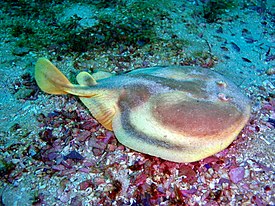 |
| Scientific classification |
|---|
| No rank : | Bilateral symmetrical |
|
| International scientific name |
|---|
Narke capensis ( Gmelin , 1789) |
| Synonyms |
|---|
- Astrape capensis (Gmelin, 1789)
- Raja capensis Gmelin, 1789
- Torpedo capensis gronow, 1854
|
| Area |
|---|

|
| Security status |
|---|
Not enough data IUCN Data Deficient : 161614 |
|
Content
The species was first scientifically described in 1789 by the German naturalist Johann Friedrich Gmelin as Raja capensis [3] . In some publications, the name Raja rapensis was mistakenly indicated. The holotype was not assigned. In 1826, the German naturalist Johann Jacob Kaup singled out a new genus of narok , which differs from other electric stingrays by the presence of only one dorsal fin and arched back, and carried the Cape Narck to it [4] . The species epithet is associated with the habitat of these fish ( Cape of Good Hope - Cape of Good Hope ).
Cape Narcotics live in the East and West Cape Provinces of South Africa . Their range extends from the center of Namibia to Walvis Bay . [5] . Historical data on the presence of this species in the waters of Madagascar may be erroneous [1] [6] . These slopes are found in bays on a sandy and silty bottom, as a rule, not deeper than 50-100 m, although they can sink to a depth of 183 m [1] [7] .
The pectoral fins, whose width exceeds the length, form an almost round disc. On both sides of the head, electrical paired organs in the form of kidneys are visible through the skin. Small eyes protrude above the surface of the body. Immediately behind the eyes are large spatter with three small finger-shaped protrusions at the edges. The nostrils are located quite close to each other. They are surrounded by long skin folds that reach the mouth. A small, almost straight and protruding mouth is surrounded by noticeable grooves. Tiny teeth are pointed. Five pairs of gill slits [7] [6] are located on the lower side of the disk.
The edges of the large and wide ventral fins are arched, the base of the fins lies under the pectoral fins. Adult males have thick and short pterygopodia. Above the ventral fins is the only dorsal fin. There are folds of skin on the sides of the short and thick tail, the tail ends with a large triangular caudal fin, the upper and lower lobes of which are almost symmetrical. The skin is devoid of scales [7] [6] .
The color of the dorsal surface ranges from yellow-brown to dull-brown in color, on the tail there are yellowish areas. The ventral surface is white or yellowish, the edges of the fins are brown. The maximum recorded length is 38 cm and the width is 26 [7] [8] .
Cape Narcotus are bottom marine fish. Despite their small size, they are able to deliver a strong electric shock, defending themselves from predators, for example, from flat-headed seven-gill sharks [9] . These slopes move along the bottom, repelled by a muscular tail, and not by pectoral fins [7] . Their diet consists mainly of polychaetes. They probably reproduce by oviposition, like other electric ramps. Males and females reach puberty with a length of 11-17 cm and 16 cm, respectively [10] .
Flat-headed seven-footed sharks prey on Cape Naroks.
Cape Narcotics are capable of delivering a painful, but non-hazardous to human life electric shock. These ramps are not of interest for commercial fishing. They are often caught by- catch in commercial fisheries using bottom trawls. They live in the coastal zone and therefore suffer from environmental pollution associated with anthropogenic factors. The International Union for Conservation of Nature has assigned this species the status of “Insufficient data” [1] .
- View of the Cape Narcot in the World Register of Marine Species .
- Cape narc (in English) in the FishBase database.
- ↑ 1 2 3 4 Cape Narc (Eng.) . The IUCN Red List of Threatened Species . Date of treatment May 13, 2014.
- ↑ Compagno, LJV Narkidae = In MM Smith and PC Heemstra (eds.) Smiths' sea fishes. - Berlin: Springer-Verlag, 1986. - P. 113-114.
- ↑ Gmelin, JF (1789) Caroli a Linné. Systema Naturae per regna tria naturae, secundum classes, ordines, genera, species; cum characteribus, differentiis, synonymis, locis. Editio decimo tertia, aucta, reformata. 3 vols. in 9 parts. Lipsiae, 1788-93. Caroli a Linné. Systema Naturae per regna tria naturae, secundum classes, ordines, genera, species; v. 1 (pt 3): 1033-1516
- ↑ Kaup, JJ (1826). Beyträge zu Amphibiologie und Ichthiyologie. Isis (Oken) 19 (1): 87–90.
- ↑ Bianchi, G .; Carpenter, KE; Roux, JP; Molloy, FJ; Boyer, D .; Boyer, HJ Field Guide to the Living Marine Ressources of Namibia. - Food and Agriculture Organization of the United Nations, 1999. - P. 92. - ISBN 9251043450 .
- ↑ 1 2 3 Garman, S. The Plagiostomia (sharks, skates, and rays) // Memoirs of the Museum of Comparative Zoology. - 1913. - No. 36 . - P. 1-515.
- ↑ 1 2 3 4 5 Compagno, LJV Family No. 24: Narkidae = In Smith, MM; Heemstra, PC, eds. Smiths' Sea Fishes. - Struik, 2003 .-- P. 113-114. - ISBN 1868728900 .
- ↑ Compagno, LJV, DA Ebert and MJ Smale. Guide to the sharks and rays of southern Africa. - London: New Holland (Publ.) Ltd., London, 1989.
- ↑ Ebert, DA Diet of the seven gill shark Notorynchus cepedianus in the temperate coastal waters of southern Africa // South African Journal of Marine Science. - 1991. - Vol. 11, No. 1 . - P. 565-572. - DOI : 10.2989 / 025776191784287547 .
- ↑ Compagno, LJV; Heemstra, PC Electrolux addisoni , a new genus and species of electric ray from the east coast of South Africa (Rajiformes: Torpedinoidei: Narkidae), with a review of torpedinoid taxonomy // Smithiana Bulletin. - 2007. - No. 7 . - P. 15-49.

