Electrolux addisoni (lat.) Is the only species of rays of the Electrolux genus of the family of narcotic detachments of electrical rays . These are cartilaginous fishes leading to the bottom lifestyle, with large, flattened pectoral and ventral fins in the form of a disk, pronounced tail and two dorsal fins. They are capable of generating electrical current. They live in the subtropical waters of the western Indian Ocean at a depth of 50 m. The maximum recorded length is 52 cm [1] [2] .
| Electrolux addisoni |
| Scientific classification |
|---|
| No rank : | Bilateral symmetric |
| Rod: | Electrolux Compagno & Heemstra, 2007 |
|
| International Scientific Name |
|---|
Electrolux addisoni Compagno , Heemstra , 2007 |
| Security status |
|---|
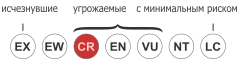
Endangered SpeciesIUCN 3.1 Critically Endangered : 161428 |
|
In 2008, the species was included in the Top 10 New Species ( Ten Top Wonderful Species ) —an annually compiled by the list of the most remarkable biological species described in the previous year [3] .
Content
The species was first scientifically described in 2007. Prior to that, only 4 genera belonging to the family of narcovy were known; therefore, the discovery of a monotypic genus of rather large, aposematic, endemic stingrays inhabiting coastal waters and leading a daytime lifestyle was a big surprise for scientists [1] . The name of the genus comes from the words "electro" and lat. lux - “light” and is associated with the ability to emit an electric discharge, as well as the fact that its discovery shed light on the diverse and poorly understood underwater world of the western Indian Ocean. The specific epithet is given in honor of Mark Addison, director of Blue Wilderness dive charters , Weidenham , KwaZulu-Natal , organizing charter dives with sharks, which caught the specimen appointed by the holotype of a new species [4] . The holotype is an adult male with a length of 51.5 cm, a disk width of 30.5 cm, caught south of KwaZulu-Natal ( ). Paratype - an adult male 50.2 cm long, disc width 29.1 cm, caught there [5] .
Electrolux addisoni inhabit the western part of the Indian Ocean, they are endemics of the warm temperate subtropical waters of South Africa and are found in 4 locations along the coastline about 300 km long: from , Eastern Cape , to Durban, KwaZulu-Natal, at a depth of no more than 50 m. These slopes are kept on a narrow continental shelf below the tidal zone near rocky reefs [1] .
Pectoral fins form an oval disc. The skin is devoid of scales. Snout widely rounded. There are two dorsal fins and a tail ending in a tail fin. The cartilage framework is reduced and is a thin medial stem. This feature distinguishes them from the slopes of the Narcinidae family, in which the elongated snout supports wide rostral cartilage . The mouth is straight, very narrow, there are wrinkles in the corners of the mouth, and a small groove runs along the periphery. The nostrils are located directly in front of the mouth and are connected to it by a wide groove. They are surrounded by long skin folds that join to form a central flap, partially covering the mouth [6] .
Behind the eyes there are large squiggles . At the base of the pectoral fins, before the eyes, electric paired organs in the shape of the kidneys, which stretch along the body to the end of the disk, are visible [7] .
These skates are easily distinguished by the characteristic color of the dorsal surface of the body: small dark yellow spots and a series of concentric black stripes are scattered over a dark brown background. The maximum recorded length is 51.5 cm, and the weight is 1.8 kg. This is the largest species in the family of drugs. The females so far have not come across [2] [8] .
Electrolux addisoni are bottom sea fishes. They multiply by egg production , embryos hatch from eggs in the womb and feed on yolk [7] . Lead daily life. They move along the bottom with wide abdominal fins and search for food in the ground. May lie still for a long time at the bottom. Being agitated, they demonstrate aggression: they arch their backs, wrap the edges of the disk and lift the tail. Like the other narcists living in this area, they feed on polychaetes. In addition to the half-digested worms, at least one crustacean resembling a shrimp was found in the paratype stomach. It was suggested that the bright color of the dorsal surface of the body serves to scare away the sharks that hunt during the day. Bright colors, coupled with a demonstration of the threat, can be a manifestation of and signal that the ramp is capable of inflicting electrical shock, is ready to repel the attack and should be left alone. In the shallow waters inhabited by Electrolux addisoni , they can become prey for large gray , hammerhead , tiger sand and white sharks [1] [2] .
These stingrays are of no interest to commercial fishing. Their range is subject to strong anthropogenic pressure (diving, sport and commercial fishing, coastal development, water transport, use of beaches, placement of crawl nets and habitat pollution). Probably, stingrays of this species come across as by- catch in commercial fishing. In addition, they can potentially be of interest as an aquarium pet. The International Union for Conservation of Nature has granted this species the status of “On the verge of extinction” [1] .
- ↑ 1 2 3 4 5 Electrolux addisoni (English) . The IUCN Red List of Threatened Species . The appeal date is May 10, 2014.
- 2 1 2 3 Compagno, LJV and Heemstra PC (Rajiformes: Torpedinoidei: Narkidae), with a review of torpedinoid taxonomy // Smithiana Bull. - 2007. - № 7 . - P. 15-49.
- 10 Top 10 New Species of 2008. Number 1 - A Sleeper Ray with a Name that Sucks (eng.) . State University of New York College of Environmental Science and Forestry (2008). The date of circulation is June 9, 2015. Archived June 9, 2015.
- ↑ Christopher Scharpf and Kenneth J. Lazara. Fish Name Etymology Database (Unreferenced) . The ETYFish Project . The appeal date is May 10, 2014.
- ↑ Electrolux addisoni (Neopr.) . Shark References. The appeal date is May 10, 2014.
- ↑ Compagno, LJV and Last, PR Narkidae. Sleeper rays p. 1443-1446. In: KE Carpenter and VH Niem (eds.) FAO identification guide for fishery purposes. The living marine resources of the Western Central Pacific .. - Rome: Food and Agricultural Organization, 1999.
- ↑ 1 2 Compagno, LJV and Last, PR Narcinidae. Numbfishes. p. 1433-1437. In: KE Carpenter and VH Niem (eds.) FAO identification guide for fishery purposes. The living marine resources of the Western Central Pacific .. - Rome: Food and Agricultural Organization, 1999.
- ↑ Heok Hee. New fish named after vacuum cleaner (Unreferenced.) . Practical fishkeeping. The date of circulation is May 10, 2014. Archived July 7, 2007.