The Siege of Busanjin , The Siege of Busan ( cor. 釜山 鎭 戰 鬪, 부산진 전투 , Japanese 釜山 鎮 の 戦 уд, Fujantin-no Tatakai ) - the battle took place on May 25, 1592 between Japanese and Korean forces over the Pusanjin fortress of the Tonne urban district (now ) at the beginning of the Imda War . Ended up in victory for the Japanese.
| Siege of Busan | |||
|---|---|---|---|
| Main Conflict: Imda War | |||
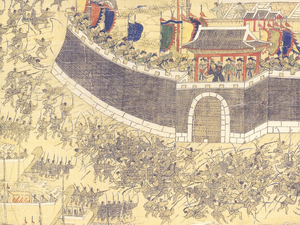 "Busan Defense" (Korean painting, 1760) | |||
| date of | May 25, 1592 [1] 1592 | ||
| A place | Busanjinson , Tonne City District, Gyeongsangdao Province, Korea | ||
| Total | Japan victory | ||
| Opponents | |||
| |||
| Commanders | |||
| |||
| Forces of the parties | |||
| |||
| Losses | |||
| |||


Content
Background
On May 23, 1592, at noon, the vanguard of the Japanese invaders arrived in 400 light boats from Tsushima to Busan Bay. It was the 1st Japanese Expeditionary Army with 18,700 warriors. The backbone of the troops was the detachments of Army Commander Konishi Yukinaga (7000 people). In addition, the troops included units of So Yoshitoshi (5,000 people), Matsuri Shigenobu (3,000 people), Arima Harunobu (2,000 people), Omura Yoshiaki (1,000 people) and Goto Sumiharu (700 people). Most of the personnel were Christian infantry from the Kyushu region, armed with arquebuses [4] . The army did not land, but was waiting in the port. The Japanese hoped that the Koreans would let them through the Chinese border without a fight, since the main purpose of the campaign was to conquer China, not Korea [5] .
Meanwhile, the Korean side discovered the approach of the enemy in the morning. The commander of the Busan garrison, 60-year-old Chung Bal raised the alarm, closed all the gates of the fortress and gave the order to prepare for the defense. He sent messengers to nearby forts, reporting the Japanese. The Korean left and right fleets of the Gyeongsang-do province under the command of Pak Hon and Won Gyun did not dare to attack Japanese forces at sea, although they had numerical and technical superiority. This was the first big mistake Koreans made in the war. [6]
At 19:30, the Japanese commander So Yoshitoshi, accompanied by the Buddhist monk Genso, handed a letter to Busan’s defenders demanding that the Japanese army be allowed to enter China without a fight. The Koreans answered in silence, which was regarded as a refusal. May 24, at 4:00, the Japanese expeditionary army began to land ashore [7] .
Move
In order to break through the enemy’s defense line and gain a foothold on the southern coast of the Korean Peninsula , the Japanese divided their forces. It was decided to carry out simultaneous attacks on several Korean fortifications: the fortresses of Pusanjin , Tadejin ( cor. 다대 진성 ) at the mouth of the Naktong river and the port of Sophyungpo ( cor. 서평 포 , Seopyeongpo ). The attack on the first point was taken by So Yoshitoshi, son-in-law of Konishi Yukinaga [8] .
In the evening, May 24, 1592, Japanese troops approached Busanjin. With Yoshitoshi, the last time he turned to the Korean commander, Jung Bal, demanded surrender, promising not to harm the Koreans. Jung Bal refused, explaining that he had an order from the Korean ruler to stop the onslaught of the Japanese invaders. [9]
May 25, early in the morning, the Japanese went on an attack Busanjina. The Korean garrison defended itself until the arrows ran out. When the fire of the Japanese arquebus demolished all the defenders on the walls, the conquerors broke into Pusanjin. According to the then-participant of the assault, the Japanese warrior Yoshino Dzingodzaemona, the city was razed to the ground:
| We saw people who fled and tried to hide between houses; those who could not hide ran out to the East Gate and, with folded arms, shouted to us in Chinese, “Mano! Mano! ”, Probably praying for mercy. Despite this, our troops rushed forward and chopped them, making bloody sacrifices to the god of war. Everyone’s heads were chopped off - both men and women, and even dogs with cats [10] [11] |
Consequences
The fight ended around 9:00. The resistance of the Koreans was finally broken. According to Japanese estimates, the number of killed defenders and residents of the city amounted to 8500 people [3] . About 200 men and women were captured [3] . The commander of the Busanjin garrison, Chung Bal, was killed. Next to him was found the body of 18-year-old concubine Ahean, who committed suicide [3] .
Upon learning of the fall of Busanjin, Park Hong, the commander of the left fleet of Gyeongsangdao Province, instead of attacking the Japanese armada from the sea, sank his fleet in the waters of the Kichan naval base. One hundred large ships, including 50 Panoxon (판옥선) class ships - a quarter of the entire Korean fleet - were lowered to prevent the enemy from reaching. Pak Hong himself fled to Seoul , leaving the officers and sailors to their own devices. The latter also fled, following the example of the commander [12] .
The battle for Busanjin showed Korea's unpreparedness for war. Korean weapons, armor, training and battle tactics were inferior to the Japanese. The Korean fleet, which surpassed the Japanese in all respects, was not used due to the weak character of the command. As a result, the captured Pusanjin was turned into the main base of Japanese troops in Korea, a liaison point between the Korean peninsula and Japan [12] .
Notes
- ↑ According to the Chinese calendar : 14th day 4 months // Tsuchihashi, Paul Yachita. Japanese Chronological Tables from 601 to 1872 AD - Tokyo: Sophia University Press, 1952
- ↑ Hawley, Samuel. The Imjin War: Japan's sixteenth-century invasion of Korea and attempt to conquer China . - Seoul: Royal Asiatic Society, Korea Branch, 2005. - p. 99, 136
- ↑ 1 2 3 4 5 Hawley, Samuel. The Imjin War: Japan's sixteenth-century invasion of Korea and attempt to conquer China . - Seoul: Royal Asiatic Society, Korea Branch, 2005. - p. 138
- ↑ Hawley, Samuel. The Imjin War: Japan's sixteenth-century invasion of Korea and attempt to conquer China . - Seoul: Royal Asiatic Society, Korea Branch, 2005. - p. 99.
- ↑ Hawley, Samuel. The Imjin War: Japan's sixteenth-century invasion of Korea and attempt to conquer China . - Seoul: Royal Asiatic Society, Korea Branch, 2005. - p. 134-135
- ↑ Hawley, Samuel. The Imjin War: Japan's sixteenth-century invasion of Korea and attempt to conquer China . - Seoul: Royal Asiatic Society, Korea Branch, 2005. - p. 134
- ↑ Hawley, Samuel. The Imjin War: Japan's sixteenth-century invasion of Korea and attempt to conquer China . - Seoul: Royal Asiatic Society, Korea Branch, 2005. - p. 136-137
- ↑ Hawley, Samuel. The Imjin War: Japan's sixteenth-century invasion of Korea and attempt to conquer China . - Seoul: Royal Asiatic Society, Korea Branch, 2005. - p. 137
- ↑ Hawley, Samuel. The Imjin War: Japan's sixteenth-century invasion of Korea and attempt to conquer China . - Seoul: Royal Asiatic Society, Korea Branch, 2005. - p. 137-138
- ↑ 吉野 甚 五 左衛 門 覚 書 // 続 群 書 類 従 20 下 合 戦 部; Quote from Hawley, Samuel. The Imjin War: Japan's sixteenth-century invasion of Korea and attempt to conquer China . - Seoul: Royal Asiatic Society, Korea Branch, 2005. - p. 138
- ↑ Thai-Kan School - Philosophy - Bushido
- ↑ 1 2 Hawley, Samuel. The Imjin War: Japan's sixteenth-century invasion of Korea and attempt to conquer China . - Seoul: Royal Asiatic Society, Korea Branch, 2005. - p. 138-139
Links
Sources and Literature
- History of Korea. From ancient times to the present day : in 2 t. M., 1974. - T. 1
- Lee Jong Won Imda Patriotic War of 1592-98 - Pyongyang: Department of Cultural Relations with the Foreign Ministry of the DPRK, 1953
- (Eng.) Hawley, Samuel. The Imjin War. Japan's Sixteenth-Century Invasion of Korea and Attempt to Conquer China , The Royal Asiatic Society, Korea Branch, Seoul, 2005.