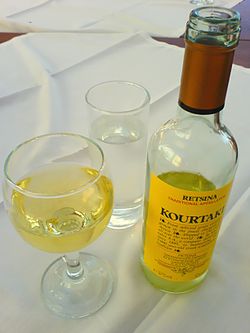

Rezina ( Greek Ρετσίνα ) - Greek tar white wine with a strength of 11.5% vol [1] . Less common is rosé wine made using a similar technology called “kokkineli” ( Greek κοκκινέλι ) [2] .
History and Production
Such "tar" wines have been known for at least 2700 years. The word "ρετσίνα" is translated as "resin", the Russian word " rubber " comes from the same Greek word ( Greek. Ρετσίνα → Latin. Resina → Russian rubber ) [3] [4] .
The original taste of this wine comes from the fact that vessels with wine, in particular amphora , were sealed with pine resin to prevent contact with air [2] .
The Romans began using barrels in the third century BC. e. , eliminating the need for resin, but the aroma and taste of retsina were so popular that they have survived to this day. Currently, the resin is specially added at the fermentation stage to give the wine a characteristic aroma [1] , after completion of the fermentation process, the resin is removed. Recycling is permitted only in Greece. For the preparation of modern recina, only the Aleppo pine resin is used (it is added to the must at the fermentation stage), its amount should not exceed 10 g / liter [2] , however, to achieve the best results, the amount of resin should not exceed 5-15% of the allowed while still retaining the actual wine bouquet. Earlier, before the Second World War , the amount of resin reached 7% of the weight of wine [5] . In general, a very strong tar smell is a sign of poor quality.
Perhaps this is the most common wine in Greece , despite the varying popularity in various fields. In fact, wines without the use of tar generally do not have quite a long tradition in Greece, due to the centuries-old domination of the Turks . Only after independence , at the beginning of the XIX century, winemaking began to return to the everyday life of the Greeks [2] .
Due to its strong taste, Retsin is best served with richly seasoned dishes typical of Greek and Mediterranean cuisine . Owing to the same exotic taste, it is almost impossible to fit into the sequence of wines served to the table, and it is better to leave the only wine at the meal.
Retsin is served chilled to 7–9 ° C, the traditional vessel for it is cylindrical copper mugs with a volume of 0.25, 0.5 or 1 liter [5] , however, the use of ordinary wine glasses will allow a better assessment of the exotic bouquet.
For a long time, retsina was not delivered to Russia because of the rather limited number of its fans among Russians. However, in the past few years, in connection with the growth of tourist flow from Russia to Greece in the opposite direction, supplies of retsina, including its pink variety, began. Retsina is called “Love from the third sip”, the first - you smell the tar, the second - the tart taste of wine, the third - either you will love it and you will remember the taste forever, or you won’t drink again.
Sources
- Transfer of wines and grapes of Greece [1]
- Article about the modern culture of winemaking in Greece [2]
- KM.RU Encyclopedia, article “Rezina” [5]
Notes
- ↑ 1 2 3 author unknown. http://www.greek.ru/all/citchen/wine/ . www.greek.ru (published earlier 2009-03-09). - "Greek wines." Date of treatment March 9, 2009. Archived August 24, 2011.
- ↑ 1 2 3 4 5 author unknown. http://www.kulina.ru/articles/bar/vino/marki/doc_5/ . www.kulina.ru (published earlier 2009-03-09). - "Wines of Greece". Date of treatment March 9, 2009. Archived August 24, 2011.
- ↑ I. Kh. Butler Latin-Russian Dictionary. 6th edition, stereotyped. Moscow. Publishing house "Russian language". 2000. Talks about the Greek origin of the word "resina".
- ↑ Ushakov's Explanatory Dictionary [1] speaks of the Latin origin of the word “rubber”
- ↑ 1 2 3 author unknown. http://mega.km.ru/kitchen_2002/encyclop.asp?TopicNumber=6349&rubr=802 . km.ru (published earlier 2009-03-09). - "Rezina." Date of treatment March 9, 2009. Archived August 24, 2011.