Monarch Butterfly Biosphere Reserve ( Spanish: Reserva de la biosfera de la Mariposa Monarca ) is an entomological reserve , a conservation area in the Mexican state of Michoacan and partly in the state of Mexico . The reserve was created in order to preserve the wintering area of the monarch butterfly and covers an area of 56,259 hectares. It is located in a wooded mountainous area at an altitude of about 3,000 meters above sea level. There are eight colonies of this butterfly in the park. On the territory of the biosphere reserve during the period from November to March, up to a billion individuals winter. [one]
| Monarch Butterfly Biosphere Reserve | |
|---|---|
| Spanish Reserva de la biosfera de la Mariposa Monarca | |
 Butterfly cluster in the reserve | |
| IUCN Category VI (Sustainable Management Area) | |
| basic information | |
| Square | 560 km² |
| Location | |
| A country |
|
 World Heritage Site World Heritage Site | |
| Mariposa Monarca Biosphere Reserve (Monarch Butterfly Biosphere Reserve) | |
| Link | No. 1290 on the World Heritage List |
| Criteria | vii |
| Region | Europe and North America |
| Turning on | 2008 ( 32nd session ) |


Content
Creation and History
In the pre-Hispanic period, this area was inhabited by the Otomi people. Near Mount Coatepec, there was a large settlement, now the archaeological zone of San Felipe los Alsati . This settlement is believed to lie on the border of the zone of distribution of the culture of the empire of the Purepecha people . Later, this area became an important place for mining and agriculture , remaining mostly rural, with significant otomi and masaua communities, especially from the state of Mexico City [2] .
In 1975, zoologist Fred Urguhart discovered the importance of this area as the endpoint for the migration of monarch butterflies from the eastern United States and Canada [3] . In 1980, Mexican President José López Portillo assigned this area the status of a conservation zone. In the second half of the decade, the management of the area passed into the hands of the Secretariat of Urban Planning and Ecology, which assigned it the category of “special biosphere reserve”. In 1986, the federal decree precisely defined the area and boundaries of protected zones [2] . Initially (in the 1980s ), efforts were aimed at the preservation and well-being of only the monarch’s butterfly. Later, research and other efforts focused on preserving the ecosystem of which the butterflies are a part. At the same time, work was carried out with local communities to help them participate in efforts to preserve and find ways to earn a living without harming the habitat of butterflies. While the federal government declared these areas a biosphere reserve, ownership has not changed. Most of them are divided between 38 ejido, seven indigenous communities and 16 private estates [2] . In 2000, the object was given the name “Mariposa-Monark Biosphere Reserve” [3] [4] .
In 2008, the reserve simultaneously with the city of San Miguel de Allende was included in the UNESCO World Heritage List at the 32nd session of the UNESCO World Heritage Committee in Canada .
Danaida Monarch and her Migration
Danaida monarch ( lat. Danaus plexippus ) - a species of butterflies from the subfamily Danaida . One of the most famous butterflies of North America . Monarchs are the only species of butterflies that make annual migrations over long distances from north to south. In North America, migration can be conditionally divided into two stages: southward to California from August until the first frost, and then the butterflies return. Northern individuals migrate in the spring. In Australia, they migrate to cooler places. A fertilized female stores eggs during their migration. By the end of October, individuals east of the Rocky Mountains migrate to the Mariposa-Monark Biosphere Reserve for refuge. Nevertheless, not a single butterfly makes the whole trip back and forth, as its life span lasts from two to seven months [5] . It is not yet known how the butterflies recognize the return path to the wintering of their ancestors [6] [7] .
Butterflies fly from the north of Texas and Oklahoma to the south of Mexico, crossing the border south of Texas, and then to the east of the Sierra Madre mountains . After thirty years of studying the migration of the eastern monarchs, in 1975 , zoologist Fred Urguhart discovered a site where butterflies migrate. They winter in pine and fir forests in central Mexico, on the border of the states of Michoacan and Mexico City. For butterflies arriving from the US border zone, this is a journey of about 4000 km in length [3] . Moreover, many insects from vast territories in the north are concentrated on a small area in the south. This situation is unique [1] [2] . These butterflies spend here about five months, flying in October and flying in March next year [3] .
It is estimated that anywhere from 60 million to a billion butterflies are found in the central Mexican highlands every winter, mainly concentrating in a small area along the border of the states of Michoacan and Mexico City [3] [1] . These butterflies gather in colonies and are located on pine trees. In most cases, there are so many of them that the trees turn orange and branches bend under their weight [1] [8] . When these butterflies take off for mating, they can completely eclipse the sky, gathering in clouds and flapping their wings. Although these forests are located in central Mexico, the height of the area creates the possibility of night frosts. Low temperatures at night every year kill a certain percentage of butterflies, usually the weakest. An unusually cold winter from 1996 to 1997 killed so many butterflies that their bodies covered the ground. However, not all butterflies that fall to the earth die. Some of them may come to life after sunrise. One of the reasons why butterflies gather so densely on trees is the need to keep warm. At dawn, butterflies open their wings to catch the sun's rays. When the temperature rises, butterflies rise into the air for mating.
Ecosystem
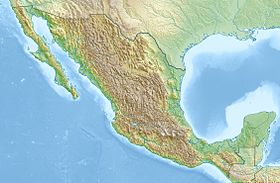
Butterfly hibernations are located in mountain forests extending in the east of the state of Michoacan and the west of the state of Mexico , about 100 km northwest of the city of Mexico City [2] [8] . The area in Michoacán consists of the highest mountains of Mexico, reaching 3840 meters above sea level. The climate of the region is classified as temperate and somewhat humid with the summer rainy season. The average maximum temperature is 22 ° C, with a difference of 5 and 7 ° C. Altitude divides the region into three climatic subgroups (semi-cold and semi-wet, semi-cold and wet, cold and wet).
The area is part of the Trans-Mexican volcanic belt and the relief of most of the area is due to basalt outcrops that formed cracks, faults and rocks with an orientation from north-east to south-west. These rock formations lie on older ones (volcanic cones and lava fields) and are characterized by high water permeability, therefore there are only shallow reservoirs there [2] . The mountains are mainly covered with forests, which differ in prevailing species depending on the height and area: oak up to 2900 meters above sea level, oak and pine from 1500 to 3000 m, fir from 2400 to 3600 m. There are also small areas with juniper , Mexican cedar ( pine cedar ) and meadows . Areas below 2400 were mostly heavily altered by agriculture and development. The most important shelters of the monarchs are pine and fir forests, with a microclimate that provides shelter when the temperature drops to zero or when winter rains pass.
The fauna of the region includes species that are characteristic of a wide variety of zones - from subtropical to subarctic. There are species endemic to this area. These include white-tailed deer ( Odocoileus virginianus ), coyotes ( Canis latrans ), long-tailed weasels ( Mustela frenata ), gray foxes ( Urocyon cinereoargenteus ), American rabbits ( Sylvilagus ), ravens ( Corvus corax ), turkey vultures ( Cath ) Virginian owls ( Bubo virginianus ), as well as various species of hummingbirds , reptiles and amphibians [2] .
On January 9, 2016, Google released a doodle dedicated to the 41st anniversary of the opening of the Butterfly Wintering Site.
Notes
- ↑ 1 2 3 4 Monarch Butterfly Biosphere Reserve . UNESCO / WHC. Date of treatment May 8, 2014.
- ↑ 1 2 3 4 5 6 7 Comisión Nacional para el Conocimiento y Uso de la Biodiversidad (unavailable link) . Col. Insurgentes Cuicuilco. Date of treatment May 8, 2014. Archived on September 13, 2010.
- ↑ 1 2 3 4 5 Sanchez Reyna, Ramon (2008). Turiguía: Michoacán [Tour Guide: Michoacán] (in Spanish). Mexico City: Grupo Azabache, SA de CV p. 152. ISBN 978-607-7568-08-7 .
- ↑ Declara UNESCO reserva de Mariposa Monarca como Patrimonio Mundial . El Uniserval. Date of treatment May 8, 2014.
- ↑ Pyle, Robert Michael, “National Audubon Society Field Guide to North American Butterflies,” p.712-713, Alfred A. Knopf, New York, ISBN 0-394-51914-0
- ↑ Merlin C., Gegear RJ, Reppert SM (2009). Antennal Circadian Clocks Coordinate Sun Compass Orientation in Migratory Monarch Butterflies. Science 325: 1700-1704. DOI : 10.1126 / science.1176221 PMID 19779201
- ↑ Kyriacou CP (2009). Unraveling Traveling. Science 325: 1629-1630 DOI : 10.1126 / science.1178935 PMID 19779177
- ↑ 1 2 Reserva de Biosfera de la Mariposa Monarca . Date of treatment May 8, 2014.