Saluma National Park - 76,000 ha national park in Senegal . It was founded in 1976. Located in the Salum River Delta at its confluence with the Atlantic Ocean .
| Delum salum | |
|---|---|
| fr. Parc national du delta du saloum | |
 | |
| IUCN Category II ( National Park ) | |
| basic information | |
| Area | 760 km2 |
| Established | 1976 year |
| Location | |
| A country |
|
 World Heritage Site World Heritage Site | |
| Parc national du delta du saloum (Delum Salum) | |
| Link | No. 1359 on the World Heritage List |
| Criteria | iii, vi, v |
| Inclusion | 2011 ( 35th session ) |


It is part of a larger biosphere reserve with an area of 180,000 hectares, of which 61,000 hectares of water, coastal mangroves and marine vegetation of 7,000 hectares, savannas and forests of 8,000 hectares. The following bird species live on the territory of the park: king tern , common flamingo , common spoonbill , red- necked beetle , rock- beetle , sandpiper .
Included in 2011 as a UNESCO World Heritage Site [1] ..
Content
- 1 Geography
- 2 History
- 3 Nature
- 3.1 fauna
- 4 notes
- 5 Links
Geography
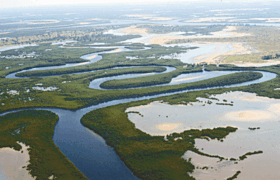
The park is located in western Senegal, adjacent to the Atlantic coast; its southern part borders with the Gambia . Abundant mangroves grow in the Salum River Delta. The landscape of the park is also represented by wetlands, bogons (a specific term for coastal areas in Senegal and the Gambia) and savannahs.
History
On May 28, 1976, according to Law No. 76-577 of the Senegalese Government, this territory was declared a national park. In 1981, it was declared a UNESCO Biosphere Reserve, in 1987 it was included in the Ramsar Convention . On November 18, 2005, the Saluma delta was included in the preliminary list of UNESCO World Heritage Sites, and in 2011 the park was included in the list itself.
Nature
The environment of the park is represented by three biotopes: mangroves, “barren” lands (French tanne - a specific local term) and “savannah zone” (also called “Sudanese”).
Fauna
The number of species of mammals in the park is not very large: desert warthog , spotted hyena , forest antelopes , dukers , monkey hussar , red colobus . Dolphins and manatees live in the waters of the park.
The following bird species live on the territory of the park: small flamingo , pink -backed pelican , gigantic heron , sea dove , gray-headed gull , king tern , tegrava , large godwit , shiloklyuv and others.
In addition, 114 species of fish inhabit the waters of the park, making it the site of the greatest fish biodiversity in Senegal.
Notes
- ↑ Siegfried Forster, "Les sites africains entrent en force dans le patrimoine mondial de l'Unesco" , RFI , 28 juin 2011.
Links
- UNESCO (English)