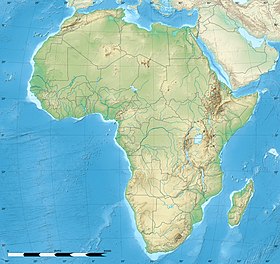
Sanga ( Sangha ) is a tropical forest and national park located on both banks of the African region of Sanga , a tributary of the Congo River. The forest is located on the territory of three states at once: the Republic of the Congo in the east, the Central African Republic in the central part and Cameroon in the west.
| Sanga Forest of Three Nations | |
|---|---|
| English Sangha trinational | |
 Sanga Forest | |
| IUCN Category - V (Protected Landscape / Water Area) | |
| basic information | |
| Square | 2178.54 km² |
| Established | 1990 year |
| Location | |
| Country |
|
 World Heritage Site World Heritage Site | |
| Sangha trinational (Sanga Forest of Three Nations) | |
| Link | No. 1380 on the World Heritage List |
| Criteria | ix, x |
| Region | Africa |
| Turning on | 2012 ( 36th session ) |




The forest includes three national parks:
- Lobeke in Cameroon, the status of the park has been since 2001, the area is 2178.54 km².
- Dzanga Sanga in the Central African Republic, the status of the park has been since 1990 and is divided into two parts: the northern one with an area of 495 km² and the southern one with an area of 1220 km². These two parts of the nature reserve are separated by the Sanga River.
- Nubale Ndoki in the Republic of Congo, covering an area of 3865.92 km², has been a park since 1993.
In 2000, an agreement was signed on cooperation between the three countries in the field of creating a biosphere reserve, and in 2007 the Institute of Sanga National Park was founded. In 2012, it was inscribed on the World Heritage List with a total area of 7,542.86 km² and a buffer zone of 17,879.5 km² [1] [2] . The international name of the park is Sangha Trinational (can be translated as “Sanga of the Three Nations”).
Flora
The landscape of the Sangha Forest consists of deciduous evergreen rain forests , forest marshes and periodically flooded wetlands, lakes and several types of open savannah , some of which are eroded. These areas, of which only 138 are described, are divided into savannas along rivers and streams (be) and areas characterized by a decrease in relief (wang). Savannah areas differ in size, soil and hydrological characteristics, and therefore the fauna and flora on them are also different. In addition to the natural beauties themselves, the forest is valuable for the possibility of conducting scientific research and hiking there, which is often impossible in other tropical forests.
The natural wealth of the Sangha Reserve is largely due to the fact that it is located in the transitional region of the flora of the Congo Basin. In addition, this area is well preserved compared to many other areas in the Congo Basin due to the insignificant human presence in it. The human use of the region for many centuries was limited to hunting and gathering, which were conducted by small tribes, and about 30% of its area began to be used partially for commercial purposes only in the second half of the 20th century. Today, economic activity in the forest is minimal, and the population density around it is low.
Fauna
The forest is a habitat for various species of animals, some of which are endemic, others are rare or endangered species. The Sangha River crosses the forest from north to south; it is inhabited by large populations of Nile crocodile and predatory fish Hydrocynus goliath ( Big tiger fish ), individuals of which can reach a length of 1.33 meters. The combination of densely forested and open spaces in the reserve allows the populations of the African forest elephant , large populations of gorillas and chimpanzees , most of which, according to estimates, have never met humans, a number of species of antelopes, such as sitatunga and bongos , to buffaloes , to coexist. and several species of wild boar. The populations of some species are located only on a particular bank of the Sanga River; there are also behavioral differences between populations living in the east and southwest of the reserve.
Notes
- ↑ Sangha Trinational Neopr . UNESCO Date of treatment September 2, 2012.
- ↑ Gerken, James . Sangha Tri-National Protected Area Declared A World Heritage Site , huffingtonpost. (July 9, 2012). Date of treatment September 3, 2012.