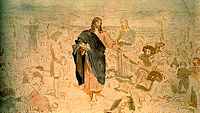
Saturation of a multitude of people are two separate miracles created by Jesus Christ . These are miracles about turning a small amount of food into a large one in order to feed (saturate) a lot of hungry people.
The first miracle - “ Saturation of 5,000 people ” - is the only miracle (except for the resurrection ) that is present in all four canonical Gospels ( Matthew 14: 13-21 , Mark 6: 31-44 , Luke 9: 10-17 and John. 6: 5-15 ) [1] . This miracle is also known under the name: "The miracle of five loaves and two fish ."
The second miracle - “ Saturation of 4000 people ” is recorded in the Gospels of Mark ( Mark 8: 1-9 ) and Matthew ( Matthew 15: 32-39 ), but is absent in the Gospels of Luke and John . This miracle is also known as: “The miracle of seven loaves of bread and fish ” [2] .
Often these two miracles, by mistake, are perceived as one and therefore discrepancies in the number of people and food appear.
Bible Story
Saturation of 5,000 people
The second name: “The miracle of five loaves and two fish” [3] . In the Gospel of John, it is reported that five barley loaves and two fish were provided by the boy to Jesus to feed many people. Through a verse in the Gospel of John, we no longer use the diminutive form of the word “fish” ( John 6:11 ). The rest of the Gospels do not mention the boy.
According to the Gospels, Jesus, hearing that John the Baptist was killed, left by boat ( πλοῖα ) to a deserted place ( Matthew 14:13 ) near Bethsaida ( Luke 9:10 ). A huge crowd of several cities followed him on foot. When Jesus got out of the boat and saw a large crowd, He took pity on them and healed the sick. In the evening, the disciples approached Him and told Jesus to let the people go to the villages to buy food, because it was getting late. Jesus replied: “give them something to eat” ( Matthew 14:16 ; Mark 6:37 ). The students said they only have five loaves of bread ( ἄρτους ) and two fish. After that, Jesus said to bring food and people to sit on the grass. It is especially noted that people sat in rows of 100 ( Mark 6:40 ) and 50 people ( Luke 9:14 ). Taking bread and fish, looking up to heaven, Jesus offered thanks. Then he broke bread and gave food to the disciples, and they gave them to the people. And they all ate, and were filled, and the disciples afterwards gathered twelve baskets ( κοφίνους ) of pieces ( Luke 9:17 ).
The number of those who ate was about five thousand ( πεντακισχίλιοι ) people, excluding women and children ( Matthew 14:21 ).
Saturation of 4,000 people
The second miracle is recorded in the Gospels of Mark and Matthew , and is known as: "The Miracle of the Seven Loaves and Fish." According to the Gospels, a crowd of people gathered and followed Jesus. Jesus, having called the disciples to Himself, said that He was sorry for the people, because he and He had not eaten anything for three days and He did not want to send them home hungry so that they would not weaken on the way. His Disciples asked where they could get enough bread in this remote place for this people. When it turned out that there were seven loaves of bread and several small fish, Jesus told the crowd to sit on the ground. Then, taking seven loaves of bread and fish, Jesus prayed, broke the bread, and gave it to the disciples, and they, in turn, were people. And they all ate, and were satisfied, and after the disciples gathered seven baskets of the pieces. The number of those who ate was four thousand, except for women and children. After Jesus let the crowd go home, He got into a boat and went to the borders of Magdala.
Interpretation
John Chrysostom in this saw the submission of the poor to his fate. They grumbled, but faithfully gave their bread and fish. And Christ, by the power of prayer, multiplied their food. By the fact that he sat the people on earth, he says that Christ teaches simplicity [4] .
Ephraim the Syrian compares these miracles with the prayers of Moses in the desert, when, through his prayers, the Lord fed the people of heaven manna [5] .
Notes
- ↑ Robert Maguire, The miracles of Christ, expositions 1863, published in Weeks and Co. London s. 185
- ↑ John Clowes , The Miracles of Jesus Christ , 1817, published by J. Gleave, Manchester, UK, p. 161
- ↑ John Clowes . The Miracles of Jesus Christ. - Manchester: J. Gleave, 1817 .-- S. 109
- ↑ John Chrysostom. GL XIV, verse 13-23. // Comments of John Chrysostom on St. Matthew .
- ↑ Ephraim the Syrian. Comments by Ephraim the Syrian on the Gospel . - IV-V centuries.