Michel Jean-Pierre Debré ( French: Michel Jean-Pierre Debré ; January 5, 1912 - August 2, 1996 ) - French politician, close associate of Charles de Gaulle , first prime minister of the French Fifth Republic ( 1959 - 1962 ). Member of the French Academy ( 1988 ). Debre is one of the largest political figures in France of the post-war era. It was he who embodied the constitutional ideas of Charles de Gaulle in the 1958 Constitution , which is considered the most successful constitutional project in the history of France. He is considered in France as the main ideologist of gallism after, of course, de Gaulle himself.
| Michelle Debre | |||||||
|---|---|---|---|---|---|---|---|
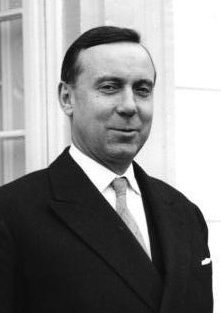 Michel Debre during a visit to Bonn . July 10, 1960 | |||||||
| |||||||
| The president | Charles de Gaulle | ||||||
| Predecessor | Charles de Gaulle | ||||||
| Successor | Georges Pompidou | ||||||
| |||||||
| Head of the government | Charles de Gaulle | ||||||
| The president | Rene Coty | ||||||
| Predecessor | |||||||
| Successor | |||||||
| |||||||
| Head of the government | he himself | ||||||
| The president | Charles de Gaulle | ||||||
| Predecessor | |||||||
| Successor | |||||||
| |||||||
| Head of the government | Georges Pompidou | ||||||
| The president | Charles de Gaulle | ||||||
| Predecessor | Valerie Giscard d'Estaing | ||||||
| Successor | Maurice Couve de Murville | ||||||
| |||||||
| Head of the government | Maurice Couve de Murville | ||||||
| The president | Charles de Gaulle | ||||||
| Predecessor | Maurice Couve de Murville | ||||||
| Successor | Maurice Schuman | ||||||
| |||||||
| Head of the government | Jacques Chaban-Delmas Pierre Messmer | ||||||
| The president | Georges Pompidou | ||||||
| Predecessor | Pierre Messmer | ||||||
| Successor | Robert Halley | ||||||
| |||||||
| Predecessor | |||||||
| Successor | |||||||
| |||||||
| Predecessor | |||||||
| Successor | |||||||
| |||||||
| Predecessor | |||||||
| Successor | |||||||
| |||||||
| Predecessor | |||||||
| Successor | |||||||
| |||||||
| Successor | position abolished; (as Senator from the Department of Indre and Loire) | ||||||
| |||||||
| Predecessor | Maurice Mercier | ||||||
| Successor | Andre Schollet | ||||||
| |||||||
| Predecessor | Andre Schollet | ||||||
| Successor | |||||||
| |||||||
| Successor | Andre Schollet | ||||||
| Birth | |||||||
| Death | Indre and Loire , France | ||||||
| Burial place | |||||||
| Father | |||||||
| Mother | |||||||
| Spouse | Ann Marie, nee. Lemarescie | ||||||
| Children | Vincent, , , Jean-Louis | ||||||
| The consignment | |||||||
| Education | |||||||
| Profession | lawyer | ||||||
| Religion | Judaism | ||||||
| Autograph |  | ||||||
| Awards |
| ||||||
| Place of work | |||||||


Content
- 1 Origin, education and youth
- 2 In the ranks of Resistance
- 3 Post-war period
- 4 Prime Minister
- 5 Reunion
- 6 Return to the national stage
- 7 Orders and medals
- 8 Political career
- 8.1 Elective mandates
- 8.2 Government posts
- 9 Government of Debre: January 8, 1959 - April 15, 1962
- 10 notes
- 11 Links
Origin, Education, and Youth
Michel Debre was born January 15, 1912 in Paris in a family of doctors from the Alsatian rabbinical - his mother, Jeanne, worked in the hospital before the First World War, and his father, , made the career of a pediatrician, and in future became a famous pediatrician and president of the French Medical Academy . His brother Olivier Debreu became an artist, and cousin Laurent Schwartz became a mathematician.
At the end of primary school, Michelle continues to study at the famous lyceums of Montain and Louis the Great .
At the age of 16, Debre, having received a secondary education, unlike his parents and sisters, chooses the state field and enters the Higher School of Political Science , while listening to lectures at the Faculty of Law of the University of Paris . At the same time, Debre read tirelessly, laying his intellectual foundation.
In 1932, the future politician joined the ranks of the French Armed Forces , where he was very addicted to horseback riding and since then has not changed this passion all his life. Debre finished military service with the rank of second lieutenant.
At the end of 1934, Debre, having successfully passed the exams, at the age of 22 became a member of the Council of State - the highest instance of French administrative justice and at the same time the collective "legal adviser" of the Government.
In 1936, Michelle marries Anne-Marie Lemaresquieu, who will give birth to four children: Vincent, Francois, Bernard and Jean-Louis. Senior, Vincent, will become a successful businessman, Francois - a journalist. Bernard, although a doctor by profession, is the head of the urology department of the famous Parisian Hospital Cochin, is a deputy of the French National Assembly from Paris, and Jean-Louis Debreu , as President of the National Assembly, has been appointed President of the Republic Jacques Chirac President of the Constitutional Council of France .
In 1938, Debreu for the first time penetrates the holy of holies of French politics, entering the office of the famous parliamentarian Paul Reynaud , appointed minister of finance.
In the ranks of the Resistance
With the outbreak of World War II , Debre leaves the work of an official and goes to the army with the rank of cavalry lieutenant. And already in the spring of 1940, when German troops entered French territory, Debre went to the front. In his memoirs, he describes the atmosphere between peace and war that surrounded him in those days when his regiment stopped for an overnight stay near Paris:
“I still remember this halt in a forest in the Seine Valley. Beautiful June night. The guns died down. I fell asleep. Silence and softness permeated the air. And when I woke up, the same silence announced to me that there was a war. Gleams of dawn lit the sky, the horizon reddened from the first rays of the still invisible sun. Not a single bird began to sing, not one animal stirred in the thickets of the forest: a feeling of emptiness, the fear of nature before impending death. ”
After the end of hostilities in France and the dissolution of its army, according to the armistice concluded by Pétain with fascist Germany, Debre was demobilized. In late 1940 - early 1941, he was in Lyon and taught political disciplines. Then he decides to enter the administrative structures formed by the Vichy government . Debre becomes the assistant to Emanuel Monique, appointed secretary general of the French residence in her colony of Morocco , and leaves with him there in the spring of 1941 . Monique believed that drawing the United States into the war would be very important. He thought that, enter the US war, they would stand up for French interests. Debre, under his influence, also shares similar views. However, life soon dispelled these illusions to smithereens, and Monique in the summer of that year was recalled from his post.
But it is here, in Morocco, that Debre understands that only Charles de Gaulle will truly fight the enemy for the liberation of France. Then he enters the ranks of the French Resistance , but decides not to emigrate to England, where General de Gaulle settled, but to France to contribute to the liberation of the land of his ancestors from foreign enslavement. In disguise, he receives an administrative post from the Vichy government and simultaneously embarks on clandestine activities.
He first becomes an ordinary member, and then one of the leaders of the organization "Supporters of Resistance", the main activity of which was the publication of illegal literature and the collection of intelligence data, and in the future - the commission of acts of sabotage, sabotage and the destruction of enemy communications.
The organization "Supporters of the Resistance", in which Debre collaborated, was one of the first to contact Jean Moulins , to whom de Gaulle received the unification of rebel groups into a single whole. So Debre became the “first-hour Gaullist” - so in France they call those who joined Charles de Gaulle during the war.
In the second half of 1943, on behalf of General de Gaulle, Debre compiled a list of commissioners of the Republic who, upon the liberation of the metropolis, should replace the people of Vichy. And in August 1944, he himself became the Commissioner of the Republic in Angers .
Post-war period
- In 1945, de Gaulle, already the Head of the Provisional Government, commissioned Debre public service reform. The most important result of Debre's work was the founding of the National School of Administration (ENA), designed to train the highest state cadres of the Republic. Very quickly, the school began to play the role of a forge of the French ruling class. Suffice it to recall that ENA graduates were such well-known political figures as Laurent Fabius , Michel Rocard , Edouard Balladur , Valerie Giscard d'Estaing , Jacques Chirac .
- In the years of the Fourth Republic, Debre joins the de Gaulle Union of the French people, where he takes part in the development of the doctrine of gallism in the research committee.
- Since 1948 - Senator from the Department of Indre and Loire.
- Since 1953 , at the personal request of de Gaulle, who had already retired from political activity, he headed the Union Group of Republican and Social Action in the Senate (since 1955 - the National Center for Social Republicans), which became the successor to the RPF.
- In 1957 , when it became apparent that the Algerian “dead end” was not leading to victory, but to a full-blown crisis that could sweep France, Debre like a storm, from the pages of the Courrier de la colère newspaper published by him (Chronicle of Anger) calls for the creation of a "government of public salvation" led by the General, and also demands to keep "French Algeria" by all means. In a December 2, 1957 issue, he writes: “So let the Algerians know that renouncing French sovereignty in Algeria is not legitimate; those who would agree with this, thereby outlawed themselves, but those who oppose it, regardless of the means used, use the right to self-defense. ” This clear call for rebellion subsequently led the socialist Alain Savary to the opinion that "in the case of the SLA, the military are not guilty: the only culprit is Debre."
Prime Minister
In 1958, Debreu became Minister of Justice in the office of General de Gaulle and played an important role in drafting the Constitution of the Fifth Republic, since it was he who transferred to paper the constitutional theses expressed by de Gaulle in a speech in Bayeux. However, Debreu, a connoisseur of constitutional law and a fan of British parliamentary traditions, introduces the post of Prime Minister and “rationalized” parliamentarism, which is designed to ensure government stability, even if members of the legislature do not agree with cabinet policies. Immediately after the draft constitution was approved by referendum, Debreu set about reforming the French justice system.
When the Constitution was approved by referendum on September 28, 1958, the President of the Republic, Charles de Gaulle, appointed Debre on January 9, 1959, to the second post in the Republic, the Prime Minister. Appointing Debre, de Gaulle bluntly told him: “I am not going to go into the details of government activities. I will limit myself to defining the main directions. ” Indeed, since the founding of the Fifth Republic in the exclusive jurisdiction of the head of state as a national leader, his “reserved sphere” (Jacques Shaban-Delmas) of activity has been diplomacy, Algeria and defense policy; concern for the "French home and hearth" was assigned to the Prime Minister and the government.
And if de Gaulle set about restoring the “national greatness of France” in the international arena, then Debre's task was to ensure that French domestic politics corresponded to this high standard. First of all, the government of Debre took up the improvement of the country's economic situation. In addition to the devaluation of the franc, the Debre cabinet is developing a system of measures to ensure state regulation of the economy and in February 1959 adopted a plan for modernization and equipment. The task was set in it to develop mainly those industries that most successfully contribute to the improvement of the balance of payments. Much attention was paid to improving the competitiveness of the French economy. The government also took care of the prosperity of agriculture. In 1960 was adopted on the provision of large subsidies to state farms. Such a policy began to immediately bring advantages. Thus, the country's trade deficit has significantly decreased, the balance of payments deficit for the French franc zone has completely disappeared, and finally, for the first time in many years, the state budget deficit has been reduced. And in 1959, the Government implemented the tax reform approved by the Parliament, which aimed to simplify the complex and cumbersome taxation system, in particular, combine progressive and proportional taxes into a single income tax for each taxpayer. The cabinet’s social policy was aimed at improving the living standards of the French. Over the course of three years, the minimum wage has increased several times.
Debre, as they say, from dawn to dawn worked for the good of the motherland, controlling the work of each minister and their fulfillment of his instructions, always being aware of even the smallest problems. Every Wednesday, the Council of Ministers met at the Champs Elysees, chaired by the President of the Republic; and the head of state was seated not at the end of the oval-shaped dining table, but at its center, face to face in front of the Prime Minister. On all matters of French politics, the President and the Prime Minister had no disagreements, except for one, but the most dangerous, bleeding wound on the body of France - the Algerian conflict. And while de Gaulle led smooth steps to ensure independence for Algeria, while maintaining "preferential" ties with France, then Debreu, on the contrary, is categorically opposed. Several times he tried to talk to de Gaulle about this, even to convince him. The president evaded such conversations. More than once, Debre handed the General a resignation letter. De Gaulle does not accept her. But after the Evian Agreements were signed, under which France left Algeria. Then, at the request of De Gaulle, Debre resigns, turning from a second person of the state into an ordinary citizen of the Republic.
Reunion
In November 1962, on the occasion of the elections to the National Assembly following the dissolution of his previous convocation, he tried to be elected as a deputy in the Indre and Loire department , but failed. And already in the spring of that year, Debre was “anchored” and sent to ... Reunion Island to join the fight for the vacant seat of the deputy. This amazing choice is explained by his fear of seeing what remains of the French colonial empire, if you follow the path borrowed from Algeria, that is, independence on which this process will not stop. To justify the division of the island into departments, unexpectedly introduced in 1946, and to protect its inhabitants from the desire to stand for independence, he implements a development policy aimed at managing the birth rate and poverty that it engenders, in which observers recognized the influence inherited from his father Robert on social issues. He insists on opening the first family development center on the island. He begins to create numerous school canteens, where he insists on the distribution of free milk powder, the so-called. "Debre Milk." He personally fights to get Paris to open a second lyceum in the south of the island, in Buffer: before that there was only one lyceum in Saint-Denis, for several hundred thousand inhabitants. He is also developing an adaptable military service created by Pierre Messmer. Believing that the demography of the island is a threat to its development, he organizes numerous programs to resettle the inhabitants of Reunion to the metropolis.
Return to the National Stage
In 1966, Debre, at the personal suggestion of General de Gaulle, again transferred to work in the Government, this time to the post of Minister of Economics and Finance, where he develops measures to combat inflation and stabilize the franc and does everything in his power to ensure French the economy is a new boom. From 1968 to the spring of 1969, until the resignation of General de Gaulle, Debre headed the Ministry of Foreign Affairs. He described his activities as the head of French diplomacy as follows: “Relations with the two superpowers, the United States and the Soviet Union; cooperation with Germany and the organization of a united Europe, which meant at that time the expansion of the Community, the inclusion of Great Britain; Israel, the Middle East and the Mediterranean; finally, Black Africa, as well as the Far East, where the war in Vietnam was still going on. ”
After the election of Georges Pompidou as President of the Republic in June 1969, Debreu receives a portfolio of the Minister of National Defense in the office of Jacques Chaban-Delmas. After the death of General de Gaulle on November 9, 1970, Debre sees his mission in continuing the work of the “man of June 18” - to help ensure that the ideas of the first President of the new France lie at the heart of her domestic and foreign policy. He constantly speaks of the importance of maintaining the Gaullist principles at meetings of the Council of the Republic. But time is making its adjustments, and Pompidou is moving away from de Gaulle's course to the supremacy of France’s national interests. Then, in 1973, Debre resigns and renews the mandate of a deputy of the National Assembly of the Republic.
In 1981, Debre is running for President of the Republic, but gaining only 1.6% of the vote. Explaining his decision - after all, everyone knew for sure that the favorites of the presidential election would be Valerie Giscard D'Estaing and Francois Mitterrand, and from the Gaullists - Jacques Chirac - Debre said: "I wanted to continue de Gaulle's business." Later, he specified: "I would like to save at least the main thing."
Orders and medals
- Legion of Honor Commander
- The Cross for Military Merit 1939-1945
- Resistance Medal with a socket
- Medal of Volunteer Service in Free France
Political career
Elected Mandates
- Member of the Council of the Republic from the Department of Indre and Loire in 1948-1958
- Member of the National Assembly from 1963 to 1988 (with a break in 1966-1973)
- Member of the General Council of the Department of Indre and Loire in 1951-1970.
- Member of the Municipal Council of Amboise in 1959-1966
- Member of the Reunion in 1963-1988
- Mayor Amboise in 1966-1989
- Member of the General Council of the Department of Indre and Loire in 1976-1992.
- Member of the European Parliament in 1979-1980
Government posts
- Minister of Justice, Keeper of the Seal in 1958-1959
- Prime Minister in 1959-1962
- Minister of Economics and Finance from January 8, 1966 to 1968
- Minister of Foreign Affairs in 1968-1969
- Minister of National Defense in 1969-1973
Government of Debre: January 8, 1959 - April 15, 1962
- Michel Debre - Prime Minister of France;
- Maurice Couve de Murville - Minister of Foreign Affairs;
- Pierre Guillaume - Minister of National Defense;
- Jean Bertoin - Minister of the Interior;
- Antoine Pine - Minister of Finance and Economic Affairs;
- Жан-Марсель Жанненей — министр торговли и промышленности;
- Поль Бакон — министр труда;
- Эдмон Мишле — министр юстиции;
- Андре Буллош — министр национального образования;
- Раймод Трибуле — министр по делам ветеранов;
- Андре Мальро — министр культуры;
- Роже Уде — министр сельского хозяйства;
- Робер Бюрон — министр общественных работ и транспорта;
- Бернар Шено — министр здравоохранения и народонаселения;
- Бернар Корну-Жентиль — министр почт и телекоммуникаций;
- Роже Фрей — министр информации;
- Пьер Судро — министр строительства;
Changes
- 27 марта 1959 — Робер Лекур входит в Кабинет министров как министр коопераций.
- 27 мая 1959 — Анри Рошеро наследует Уде как министр сельского хозяйства.
- 28 мая 1959 — Пьер Шатене наследует Бертоену как министр внутренних дел.
- 23 декабря 1959 — Дебре наследует Буллошу как и. about. министра национального образования.
- 13 января 1960 — Уилфрид Баумгартнер наследует Пине как министр финансов и экономических дел.
- 15 января 1960 — Луи Жокс наследует Дебре как министр национального образования
- 5 февраля 1960 — Пьер Мессмер наследует Гийома как министр национальной обороны. Робер Лекур становится министром заморских департаментов и территорий и по делам Сахары. Его предыдущий пост министра коопераций упразднен. Мишель Морисе-Бокановски наследует Корну-Жентилю как министр почт и телекоммуникаций. Луи Террнуа наследует Фрею как министр информации.
- 23 ноября 1960 — Луи Жокс становится министром по делам Алжира. Пьер Гийома наследует Жоксу как и. about. министра национального образования.
- 20 февраля 1961 — Люсьен Пайе наследует Гийома как министр национального образования.
- 6 мая 1961 — Роже Фрей наследует Шатене как министр внутренних дел.
- 18 мая 1961 — Жан Фойе входит в Кабинет как министр коопераций.
- 24 августа 1961 — Бернар Шено наследует Мишле как министр юстиции. Жозеф Фонтане наследует Шено как министр здравоохранения и народонаселения. Эдгар Пизани наследует За Рошеро как министр сельского хозяйства. Луи Жакино наследует Лекуру как министр заморских департаментов и территорий и по делам Сахары. Террнуа прекращает быть министром информации, и пост упразднен.
- 19 января 1962 — Валери Жискар д'Эстен сменил Баумгартнера на посту министра финансов и экономических дел.
Notes
- ↑ 1 2 Немецкая национальная библиотека , Берлинская государственная библиотека , Баварская государственная библиотека и др. Record #11917975X // Общий нормативный контроль (GND) — 2012—2016.
- ↑ http://www.senat.fr/senateur-4eme-republique/debre_michel0147r4.html
- ↑ 1 2 BNF identifier : Open Data Platform 2011.
- ↑ Дебре Мишель // Большая советская энциклопедия : [в 30 т.] / под ред. А. М. Прохоров — 3-е изд. — М. : Советская энциклопедия , 1969.
Links
- Биография на сайте Французской академии (недоступная ссылка с 23-05-2013 [2323 дня] — история , копия ) (фр.)