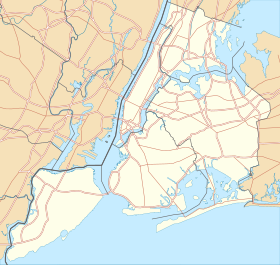
Bedford - Stuyvesant ( English Bedford – Stuyvesant ) - a district in the north of borough Brooklyn , New York . In the north, Bedford-Styvesant is bounded by Flushing Avenue and Williamsburg , in the east by Brooklyn Broadway and Bushwick , in the south by Atlantic Avenue and Crown Heights , in the west by Klosson Avenue and Klin .
| New York City | |
| Bedford - Styvesant | |
|---|---|
| English Bedford – stuyvesant | |
 North view | |
| Borough | Brooklyn |
| Square | 7.2 km² |
| Population | 157 530 people (2011) |
| Population density | 21 879.17 people / km² |
| Metro routes |        |

Content
Etymology
The district got its name from the working areas of Bedford and Styvesant Heights, which were located in its western and eastern parts in the 19th century, respectively. Often the name of the area is shortened to Bed-Stuy ( born Bed – Stuy ).
History
Until the second half of the 17th century , Canaries Indians lived on the territory of the district. The Dutch West Indies company bought their land and founded the Bedford settlement. Dutch farmers and their slaves lived in the village.
In August 1776, during the battle of Long Island, Brooklyn and its suburbs were captured by the British. Soon after the war, land began to be sold to newly arrived settlers. Some of the plots went to blacks, representing more than a quarter of Bedford's population.
In 1836, a railway was laid across Bedford along Atlantic Avenue. Now it is part of the Long Island Rail System.
By 1873, the population reached 14,000. In addition to blacks, Germans , Scots , Dutch and Jews lived in the area. Significant population growth in the 1880s was ensured by the construction of an overpass railway and the Brooklyn Bridge . Entire new housing estates have appeared in Bedford: St. Marks, New and East Brooklyn. At the turn of the 19th and 20th centuries, the district began to be inhabited by representatives of the middle and upper class; businessmen Frank Woolworth and settled in Bedford. In 1920, over 45,000 people lived in the district.
In the 1930s, a subway was laid in the area. Italians, Jews from Eastern Europe and blacks from the southern states and the Caribbean began to settle in Bedford. By 1940, the number of blacks was close to 70,000; the welfare of the area began to decline. The fight against poverty and segregation was launched in the area. One of the public organizations that took part in it was the National Association for the Advancement of Colored People . On this basis, residents gained a certain political influence. So, in 1968, Shirley Chisholm was elected to the US House of Representatives from the 12th District of the State of New York , which included the Bad Pack,. She became the first black representative of Congress .
In the late 1960s, Sen. Robert Kennedy visited Bedford-Styvesant. Impressed by the social problems of the area, he created the Bedford-Stuyvesant Restoration Corporation .
In the 1980s, the area experienced a new influx of blacks from the Caribbean. At the end of the 20th century, wealthy and prosperous descendants of the second and third generations of visitors from the West Indies began to settle in Bedford. Thanks to them, the economic condition of the region has stabilized.
At the beginning of the 21st century, the Bedford-Styvesant housing stock was mainly represented by the development of mansions of the early 20th century.
Population
According to 2011 data, the population of the quarter was 157,530 inhabitants. The average population density was about 21,879 people / km², which is about 1.6 times higher than the average Brooklyn population density. Most of the population is still represented by African Americans , but at the beginning of the XXI century there is a tendency to reduce their share and increase the number of white residents [1] . The average household income was about 1.5 times lower than the city average: $ 37,518 [2] .
According to a survey conducted at the intersection of 2013-2014, the proportion of residents dissatisfied with housing conditions in Bedford-Styvesant is one of the highest in New York [3] .
Attractions
In the south of Bedford-Styvesanta, there is a 4- hectare Styvesant Heights microdistrict, represented by 577 buildings dating from 1870-1900. In 1975, 13 residential areas were listed on the US National Register of Historic Places . In 1996, this status was assigned to four more neighborhoods of the microdistrict. Another notable attraction in the area is the men's high school ( English ), built in 1891. At one time, the writers Norman Mailer , Isaac Asimov and composer Aaron Copland studied in it.
Public Transport
Bedford-Styvesant is served by routes A , C , G , J , M , S and Z of the New York Metro [4] . As of April 2014, bus routes B15, B24, B25, B26, B38, B43, B44, B46, B47, B48, B52 and B54 operated in the district [5] .
Notes
- ↑ Sam Roberts. Striking Change in Bedford-Stuyvesant as the White Population Soars . The New York Times (August 4, 2011). Date of treatment May 1, 2014.
- ↑ Bedford Stuyvesant (Bed-Stuy) neighborhood in Brooklyn, New York (NY ) . city-data.com. Date of treatment May 1, 2014.
- ↑ Reuven Blau. Bedford-Stuyvesant residents are among the least happy in the city, according to Talking Transition report . NY Daily News (February 10, 2014). Date of treatment May 1, 2014.
- ↑ MTA Subway Map . mta.info. Date of treatment May 1, 2014.
- ↑ Brooklyn Bus Map . mta.info. Date of treatment May 1, 2014.
Literature
- Mario A. Charles. Bedford – Stuyvesant // The Encyclopedia of New York City / Kenneth T. Jackson, Lisa Keller, Nancy Flood. - 2. - Yale University Press, 2010 .-- P. 109-110. - 1584 p. - ISBN 0300182570 .