PT-76 ( Object 740 ) - Soviet light amphibious tank . Adopted in 1951. During serial production, from 1951 to 1967, it was repeatedly modernized, in total 3039 PT-76 were produced, as well as a number of machines based on it [1] . The tank was in service with the Soviet Army , but was subsequently largely replaced by infantry fighting vehicles . Nevertheless, up to 100 tanks of this type as of 2004 were in service with the Russian armed forces [2] . About 2000 PT-76s were exported to a number of countries, in some of which it served as the basis for the release of its own modernized versions [3] . As of the beginning of 2008, it is still in service in a number of countries [2] .
| PT-76 | |||||||||||||||||||||||||||||||||||||
|---|---|---|---|---|---|---|---|---|---|---|---|---|---|---|---|---|---|---|---|---|---|---|---|---|---|---|---|---|---|---|---|---|---|---|---|---|---|
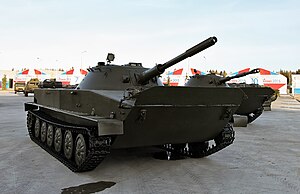 PT-76 in the Patriot Park. | |||||||||||||||||||||||||||||||||||||
| PT-76 arr. 1952 | |||||||||||||||||||||||||||||||||||||
| Classification | light amphibious tank | ||||||||||||||||||||||||||||||||||||
| Combat weight, t | 14.5 | ||||||||||||||||||||||||||||||||||||
| Layout diagram | classic | ||||||||||||||||||||||||||||||||||||
| Crew | 3 | ||||||||||||||||||||||||||||||||||||
| Story | |||||||||||||||||||||||||||||||||||||
| Manufacturer | |||||||||||||||||||||||||||||||||||||
| Years of production | 1951 - 1967 | ||||||||||||||||||||||||||||||||||||
| Years of operation | since 1951 | ||||||||||||||||||||||||||||||||||||
| The number of issued, pcs. | 3039 [1] | ||||||||||||||||||||||||||||||||||||
| Key Operators |      | ||||||||||||||||||||||||||||||||||||
| Dimensions | |||||||||||||||||||||||||||||||||||||
| Body length mm | 6910 | ||||||||||||||||||||||||||||||||||||
| Length with gun forward, mm | 7625 | ||||||||||||||||||||||||||||||||||||
| Width mm | 3140 | ||||||||||||||||||||||||||||||||||||
| Height mm | 2195 | ||||||||||||||||||||||||||||||||||||
| Base mm | 4080 | ||||||||||||||||||||||||||||||||||||
| Track mm | 2740 | ||||||||||||||||||||||||||||||||||||
| Clearance mm | 370 | ||||||||||||||||||||||||||||||||||||
| Reservation | |||||||||||||||||||||||||||||||||||||
| Type of armor | rolled steel homogeneous high hardness | ||||||||||||||||||||||||||||||||||||
| Forehead of the body (top), mm / city. | 10/80 ° | ||||||||||||||||||||||||||||||||||||
| Forehead of the body (middle), mm / city. | 10/45 ° | ||||||||||||||||||||||||||||||||||||
| The forehead of the body (bottom), mm / city. | 10 / 45–90 ° | ||||||||||||||||||||||||||||||||||||
| Board of the case (top), mm / city. | 10/0 ° | ||||||||||||||||||||||||||||||||||||
| Board of the case (bottom), mm / city. | 8/0 ° | ||||||||||||||||||||||||||||||||||||
| Housing feed (top), mm / city. | 6/0 ° | ||||||||||||||||||||||||||||||||||||
| Housing feed (middle), mm / city. | 6/45 ° | ||||||||||||||||||||||||||||||||||||
| Housing feed (bottom), mm / city. | 6 / 45–90 ° | ||||||||||||||||||||||||||||||||||||
| Bottom mm | five | ||||||||||||||||||||||||||||||||||||
| Housing roof, mm | 6 / 85—90 ° | ||||||||||||||||||||||||||||||||||||
| Tower forehead, mm / city. | 15/35 ° | ||||||||||||||||||||||||||||||||||||
| Board towers, mm / city. | 15/35 ° | ||||||||||||||||||||||||||||||||||||
| The feed of the tower, mm / city. | 10/35 ° | ||||||||||||||||||||||||||||||||||||
| Roof of the tower, mm | 6 | ||||||||||||||||||||||||||||||||||||
| Armament | |||||||||||||||||||||||||||||||||||||
| Caliber and brand of guns | 76 mm D-56T | ||||||||||||||||||||||||||||||||||||
| Gun type | rifled gun | ||||||||||||||||||||||||||||||||||||
| Gun ammunition | 40 | ||||||||||||||||||||||||||||||||||||
| Angles VN, deg. | −4 ... + 30 ° | ||||||||||||||||||||||||||||||||||||
| Corners GN, hail. | 360 ° | ||||||||||||||||||||||||||||||||||||
| Firing range, km | up to 12 | ||||||||||||||||||||||||||||||||||||
| Sights | telescopic TShK-66 | ||||||||||||||||||||||||||||||||||||
| Machine guns | 1 × 7.62 mm SGMT | ||||||||||||||||||||||||||||||||||||
| Mobility | |||||||||||||||||||||||||||||||||||||
| Engine type |
| ||||||||||||||||||||||||||||||||||||
| Engine power, l with. | 240 | ||||||||||||||||||||||||||||||||||||
| Speed on the highway, km / h | 44 | ||||||||||||||||||||||||||||||||||||
| Cross country speed, km / h | 20-25 (10.2 afloat) | ||||||||||||||||||||||||||||||||||||
| Cruising on the highway , km | 240-260 | ||||||||||||||||||||||||||||||||||||
| Cruising cross country, km | 180-210 (60–70 afloat) | ||||||||||||||||||||||||||||||||||||
| Specific Power, l s / t | 17.1 | ||||||||||||||||||||||||||||||||||||
| Suspension type | individual torsion bar | ||||||||||||||||||||||||||||||||||||
| Ground pressure, kg / cm² | 0.5 | ||||||||||||||||||||||||||||||||||||
| Gradeability, hail. | 38 ° | ||||||||||||||||||||||||||||||||||||
| The overcome wall, m | 1,1 | ||||||||||||||||||||||||||||||||||||
| The overcome ditch, m | 2,8 | ||||||||||||||||||||||||||||||||||||
| Fording , m | swims | ||||||||||||||||||||||||||||||||||||
Creation History
Prerequisites for the creation of the PT-76

In the years preceding World War II , the USSR gained considerable experience in developing floating tanks . With the beginning of World War II, work on them, as well as the production of already developed designs, were discontinued, as designers faced more important tasks. In 1941, the USSR had the world's largest fleet of amphibious tanks, but in the subsequent battles of the initial period of the war, the vast majority of them were lost. As a result, by the beginning of the advance of Soviet troops to the west in 1943, the Red Army was left with only a relatively small fleet of obsolete and low- reliability vehicles, whose combat capabilities clearly did not meet the requirements of the army [4] .
In addition, in 1944-1945, Soviet troops experienced a significant need for crossing facilities to overcome numerous water barriers during the offensive in Eastern Europe [4] . However, there were no self-propelled transport means of our own production, and the floating tanks of the pre-war construction still preserved in the units were not suitable for this purpose, because they could not bear the additional burden due to the low buoyancy. All this led to the fact that before the arrival of the Red Army soldiers who had not kept pace with the pace of the moving troops of the pontoon bridges, they had to use improvised means for crossing, usually excluding the transportation of any heavy weapons. This significantly slowed the pace of offensive and led to increased losses [4] .
After the war ended, the problem of the lack of amphibious equipment in the arsenal of the Soviet Army remained acute. In the event of a possible conflict with the West, Central Europe was considered the main theater of operations , which, with its significant number of water barriers, would cause many difficulties to the Soviet troops [5] . In this regard, by the end of the 1940s, a whole series of both transportable means of transport and floating vehicles and conveyors was developed and adopted. The development of amphibious armored vehicles was, however, not so successful. Immediately after the war, the terms of reference were developed for the creation of a floating tank and armored personnel carrier with a maximum degree of unification. The tank was supposed to be armed with a 76-mm cannon, and in addition should be able to carry afloat landing of 20 people on the armor. Developed by the Krasnoye Sormovo plant in 1946-1948, the R-39 tank, similar in design to amphibious tanks of pre-war development, was poorly armored and showed insufficient reliability, water speed and buoyancy in tests, which led to the cessation of work on it [ 6] .
Object 740
The development of a new amphibious tank by the decree of August 15, 1949 was entrusted to two design teams of VNII-100, located in Leningrad and Chelyabinsk . In parallel, the most unified amphibious tanks were to be developed, which received the designation Object 740 and the floating armored personnel carrier Object 750 , which later became the BTR-50 . According to the updated technical specifications, the tank was supposed to have a mass of 13-14 tons, armament from a 76-mm gun with an ammunition load of 40 rounds and armor up to 10 mm thick. The V-6 engine was supposed to provide the tank with a speed of 40 km / h on land and 10 km / h afloat. By the end of 1950, the design bureau was obliged to provide a prototype tank for testing [7] .
As a mover of the tank afloat, this time various options were considered, but as a result a jet mover was chosen. The chief designer of the tank was N.F. Shashmurin. However, the jet propeller found many opponents, and as a result, an alternative project was started at Moscow VRZ No. 2, which used propellers as a propeller based on earlier designs [8] . In the meantime, work on the 740 facility was progressing well, and the design of the tank took into account many of the shortcomings of its predecessors. The prototypes of the tank and the armored personnel carrier were completed in the spring of 1950 and by June of the same year had already entered state tests. By that time, samples of VRZ No. 2 were also completed - the K-90 tank and the K-78 armored personnel carrier [9] .
Comparative tests of the object 740 and K-90 were carried out from July 5 to 29, 1950. In tests, the 740 showed significantly better cross-country ability than the K-90. The selection committee also noted that in a number of parameters, in particular in armor thickness, ground pressure, ground speed and cruising range, the new tank even significantly exceeds the requirements given by the task [10] . The conclusion of the state commission said [11] :
A number of structurally new units and assemblies installed on the presented floating tank that were not previously used on floating tanks, such as jet propellers, an ejection cooling system, air purification with automatic dust removal, hydraulic shock absorbers, etc., provide the following advantages:
- a) Water-jet propulsors provide good speed and maneuverability afloat and high traffic through water bodies overgrown with shrubs, reeds and various algae. The low specific pressure of the tracks on the ground ( 0.44 kg / cm² ) allows the tank to overcome very wetlands, and in the presence of water, traction created by water cannons can be additionally used.
- Tests of water cannons under conditions when a significant amount of pebbles were transported through water pipes confirmed the reliability of the work and the structural strength of the entire water jet installation.
- b) The ejection cooling system, unlike the fan one, consumes significantly less power, has small dimensions, and is simple in design and maintenance.
- c) Installation of hydraulic shock absorbers in the presence of an individual torsion bar suspension provides high smoothness of movement, which increases the average speed and accuracy of fire on the move.
- d) Forced marches up to 510 km carried out during testing, as well as non-stop and night marches confirm the ability of amphibious tanks to make long, intense marches with high average speeds.
As a result, on August 6, 1951, by decree of the Council of Ministers of the USSR, object 740 was adopted by the Soviet Army under the designation PT-76 (amphibious tank with a 76-mm gun) [12] .
Series Production
| Production schedule of the PT-76 for the Soviet Army [13] [14] | ||||||||||||||||||
| Year | 1951 | 1952 | 1953 | 1954 | 1955 | 1956 | 1957 | 1958 | 1959 | 1960 | 1961 | 1962 | 1963 | 1964 | 1965 | 1966 | 1967 | Total |
| PT-76 | ten | 85 | 210 | 400 | 500 | 206 | 265 | 180 | 40 | - | ||||||||
| PT-76B | - | 110 | 105 | 121 | 112 | 204 | 191 | 69 | 116 | 115 | 3039 | |||||||
Further Development
Design Description
Armored Corps and Tower
Armament
| Ammunition gun D-56T [15] [16] | |||||||||
| Shot mark | Projectile type | Projectile mark | Shot weight, kg | Projectile weight, kg | The mass of explosives, g | Fuse mark | Muzzle velocity, m / s | Range direct shot at a target with H = 2m | Year of adoption |
| Armor-piercing shells | |||||||||
| UBR-354 | pointed armor-piercing ballistic tip tracing | BR-354 | MD-10 | 655 | 780 | ||||
| UBR-354A | armor-piercing blunt-headed with locators and a ballistic tip, tracing | BR-350A | 9.12 | 6.30 | 155 | MD-7 | 662 | 780 | |
| UBR-354B | armor-piercing dull-headed with a ballistic tip, tracing | BR-350B | 9.12 | 6.50 | 119/65 [17] | MD-8 | 655 | 780 | |
| UBR-354P | armor-piercing subcaliber coil type tracer | BR-354P | 6.30 | 3.02 | - | - | 950 | 940 | 1943 |
| UB-354N | streamlined armor-piercing subcaliber | BR-354N | 6.00 | 3.02 | - | - | 950 | 1050 | |
| UBP-353M | cumulative tracer | BP-350M | 5.47 | 3.94 | 490 | BM | |||
| UBK-354 / UBK-354M | cumulative feathered tracer | BK-354 / BK-354M | 7.00 | 740 | GPV-1 or GKN | 1955 | |||
| High-explosive shells | |||||||||
| UOF-354M | high-explosive steel fragmentation grenade | OF-350 | 8.82 | 6.20 | 710 | MG-1 or KTM-1-U or KTMZ-1-U | 680 | 820 | |
| UO-354AM | cast iron fragmentation grenade | O-350A | 8.83 | 6.21 | 540 | MG-N or KTM-1-U | |||
| Armor penetration table for D-56T [18] | ||||||
| Shell \ Distance, m | 100 | 300 | 500 | 1000 | 1500 | 2000 |
| BR-350B | ||||||
| (90 ° meeting angle) | 80 | 75 | 70 | 60 | 50 | 45 |
| (meeting angle 60 °) | 65 | 60 | 55 | 50 | 45 | 35 |
| BR-354 | ||||||
| (90 ° meeting angle) | 95 | 80 | 70 | 60 | ||
| (meeting angle 60 °) | 75 | 76 | 55 | 45 | ||
| BR-354P | ||||||
| (90 ° meeting angle) | 120 | 105 | 90 | 60 | - [19] | |
| (meeting angle 60 °) | 95 | 85 | 75 | 50 | ||
| BR-354N | ||||||
| (90 ° meeting angle) | 125 | 110 | 90 | 75 | ||
| (meeting angle 60 °) | 100 | 90 | 75 | 65 | ||
| BP-350M | ||||||
| (90 ° meeting angle) | ||||||
| (meeting angle 60 °) | 70-75 at any distance [15] | |||||
| It should be remembered that at different times and in different countries used different methods for determining armor penetration. As a result, direct comparison with similar data from other guns is often impossible. | ||||||
Monitoring and communication tools
In non-combat conditions, the PT-76 commander can monitor the terrain while standing in an open hatch. In battle, in addition to the sight, the commander has three periscopic observation devices located in a rotating commander’s turret. The devices are installed in a dense group and provide an overview of only a relatively narrow sector. The main one on tanks of early releases was the binocular commander’s TPKU , on the PT-76 of later releases and the PT-76B replaced by a slightly different TPKU-2 [20] . Both devices have a magnification of 5 × and a field of view of 7.5 ° horizontally, allowing observation at ranges up to 3000 meters and are equipped with a coordinate grid for targeting and adjusting fire, as well as a rangefinder scale for determining the distance to a target of known height - 2.7 m (“Tank”) [21] . On the sides of it are two prismatic periscope devices of a single-magnification TNP [20] .
Charging for viewing the terrain in battle has only one rotary periscope device MK-4 of a single increase, located in the roof of the tower in front of the hatch [20] . The driver on the march observes through the open hatch, while in battle, to view the terrain, he uses three consumer goods devices that are fan in front of the hatch and provide an overview of the frontal sector. For observation afloat with a raised wave-reflecting shield on tanks of early releases, periscope devices PER-17 or PER-17A are used , later replaced by TNP-370 [22] . To drive the tank at night, the late-production PT-76 and PT-76B are equipped with a TVN-2B binocular night-vision device , which is installed in place of the central consumer goods. TVN-2B is an electron-optical device that works by illuminating the headlamp FG-100 , or, on PT-76B, FG-125 with an infrared filter, providing the driver with a visual range of 50-60 m and a field of view of 30 ° at one-time increase <Communication facilities VHF radio station R-123 ref name = "TV 09-01 45"> M.V. Pavlov, I.V. Pavlov. Domestic armored vehicles 1945-1965 // Equipment and weapons: yesterday, today, tomorrow. - M .: Tekhinform, 2009. - No. 1 . - S. 45 . </ref>
Engine and transmission
The engine and gearbox represent the modernization of these units from the T-34 tank.
Chassis
Jet engine
The PT-76 moves afloat using a hydro-jet jet engine.
Modifications
The following modifications of the PT-76 tank were produced, which are distinguished by the type of gun:
- PT-76 Model 1 - with the D-56T gun. Armor - piercing projectile at 2000 m - 60 mm (armor at an angle of 60 degrees)
- PT-76 Model 2 - with the D-56TM gun. The muzzle brake on the gun has been upgraded.
- PT-76 Model 3 - with the D-56TM gun. Two-chamber muzzle brake on the gun.
- PT-76B Model 4 - with a gun D-56TS. The gun is stabilized in two planes. The tank was produced from 1959 to 1963.
- PT-76M is an experimental vehicle based on PT-76B. It was made in a single copy, which failed the test due to insufficient seaworthiness.
- AU-220M combat module - was developed in the 2000s by the Central Research Institute "Petrel". The module consists of a 57-mm automatic gun BM-57 based on the S-60 anti - aircraft gun) and a PKT machine gun coaxial with it with an upgraded fire control system. The AU-220M developers are already proposing to install this installation on a PT-76 amphibious tank as the main weapon for modernization. first prototype, equipped with a combat module with a 57-mm automatic gun , was presented in 2013 in Nizhny Tagil at the Russian Expo Arms-2013 defense exhibition .
The tank was produced in Poland under the name PT-76. In the later modification, another 7.62 mm machine gun and separate hatches for the commander and gunner were added.
In Indonesia, the PT-76s were modernized in the late 1990s, with new engines, transmissions and 90mm Kokeril guns installed on them. These machines are designated in the Western press as PT-2000 .
“Object M906” - the machine is made of armored aluminum alloys, boosted to 221 kW (300 hp) 8D6-300M engine
Combat use
PT-76s were widely used in a number of armed conflicts , including the Vietnam War , in conflicts between Israel on the one hand and Syria with Egypt on the other in 1967 and 1973, the Indo-Pakistani war of 1971 , the Yugoslav war of 1991-1995. , occasionally - during the hostilities in Chechnya .
1965 Indo-Pakistan War
Since the spring of 1965, attacks by the Pakistani side on the border have become more frequent, as a result, India turned to the Soviet Union to obtain protection against a possible invasion. India received the first PT-76 tanks in August 1965. Before the war, India had two regiments of such tanks, consisting of about 90 pieces. At first, Indian soldiers called the Patton the new tanks of unknown design. The PT-76 was the only Soviet tank that fought in the 1965 war.
On September 21, company C of the 7th Regiment, armed with the PT-76, counterattacked the Tatti Jaimal Singh village captured by the Pakistanis. During the battle, the Indian PT-76 knocked out Pakistanis from the village, knocking out one Patton, one Sherman and capturing 2 jeeps with 106-mm M40 guns and 2 ammunition trucks, in turn, the Pakistanis managed to knock down one Indian tank. The total Indian losses during the war were around the PT-76 company, mostly abandoned, 6 or 7 of which were captured by Pakistanis. [23]
Vietnam War
The first major clash between Vietnamese tanks and American tanks took place on March 3, 1969. The 4th battalion of the 202nd tank regiment with 12 PT-76 tanks and several armored personnel carriers BTR-50PK attacked the American Ben-Hat camp, South Vietnam . The purpose of the attack was to destroy the positions of the battery of 175 mm M107 self-propelled guns . The lead PT-76 was blown up by a mine, but its crew continued to conduct cannon fire at the enemy. The remaining tanks were met by a platoon M48 "Patton" of the 69th tank regiment of the US Army and two anti-aircraft self-propelled guns M42 . One M48 was incapacitated when a PT-76 shell hit the turret. Another Patton destroyed one Vietnamese tank with return fire. The attack choked after the loss of two PT-76 and one BTR-50PK . [24]
The American expert called the PT-76 "Ghost Tank". Most likely this is due to the fact that the American commandos extremely unsuccessfully used 66-mm M72 LAW anti-tank hand grenade launchers in the battle for the Lang Wei camp - only one machine was set on fire, although up to nine shots were fired at some tanks from close range. [25]
In 1971, during the capture of the city of Snow in Cambodia, the 11th US tank regiment captured a fleet of trucks with 76 mm shells for the PT-76 tanks. [26]
During the Easter offensive, the Vietnamese People’s Army lost 56 PT-76 tanks. [27]
The Six Day War
Egyptian PT-76s participated in the 1967 war . They were used for other purposes and without much success. As a result of battles from 29 PT-76s, only 2 were destroyed and 7 were abandoned. 7 captured amphibious tanks were commissioned by the 88th reconnaissance battalion of the Israeli army. Engines were replaced on these machines, American machine guns and new radio stations were installed.
Indo-Pakistan War of 1971
Indian and Pakistani PT-76s participated in the 1971 war . The Indians deployed two regiments and 2 independent squadrons of such tanks on the eastern front (in total, the Indians had about 150 of these tanks), the Pakistanis had 6-7 PT-76s. In total, about 150 Indian tanks and 75 Pakistani clashed on the Eastern Front. [28] Virtually all units armed with the PT-76 were concentrated against the Pakistani group in East Bengal. Floating tanks were the best suited for operations in the Ganges delta.
The first clash occurred even before the official start of the war. On November 21, 14 Indian PT-76 tanks and a T-55 platoon crossed the border of East Pakistan in the Garibpur area. A company of M24 Chaffee tanks was sent to intercept them. In a subsequent tank battle, PT-76 fire destroyed 8 M24, another 3 abandoned were captured. The losses of the Indians amounted to 6 tanks PT-76, including at least 1 from aircraft fire. T-55 then dealt with the three surviving Pakistani tanks. [29]
On December 9, a company from the 1st separate squadron with Gurkha arrows on their armor broke through to the docks of the port of Chandpur. At that time, three river cannons with 450 soldiers of the 39th division were moving along the Meghne river in the direction of Dhaka. [30] The PT-76 opened fire. All three gunboats were sunk, only 180 Pakistani soldiers survived. On December 11, the same tanks sank another Pakistani ship, having fired 54 shots from 76-mm guns, 83 Pakistani soldiers were killed and 33 captured.
A day later, on another section of the front of the PT-76 of the 69th tank regiment, again with Gurk infantry on armor, they made a roundabout maneuver. After 55 km through the swampy jungle, crossing several rivers, they unexpectedly attacked Bogra on December 12. During the assault, 76 mm guns were destroyed by the Chaffee tank , two 106-mm M40 recoilless guns and 55 3-ton trucks were captured.
In two weeks of fighting, 13 Indian PT-76 tanks were destroyed and damaged.The Pakistanis lost all the tanks they had in East Pakistan, 66 M24 Chaffee and 6-7 PT-76. [23] [31] [32] [33] The Indian PT-76 made one of the most significant contributions to the victory.
Doomsday War
PT-76 tanks were used on both sides in the 1973 Doomsday War . Egypt deployed 40 PT-76 tanks as part of the 130th brigade, Israel deployed 7 tanks as part of the 88th battalion in Sinai.
Египетские ПТ-76 применялись при форсировании Суэцкого канала 6 октября. Один механизированный батальон, вооружённый этими танками, при попытке прорваться к перевалу Митла столкнулся с израильскими M48 401-й бригады (некоторые источники ошибочно указывают что это были танки M60 [34] ), понёс тяжёлые потери и был вынужден отступить. [35] За первый день египтяне потеряли 20 танков [36] , большинство из них были ПТ-76.
Ночью 16 октября израильские ПТ-76 начали операцию, которая стала переломным моментом в ходе войны. 7 танков и 8 БТР-50П с мотопехотой из состава 11-й резервной танковой бригады полковника Ела Гонена переправились в северной части Большого Горького озера на его западный берег и захватили плацдарм в районе станции Абу-Султан. [37]
Днём 17 октября 88-й батальон участвовал в засаде на египетскую 25-ю танковую бригаду. Однако, бой показал что снаряды ПТ-76 оказались не способны пробить броню Т-62 .
Утром 19 октября израильские танки, находившиеся на плацдарме, перешли в решительное наступление. Действуя мелкими группами на широком фронте, они находили слабые места в обороне египетских войск и прорывались в тыл. Лёгкие танки ПТ-76 на большой скорости выходили к позициям ЗРК и РЛС и, уничтожая их, способствовали успешным действиям авиации. [38]
Другие конфликты
Принимали участие в ходе югославских войн и в ходе войны в Чечне.
В ходе боёв за Грозный в начале 1995 года российская армия задействовала 59-й полк особого назначаения, имевший на вооружении 9 танков ПТ-76. В мае 1996 года российской армией был взят населенный пункт Бамут, в ходе боя уничтожен один танк ПТ-76, попавший в руки чеченских бандформирований. [39]
Сохранившиеся образцы
Машины на базе ПТ-76
Тип 63
В середине 1970-х годов на базе ПТ-76 в Китае начато производство танков Тип 60 и Тип 63 . Башня была заменена на полусферическую, и в ней было установлено 85-мм орудие китайского производства. Экипаж состоит из 4 человек.
БТР-50
Плавающий бронетранспортёр. Имеет высокую вместимость — 20 десантников. Также способен перевозить на крыше (в том числе на плаву) до 2 тонн груза, как то миномёт или 85-мм орудие, причём с него на плаву можно вести огонь [40] .
АСУ-85
Авиадесантируемая самоходная установка. Машина на базе плавающего лёгкого танка ПТ-76.
Пусковые установки ранних тактических ракетных комплексов
Пусковая установка 2П2 комплекса 2К1 Марс и ПУ 2П16 комплекса 2К6 Луна .
Гусеничный самоходный паром ГСП
Гусеничный самоходный паром ГСП создан в 1955 году с использованием узлов и агрегатов ПТ-76 и предназначен для переправы танков и самоходных артиллерийских установок через водные преграды [41] .
Объект 170
Советский экспериментальный ракетный танк . Серийно не производился.
Объект 280
Советская опытная боевая машина РСЗО М-14 . Создана в конструкторском бюро Ленинградского Кировского завода . Серийно не производилась.
Объект 914
Советская опытная боевая машина пехоты . Разработана в г. Волгограде в конструкторском бюро Волгоградского тракторного завода (ВгТЗ) . Серийно не производилась.
Operators
- Ангола — 10 ПТ-76, по состоянию на 2016 год [42] 68 единиц ПТ-76 поставлено из СССР в 1975 году [43] .
- Бенин — 18 ПТ-76, боеспособность которых находится под вопросом, по состоянию на 2016 год [44]
- Вьетнам — 300 ПТ-76, по состоянию на 2016 год [45]
- Гана — 15 ПТ-76, по состоянию на 2016 год [46]
- ДР Конго — 10 ПТ-76, по состоянию на 2016 год [47]
- Замбия — 30 ПТ-76, по состоянию на 2016 год [48] , 50 единиц ПТ-76 поставлено из СССР в 1984 году [43]
- Индонезия :
- Национальная армия Индонезии — 15 ПТ-76, по состоянию на 2016 год [49]
- Морская пехота Индонезии — 55 ПТ-76, боеспособность которых находится под вопросом, по состоянию на 2016 год [50]
- КНДР — 560 ПТ-76, по состоянию на 2016 год [51]
- Куба — некоторое количество ПТ-76, по состоянию на 2016 год [52] . 60 единиц ПТ-76 поставлено из СССР в период с 1971 по 1973 год [43] .
- Лаос — 10 ПТ-76, по состоянию на 2016 год [53] , 30 единиц ПТ-76 поставлено из СССР в период с 1960 по 1962 год [43] .
- Мадагаскар — 12 ПТ-76, по состоянию на 2016 год [54]
- Никарагуа — 10 ПТ-76 на хранении, по состоянию на 2016 год [55] . 22 единицы ПТ-76 поставлены из СССР в 1984 году [43] .
- Пакистан — 32-50 ПТ-76, по состоянию на 2017 год [56]
- Республика Конго — 3 ПТ-76, поставлены из СССР в 1972 году , по состоянию на 2016 год [57]
- Сирия — до 80 ПТ-76, по состоянию на 2016 год [58] [59]
- Уганда — не менее 20 ПТ-76, по состоянию на 2016 год [60] , 50 единиц ПТ-76 поставлено из СССР в период с 1974 по 1975 год [43]
Former Operators
- Афганистан — 50 единиц ПТ-76 поставлено из СССР в период с 1959 по 1960 год [43] . Сняты с вооружения [2] [61]
- Белоруссия — 8 ПТ-76, по состоянию на 1995 год, сняты с вооружения [62]
- Болгария — 250 единиц ПТ-76 поставлено из СССР в период с 1960 по 1964 год [43] .
- Босния и Герцеговина — 2 ПТ-76, по состоянию на 2010 год [63]
- Венгрия — 100 единиц ПТ-76 поставлено из СССР в период с 1959 по 1960 год [43] , сняты с вооружения [64] [65]
- Гвинея — 15 ПТ-76, по состоянию на 2010 год [66] , 20 единиц ПТ-76 поставлено из СССР в 1977 году [43]
- Гвинея-Бисау — 15 ПТ-76, по состоянию на 2010 год [67] , 20 единиц ПТ-76 поставлено из СССР в 1978 году [43]
- Германия — сняты с вооружения [64] [68]
- ГДР — 170 единиц ПТ-76 поставлено из СССР в период с 1957 по 1960 год [43] , перешли к ФРГ [64]
- Египет — 250 единиц ПТ-76 поставлено из СССР. 50 единиц в 1966 году, ещё 200 единиц в период с 1970 по 1972 год [43] , сняты с вооружения [69] [70]
- Израиль — трофейные египетские танки
- Индия — 100 ПТ-76, постепенно снимающихся с вооружения, по состоянию на 2007 год [71] , 178 единиц ПТ-76 поставлено из СССР в период с 1964 по 1965 год [43]
- Ирак — 100 ПТ-76, по состоянию на 2002 год [72] , 245 единиц ПТ-76 поставлено из СССР. 45 единиц в период с 1968 по 1970 год, ещё 200 единиц в 1984 году [43] . Сняты с вооружения.
- Камбоджа — 20 единиц ПТ-76 поставлено из СССР. 10 в 1983 году, ещё 10 в 1989 году [43] .
- Китай — 250 единиц ПТ-76 поставлено из СССР в период с 1956 по 1960 год [43] .
- Мали — некоторое количество, по состоянию на 2013 год [73] .
- Мозамбик — сняты с вооружения [2] [74]
- Польша — 300 единиц ПТ-76 поставлено из СССР в период с 1957 по 1958 год [43] , сняты с вооружения [64] [75]
- Россия — 150 ПТ-76, по состоянию на 2010 год, сняты с вооружения [76]
- Сербия и Черногория — 100 единиц ПТ-76 поставлено из СССР в 1963 году [43]
- Словения — сняты с вооружения [2] [77]
- СССР — перешли после распада к России
- Украина — 5 ПТ-76, по состоянию на 1995 год, сняты с вооружения [78]
- Хорватия — сняты с вооружения [2] [79]
- Югославия — В 1963г получила 100 ПТ-76 [80] перешли к образовавшимся после распада государствам.
- Финляндия — 15 ПТ-76, по состоянию на 1990 год [81] , поставлены из СССР в 1961 году [43]
Photo Gallery
Морской пехотинец у ПТ-76
ПТ-76 Музей Армии обороны Израиля , Тель-Авив, Израиль
ПТ-76, вид сзади
PT-76
ПТ-76, вид сбоку
PT-76
Польский ПТ-76
ПТ-76 в Киеве, Музей войны в Афганистане
Танк ПТ-76 в Музее отечественной военной истории в Подмосковье
Project Evaluation
See also
- Артиллерийские катера проекта 1204
- ZBD2000 в модификации ZTD-05
Notes
- ↑ 1 2 М. В. Павлов, И. В. Павлов. Отечественные бронированные машины 1945—1965 гг. // Техника и вооружение: вчера, сегодня, завтра. — М. : Техинформ, 2010. — № 7, 8 . — С. 48, 49 .
- ↑ 1 2 3 4 5 6 М. Барятинский. Плавающий танк ПТ-76. — М. : Моделист-конструктор, 2004. — С. 66. — 71 с. — (Бронеколлекция спецвыпуск № 1 (5) / 2004). — 2010 экз.
- ↑ M. Baryatinsky. Советская бронетанковая техника 1945—1995 (часть 1). — М. : Моделист-конструктор, 2000. — С. 6. — 32 с. — (Бронеколлекция № 3 (30) / 2000). - 4000 copies.
- ↑ 1 2 3 M. Baryatinsky. Плавающий танк ПТ-76. — М. : Моделист-конструктор, 2004. — С. 2. — 71 с. — (Бронеколлекция спецвыпуск № 1 (5) / 2004). — 2010 экз.
- ↑ M. Baryatinsky. Плавающий танк ПТ-76. — М. : Моделист-конструктор, 2004. — С. 3. — 71 с. — (Бронеколлекция спецвыпуск № 1 (5) / 2004). — 2010 экз.
- ↑ M. Baryatinsky. Плавающий танк ПТ-76. — М. : Моделист-конструктор, 2004. — С. 4. — 71 с. — (Бронеколлекция спецвыпуск № 1 (5) / 2004). — 2010 экз.
- ↑ M. Baryatinsky. Плавающий танк ПТ-76. — М. : Моделист-конструктор, 2004. — С. 3—4. — 71 с. — (Бронеколлекция спецвыпуск № 1 (5) / 2004). — 2010 экз.
- ↑ M. Baryatinsky. Плавающий танк ПТ-76. — М. : Моделист-конструктор, 2004. — С. 9. — 71 с. — (Бронеколлекция спецвыпуск № 1 (5) / 2004). — 2010 экз.
- ↑ M. Baryatinsky. Плавающий танк ПТ-76. — М. : Моделист-конструктор, 2004. — С. 8—9. — 71 с. — (Бронеколлекция спецвыпуск № 1 (5) / 2004). — 2010 экз.
- ↑ M. Baryatinsky. Плавающий танк ПТ-76. — М. : Моделист-конструктор, 2004. — С. 10—12. — 71 с. — (Бронеколлекция спецвыпуск № 1 (5) / 2004). — 2010 экз.
- ↑ M. Baryatinsky. Плавающий танк ПТ-76. — М. : Моделист-конструктор, 2004. — С. 12—13. — 71 с. — (Бронеколлекция спецвыпуск № 1 (5) / 2004). — 2010 экз.
- ↑ M. Baryatinsky. Плавающий танк ПТ-76. — М. : Моделист-конструктор, 2004. — С. 13. — 71 с. — (Бронеколлекция спецвыпуск № 1 (5) / 2004). — 2010 экз.
- ↑ М. В. Павлов, И. В. Павлов. Отечественные бронированные машины 1945—1965 гг. // Техника и вооружение: вчера, сегодня, завтра. — М. : Техинформ, 2008. — № 6 . - S. 49 .
- ↑ Данные только по производству танков, поступивших на вооружение Советской Армии, без учёта производства на экспорт и для других ведомств — МВД и КГБ.
- ↑ 1 2 М. В. Павлов, И. В. Павлов. Отечественные бронированные машины 1945—1965 гг. // Техника и вооружение: вчера, сегодня, завтра. — М. : Техинформ, 2008. — № 9 . — С. 51 .
- ↑ Широкорад, 2000 , с. 481.
- ↑ При применении тротила / А-IX-2.
- ↑ М. В. Павлов, И. В. Павлов. Отечественные бронированные машины 1945—1965 гг. // Техника и вооружение: вчера, сегодня, завтра. — М. : Техинформ, 2008. — № 9 . — С. 56 .
- ↑ Стрельба снарядом БР-354П на дальности более 1000 метров была запрещена.
- ↑ 1 2 3 M. Baryatinsky. Плавающий танк ПТ-76. — М. : Моделист-конструктор, 2004. — С. 21. — 71 с. — (Бронеколлекция спецвыпуск № 1 (5) / 2004). — 2010 экз.
- ↑ М. В. Павлов, И. В. Павлов. Отечественные бронированные машины 1945—1965 гг. // Техника и вооружение: вчера, сегодня, завтра. — М. : Техинформ, 2008. — № 12 . - S. 49 .
- ↑ M. Baryatinsky. Плавающий танк ПТ-76. — М. : Моделист-конструктор, 2004. — С. 19. — 71 с. — (Бронеколлекция спецвыпуск № 1 (5) / 2004). — 2010 экз.
- ↑ 1 2 The PT-76 Light Tank in the Indo-Pakistani Wars: The Amphibious Armor Advantage. Adam Geibel. Armor Magazine. May-June 2001
- ↑ Vietnam Tracks-Armor In Battle. 1982 edition; Osprey Publishing. Dunstan, Simon.
- ↑ Sebastien Roblin. Russia Has a Tank with the Strangest of Features: It Can Swim (англ.) . The National Interest (11 December 2017). Date of treatment January 14, 2019.
- ↑ Across The Border: The Successes And Failures Of Operation Rockcrusher./ Chapter 1. Introduction. Major Donald V. Phillips. Pickle Partners Publishing. 2014
- ↑ Trial By Fire: The 1972 Easter Offensive, America's Last Vietnam Battle. Dale Andrade. Hippocrene Books. 1995. P.536
- ↑ India's Wars Since Independence. Vol. 2, Maj Gen Sukhwant Singh, Lancer Publishers LLC, 1980. Chapter 8 "Blitzkrieg"
- ↑ Outstanding Victories of the Indian Army, 1947-1971. Col Bhaskar Sarkar - VSM (Retd). Lancer Publishers, 2016. P.137-138
- ↑ An Evaluation of the Armour Battles During The 1971 War of Libaertion of Bangladesh. /Capture of Chandup. Colonrl Abu Mohammad Aslam. December 1998
- ↑ Rivers of Silence: Disaster on River Nam Ka Chu, 1962 and the Dash to Dhaka Across River Meghna During 1971. Ashok Kalyan Verma, Lancer Publishers, 1998. P.130,133
- ↑ Liberation of Bangladesh 1971
- ↑ PT-76
- ↑ George Walter Gawrych. The Albatross of Decisive Victory. Greenwood Publishing Group, 2000, стр.176
- ↑ Торнадо - Армейская серия 68 - Танковые войска Израиля. Часть 2. стр.4
- ↑ The Crossing of The Suez. Saad El-Shazly. American Mideast Research. 1980. P.232
- ↑ Эксплуатация и боевое применение плавающих танков ПТ-76 и машин на их базе
- ↑ Эксплуатация и боевое применение плавающих танков ПТ-76 и машин на их базе
- ↑ "Новогодняя карусель" (Второе издание 09.12.2011)
- ↑ M. Baryatinsky. Советская бронетанковая техника 1945—1995 (часть 2). — М. : Моделист-конструктор, 2000. — С. 6. — 32 с. — (Бронеколлекция № 4 (31) / 2000).
- ↑ Инженерная техника Советской Армии. ГСП.
- ↑ The Military Balance 2016 .-- P. 429.
- ↑ 1 2 3 4 5 6 7 8 9 10 11 12 13 14 15 16 17 18 19 20 Stockholm International Peace Research Institute — Arms Transfers Database
- ↑ The Military Balance 2016 .-- P. 430.
- ↑ The Military Balance 2016 .-- P. 297.
- ↑ The Military Balance 2016. — P. 449.
- ↑ The Military Balance 2016 .-- P. 441.
- ↑ The Military Balance 2016 .-- P. 476.
- ↑ The Military Balance 2016 .-- P. 257.
- ↑ The Military Balance 2016. — P. 258.
- ↑ The Military Balance 2016 .-- P. 265.
- ↑ The Military Balance 2016 .-- P. 393.
- ↑ The Military Balance 2016. — P. 271.
- ↑ The Military Balance 2016. — P. 454.
- ↑ The Military Balance 2016 .-- P. 406.
- ↑ Арсеналы для радикалов | Military Industrial Courier Weekly
- ↑ The Military Balance 2016 .-- P. 438.
- ↑ Дамаск и его колесницы | Military Industrial Courier Weekly
- ↑ Оружие сирийской войны - от трехлинейки до "Раптора" - BBC News Русская служба
- ↑ The Military Balance 2016 .-- P. 475.
- ↑ The Military Balance 2007. — P. 312.
- ↑ Belarus Army Equipment (англ.) . GlobalSecurity.org .
- ↑ The Military Balance 2010. - P. 179.
- ↑ 1 2 3 4 М. Барятинский. Плавающий танк ПТ-76. — М. : Моделист-конструктор, 2004. — С. 57. — 71 с. — (Бронеколлекция спецвыпуск № 1 (5) / 2004). — 2010 экз.
- ↑ The Military Balance 2007. - P. 122.
- ↑ The Military Balance 2007. — P. 311.
- ↑ The Military Balance 2010. — P. 311.
- ↑ The Military Balance 2007. — P. 116.
- ↑ M. Baryatinsky. Плавающий танк ПТ-76. — М. : Моделист-конструктор, 2004. — С. 62. — 71 с. — (Бронеколлекция спецвыпуск № 1 (5) / 2004). — 2010 экз.
- ↑ The Military Balance 2007. — P. 221.
- ↑ The Military Balance 2007. — P. 315.
- ↑ Iraqi Ground Forces Equipment (англ.) . GlobalSecurity.org .
- ↑ ПТ-76: танк-ветеран, як і раніше, в строю — Військова панорама, 30 січня 2013
- ↑ The Military Balance 2007. - P. 284.
- ↑ The Military Balance 2007. - P. 134.
- ↑ The Military Balance 2010. - P. 223.
- ↑ The Military Balance 2007. — P. 141.
- ↑ Ukraine — Ground Forces Equipment (англ.) . GlobalSecurity.org .
- ↑ The Military Balance 2007. — P. 161.
- ↑ Непригодившаяся армия | Military Industrial Courier Weekly
- ↑ Maavoimat Army: Major Army Equipment (англ.) . GlobalSecurity.org .
Literature
- M. Baryatinsky. Плавающий танк ПТ-76. — М. : Моделист-конструктор, 2004. — 71 с. — (Бронеколлекция спецвыпуск № 1 (5) / 2004). — 2010 экз.
- M. Baryatinsky. Советская бронетанковая техника 1945—1995 (часть 1). — М. : Моделист-конструктор, 2000. — 32 с. — (Бронеколлекция № 3 (30) / 2000). - 4000 copies.
- М. Н. Свирин. Стальной кулак Сталина. История советского танка 1943—1955. - M .: Yauza; Эксмо, 2006. — 416 с. - 7000 copies. — ISBN 5-69914-628-8 .
- CF Foss. The PT-76 Amphibious Tank & Variants. — Виндзор: Profile Publications, 1974. — 20 p. — (AFV / Weapons series № 65).
- J. Magnuski. Czołg pływający PT-76. - 1st edition. — Warszawa: Wydawnictwo Ministerstwa Obrony Narodowej, 1971. — 16 p. — (Typy Broni i Uzbrojenia № 12). — 40 000+335 экз.
- А. Корнилин. Вторая молодость танка ПТ-76. Некоторые страницы из истории создания плавающего танка ПТ-76 и бронетранспортёра БТР-50П // Техника и вооружение: вчера, сегодня, завтра. — М. : Техинформ, 2006. — № 4—6, 12 .
- С. Суворов. «Плавуны» ещё послужат // Техника и вооружение: вчера, сегодня, завтра. — М. : Техинформ, 2005. — № 4 . — С. 9—15 .
- Ю. Евграфов. Потопления плавающих объектов бронетанковой техники // Техника и вооружение: вчера, сегодня, завтра. — М. : Техинформ, 2006. — № 9 . — С. 37—40 .
- M.V. Pavlov, I.V. Pavlov. Domestic armored vehicles 1945-1965 // Equipment and weapons: yesterday, today, tomorrow. — М. : Техинформ, 2008—2009. - No. 5 .
- M.V. Pavlov, I.V. Pavlov. Domestic armored vehicles 1945-1965 // Equipment and weapons: yesterday, today, tomorrow. - M .: Tekhinform, 2010. - No. 4 .
- M.V. Pavlov, I.V. Pavlov. Domestic armored vehicles 1945-1965 // Equipment and weapons: yesterday, today, tomorrow. - M .: Techinform, 2009. - No. 9 . - S. 53 .
- Guidance on the material part and operation of the PT-76 and PT-76B tanks. - M .: Military Publishing House of the Ministry of Defense of the USSR, 1967. - 608 p.
- Shirokorad A. B. Encyclopedia of domestic artillery / Under the general. ed. A.E. Taras . - Mn. : Harvest , 2000 .-- 1156 p. - (Library of military history). - ISBN 9-85433-703-0 .