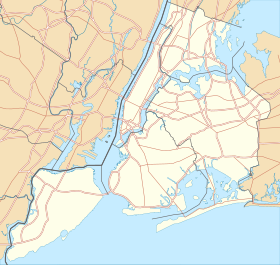
Williamsburg ( eng. Williamsburg ) - a district in the north of borough Brooklyn , New York . In the north, Williamsburg is bordered by Green Point , in the east by East Williamsburg , in the south by Flushing Avenue , and in the west by the East River Strait.
| New York City | |
| Williamsburg | |
|---|---|
| English Williamsburg | |
 Southerly view | |
| Borough | Brooklyn |
| Square | 5.64 km² |
| Population | 126 183 people (2011) |
| Population density | 22 372.87 people / km² |
| Metro routes |      |
| Site | freewilliamsburg.com |

History
In the middle of the XVII century, the Dutch settlement of Boswijk ( Dutch Boswijck ) appeared on the territory of the district. In 1663, several farmers from Europe settled in it. At the beginning of the 19th century, real estate speculator Richard Woodhull bought 5.3 hectares of land in the area and launched a ferry service to Manhattan. In 1806, however, Woodhull went bankrupt. However, after only 12 years, the merchant David Dunham launched a new ferry [1] and donated significant funds for the development of the settlement. In 1827, it was transformed into the village of Williamsburg ( born Williamsburgh ).
In 1852, when Williamsburg received city status, its population was 31,000. Three years later, he became part of Brooklyn. People from Germany , Austria and Ireland settled in Williamsburg. In those years, it was a typical industrial area: in addition to docks , shipyards , foundries and distilleries in Williamsburg, there were many hotels , pubs and entertainment venues. Companies based in the area include the pharmaceutical corporation Pfizer .
At the beginning of the 20th century, the Williamsburg population exceeded 100,000. The influx of residents was facilitated by the opening of the Williamsburg Bridge in 1903. Jewish , Italian , Polish , Russian, and Lithuanian diasporas appeared in Williamsburg. By 1917, the population density in the area was one of the highest in New York. In 1920, 260,000 people lived in Williamsburg. In the 1930s, wealthy citizens began to leave the overpopulated area, while the Jewish population continued to increase due to refugees from Europe, which was covered by Nazi sentiments.
By the middle of the century, most of the region's dilapidated housing was demolished. In its place was built municipal development. So, in 1957, over 2,000 houses were demolished as part of the construction of the I-278 interstate highway .
Some of the surviving buildings in the 1980s were restored. At the same time, immigrants from Latin America , such as Puerto Ricans and Dominicans, began to settle in large numbers in the area. At the same time, artists and musicians began to move from the Manhattan East Village , which was becoming increasingly fashionable. They converted into the lofts the former production facilities of companies that removed their facilities from Williamsburg.
As of the beginning of the 21st century, industrial enterprises still remained in Williamsburg. Basically, they were represented by waste processing and transportation stations, including radioactive ones [2] . At the same time, due to the ongoing gentrification and, as a result, rising housing prices, representatives of creative professions who had once moved here began to leave Williamsburg.
Population
According to 2011 data, the population of the quarter was 126,183 residents. The average population density was about 22,373 people / km², which is about 1.7 times higher than the average Brooklyn population density. In racial terms, almost half of the inhabitants were Hispanic and about a third were white. The average household income was below the city average a little more than 1.5 times: $ 35,499 [3] .
One of the largest Hasidic communities lives in the region, mainly composed of adherents of the Satmar direction (about 60,000 people) [4] .
Public Transport
Williamsburg is served by New York Underground's G , J , L , M, and Z routes [5] . As of April 2014, bus routes B24, B32, B46, B48, B57, B59, B62 and B67 operated in the district [6] .
Notes
- ↑ Leonard Benardo, Jennifer Weiss. Brooklyn by Name: How the Neighborhoods, Streets, Parks, Bridges, and More Got Their Names. - NYU Press, 2006 .-- P. 16. - 209 p. - ISBN 0814799450 .
- ↑ Ben Chapman. Williamsburg residents want radioactive-waste firm Radiac Corp. out of area, away from school . NY Daily News (June 7, 2010). Date of treatment April 29, 2014.
- ↑ Williamsburg neighborhood in New York, New York (NY ) . city-data.com. Date of treatment April 29, 2014.
- ↑ Joseph Berger. Divisions in Satmar Sect Complicate Politics of Brooklyn Hasidim . The New York Times (July 5, 2012). Date of treatment April 29, 2014.
- ↑ MTA Subway Map . mta.info. Date of treatment April 29, 2014.
- ↑ Brooklyn Bus Map . mta.info. Date of treatment April 29, 2014.
Literature
- Judith Berck, Cathy Alexander. Williamsburg (h) // The Encyclopedia of New York City / Kenneth T. Jackson, Lisa Keller, Nancy Flood. - 2. - Yale University Press, 2010 .-- P. 1403. - 1584 p. - ISBN 0300182570 .