Secret frog [1] ( Odorrana ishikawae ) is an endangered species of amphibians from the family of real frogs . Endemic of East Asia: Southern Japan . They are found only on the islands of Amamiyoshima and Okinawa (from the group of Ryukyu islands) in primary deciduous evergreen forests and rivers. The length of the males is about 97 mm (88-106), of the females about 110 mm (105-117). Propagate from January to May. The species O. ishikawae was first described in 1901 by the American zoologist Leonhard Hess Stejneger (1851-1943) under the original name Buergeria ishikawae Stejneger, 1901 [2] [3] [4] [5] [6] .
| Secretive frog | |||||||||||||||||||||||||||||||||||||||
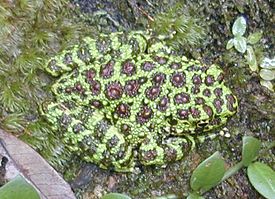 | |||||||||||||||||||||||||||||||||||||||
| Scientific classification | |||||||||||||||||||||||||||||||||||||||
|---|---|---|---|---|---|---|---|---|---|---|---|---|---|---|---|---|---|---|---|---|---|---|---|---|---|---|---|---|---|---|---|---|---|---|---|---|---|---|---|
| |||||||||||||||||||||||||||||||||||||||
| International scientific name | |||||||||||||||||||||||||||||||||||||||
Odorrana ishikawae ( Stejneger , 1901 ) | |||||||||||||||||||||||||||||||||||||||
| Security status | |||||||||||||||||||||||||||||||||||||||

Notes
- ↑ Ananyeva N. B. , Borkin L. Ya. , Darevsky I.S. , Orlov N.L. Amphibians and reptiles. Latin, Russian, English, German, French. / edited by Acad. V. E. Sokolova . - M .: Rus. Yaz., 1988 .-- S. 124. - 10,500 copies. - ISBN 5-200-00232-X .
- ↑ Stejneger, L. 1901. Diagnoses of eight new batrachians and reptiles from the Riu Kiu Archipelago, Japan. Proceedings of the Biological Society of Washington 14: 189–191.
- ↑ Odorrana ishikawae Archived on September 15, 2015. . www.iucnredlist.org
- ↑ Frost, Darrel R. Odorrana ishikawae (Stejneger, 1901) . Amphibian Species of the World 5.6, an Online Reference . American Museum of Natural History (2013). Date of treatment April 6, 2013.
- ↑ Odorrana ishikawae. AmphibiaWeb's database
- ↑ Frost, DR, T. Grant, J. Faivovich, RH Bain, A. Haas, CFB Haddad, RO de Sá, A. Channing, M. Wilkinson, SC Donnellan, CJ Raxworthy, JA Campbell, BL Blotto, PE Moler, RC Drewes, RA Nussbaum, JD Lynch, and DM Green. 2006. The amphibian tree of life. Bulletin of the American Museum of Natural History 297: 1-370.
Literature
- Maeda, N. and Matsui, M. (1990). Frogs and Toads of Japan, 2nd edition. Bun-Ichi Sogo Shuppan Co., Ltd., Tokyo, Japan.
- Fei, L., C.-y. Ye, Y.-z. Huang, J.-p. Jiang, and F. Xie. (2005). An Illustrated Key to Chinese Amphibians. Chongqing: Sichuan Publishing House of Science and Technology.
- Kurabayashi, A., N. Yoshikawa, N. Sato, Y. Hayashi, S. Oumi, T. Fujii, and M. Sumida. 2010. Complete mitochondrial DNA sequence of the endangered frog Odorrana ishikawae (family Ranidae) and unexpected diversity of mt gene arrangements in ranids. Molecular Phylogenetics and Evolution 56: 543-553.
- Kuramoto, M., N. Satou, S. Oumi, A. Kurabayashi, and M. Sumida. 2011. Inter- and intra-island divergence in Odorrana ishikawae (Anura, Ranidae) of the Ryukyu Archipelago of Japan, with description of a new species. Zootaxa 2767: 25-40.