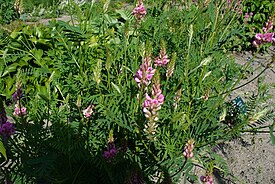
Sainfoin is sandy , also Dnieper , or Don ( Latin Onobrýchis arenária ) is a perennial herbaceous plant, a species of the genus Sainfoin ( Onobrychis ) of the legume family ( Fabaceae ). Valuable feed plant.
| Sainfoin sand | |||||||||||||||||||||||||
 | |||||||||||||||||||||||||
| Scientific classification | |||||||||||||||||||||||||
|---|---|---|---|---|---|---|---|---|---|---|---|---|---|---|---|---|---|---|---|---|---|---|---|---|---|
| |||||||||||||||||||||||||
| International scientific name | |||||||||||||||||||||||||
Onobrychis arenaria ( Kit. ) DC. , 1825 | |||||||||||||||||||||||||
Content
- 1 Distribution
- 2 Botanical Description
- 3 Value
- 4 Classification
- 4.1 Synonyms
- 4.2 Infravid division
- 5 notes
- 6 Literature
Distribution
Sainfoin is common in Central , Eastern and Southeast Europe, as well as in the Caucasus and southern Siberia ; to the west it enters central France and northern Italy .
In Russia, the sainfoin range extends from the steppe and forest-steppe zones of the East European Plain through the steppe zone of Siberia to Transbaikalia and Yakutia . It is rare in the Moscow region , it is found in the southern half of the region, apparently, as a feral alien plant.
The initial range of the group of species from which the sainfoin originated is sandy - the north of the Balkan Peninsula . [2]
Botanical Description
Sainfoin is a perennial herb with a medium-deep or deep root system (up to 270 cm in the steppes). The main root is strongly branched, yellowish. Annual elongated shoots are formed annually. Renewal buds are located at the base of the shoots. Also, the kidneys are in the axils of the leaves. Stems with a lignified base, occasionally hollow, green, straight or ascending, reaching 30-60 cm in height (rarely up to 80 cm), furrowed, usually pinnate.
Leaves are pinnate, petiolate, with 6-10 pairs of leaflets, linear-oblong to long ellipsoid in shape. The upper surface of the leaflets is green, glabrous, the lower one with pressed pubescence. Cirrus venation . Stipules are brownish, lower ones are fused, upper ones are free, wide-triangular.
Flowers are collected in thick multi-flowered brushes 14-20 cm long. Bracts are filmy, pointed, lanceolate, 2.5-3 mm long. Pedicels 2-2.5 mm long. Calyx short pubescent, divided into 5 lobes, 3–6 mm long. The corolla is purple-pink in color, with darker stripes, 8-12 mm long. The flag is obovate or broadly ellipsoidal in shape, 8-10 × 6-8 mm. Wings 2-2.5 mm long.
Fruit - a semicircular brownish bean 5-7 mm long, containing one seed, when ripening, it does not open, but falls. The surface of the bean can be finely pubescent, finely meshed. The lower beans of the inflorescence fall before the upper ones ripen. The seed is oblong, brownish, 2.5-3 × 1.5-2 mm.
The set of chromosomes is 2n = 14. Triploid and aneuploid varieties were derived. [3]
Value
Sainfoin is a valuable fodder plant that deserves widespread use in hay rotation. Introduced into the culture of Ukraine in the middle of the 20th century. High yielding and frost-resistant varieties were created in the USSR. Also used to create interspecific hybrids with sainfoin .
Sainfoin provides a highly nutritious feed with a protein content of up to 16% in the flowering phase and up to 23% in the aftermath. Hay is eaten almost without a trace. Among fodder plants, it stands out for its inability to cause bloating in livestock.
Sainfoin is a good honey plant . 0.07 mg of nectar falls on 1 flower; yield reaches 90 kg / ha. [four]
Classification
Synonyms
- Hedysarum arenarium Kit., 1814 basionym
- Hedysarum pallescens Kit., Nom. inval.
- Onobrychis arenaria f. borysthenica Širj. , 1925
- Onobrychis borysthenica (Širj.) Klokov , 1946
- Onobrychis brachypus Vassilcz. , 1930
- Onobrychis armena Boiss. & A. Huet , 1856
- Onobrychis cana (Boiss.) Hand.-Mazz. , 1909
- Onobrychis collina Jord. , 1851
- Onobrychis decumbens Jord., 1851, nom. illeg.
- Onobrychis gaudiniana Jord., 1850
- Onobrychis gracilis var. longeaculeata Pacz. , 1889
- Onobrychis graeca Hausskn. , 1893
- Onobrychis lasiostachya var. cana boiss., 1872
- Onobrychis longeaculeata (Pacz.) Wissjul. 1954, nom. illeg.
- Onobrychis miniata Steven , 1856
- Onobrychis oxyodonta subsp. armena (Boiss. & A. Huet ) Ponert , 1973
- Onobrychis paczoskiana Krytzka , 1974
- Onobrychis reticulosa Opiz , 1825
- Onobrychis sativa Ledeb. , 1842, nom. illeg.
- Onobrychis sativa var. silvestris Alef. , 1866
- Onobrychis sibirica ( Turcz. Ex Širj.) Grossh. , 1948
- Onobrychis tanaitica Spreng. , 1820
- Onobrychis tommasinii Jord., 1851
- Onobrychis viciifolia sensu auct.
- Onobrychis viciifolia subsp. arenaria (Kit.) Thell. , 1912
- Onobrychis viciifolia var. collina (Jord.) St.-Lag. , 1889
- Onobrychis viciifolia var. decumbens Jord. ex Rouy , 1899
- Onobrychis visianii Borbás , 1877
Infravid division
Due to its wide range, sainfoin is a very polymorphic species, inside which many subspecies are distinguished. One of them, Onobrychis arenaria var. ferganica Širj. from Central Asia, is currently isolated in a separate species Onobrychis ferganica (Širj.) Grossh., 1948 ( Fermented sainfoin ).
- Onobrychis arenaria subsp. cana (Boiss.) Hayek , 1926 - Armenian sainfoin
- Onobrychis arenaria subsp. lasiostachya (Boiss.) Hayek, 1926
- Onobrychis arenaria subsp. miniata (Steven) PWBall , 1968 - Sainfoin cinnabar red
- Onobrychis arenaria subsp. sibirica (Turcz. ex Širj.) PWBall, 1968 - Siberian sainfoin
- Onobrychis arenaria subsp. taurerica Hand.-Mazz., 1937
- Onobrychis arenaria subsp. tommasinii (Jord.) Asch. & Graebn. , 1909
Notes
- ↑ For the conventionality of indicating the class of dicotyledons as a superior taxon for the plant group described in this article, see the APG Systems section of the Dicotyledonous article .
- ↑ Kultiasov, 1974 , p. 90.
- ↑ Kultiasov, 1974 , p. 88-90.
- ↑ Kultiasov, 1974 , p. 97.
Literature
- Kultiasov I. M. Sand sainfoin // Biological flora of the Moscow region / Ch. ed. T. A. Rabotnov , ed. graduation of I. A. Gubanov and M. G. Vakhrameev. - M .: Publishing House of Moscow State University, 1974. - T. I. - S. 88-97. - 214 p. - 1050 copies.
- Gubanov I.A. et al. 814. Onobrychis arenaria (Kit.) DC. ( O. viciaefolia auct. Non Scop.) - Sand sainfoin // Illustrated identifier of plants in Central Russia. In 3 t . - M .: T-in scientific. ed. KMK, Institute of Technology. ISS., 2003. - T. 2. Angiosperms (dicotyledonous: dicotyledonous). - S. 457. - ISBN 9-87317-128-9 .