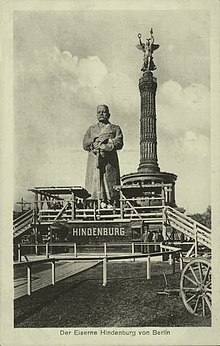

The Iron Hindenburg ( German: Eiserner Hindenburg ) is an unexploited monument to the German military commander Paul von Hindenburg , which was erected in Berlin on Königsplatz Square during the First World War .
"Iron Hindenburg" was a wooden sculpture of a field marshal in full growth 12.5 meters high, made of alder on an iron frame and studded with nails. He was the largest of the "iron warriors" involved in raising funds for military purposes. The image of Hindenburg for a propaganda monument made of nails was created by the sculptor Georg Marshall and executed by engineer Kolrausch. From September 4, 1915, when the first nail was driven into the monument, and until the end of the war the Iron Hindenburg collected more than one million Reichsmarks . The funds received during the propaganda campaign were divided between three sponsors of the sculpture: an aviation company, a national foundation and the city of Berlin. At the end of the war, Iron Hindenburg was sent to a warehouse and later put into firewood. In 1938, the surviving head of the monument became an exhibit at the Lert Station where it burned down during a fire during the bombing in World War II .
Literature
- Gerhard Schneider: In eiserner Zeit. Kriegswahrzeichen im Ersten Weltkrieg , Schwabach im Taunus 2013, S. 137ff. ISBN 978-3-94126413-7
- Ders .: Zur Mobilisierung der “Heimatfront”: Das Nageln sogenannter Kriegswahrzeichen im Ersten Weltkrieg , in: Zeitschrift für Volkskunde , 95. Jg., 1999, S. 32-62.
- oV: Kriegs-Wahrzeichen zum Benageln. 69 Entwürfe aus einem Preiswettbewerb des Deutschen Werkbundes , München 1915.
- Michael Diers: Nagelmänner. Propaganda mit ephemeren Denkmälern im Ersten Weltkrieg , in: Ders. (Hg.): Mon (u) mente. Formen und Funktionen ephemerer Denkmäler , Berlin 1993, S. 113-135.