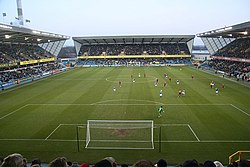
“Den” ( Eng. Den , originally called “New Den” - Eng. The New Den ) - the home stadium of the English football club Millwall [1] . Located in South Bermondsey , in southeast London, it is almost adjacent to the railway line between London Bridge and New Cross Gate stations, next to the SELCHP incinerator. The Den stadium was built in 1993 to replace the outdated stadium, bearing the same name and located less than a quarter mile from the new arena. The stadium has 20,146 seats. The new Den is the sixth stadium in the history of Millwall since its founding in 1885.
| Den | |
|---|---|
| |
| Location | Zampa Road Bermondsey London england SE16 3LN |
| Built | 1993 |
| Open | August 4, 1993 |
| Owner | |
| Capacity | 20 146 |
| Home team | Millwall |
| Field dimensions | 105 x 68 m |
| Coating | grass |
History
Old Den
Millwall Football Club was founded in 1885 in East London . Having replaced four stadiums on Dog’s Island ( Borough Tower Hamlets ), on which the Lions played at the beginning of the 20th century, the club management decided to find a new venue for a larger arena. The construction site was found in South London , in the New Cross area of Borough Louis . They decided to build a football stadium near the New Cross Stadium on Old Kent Road, where dog races and track and field competitions were held , and later a speedway .
Club director Tom Thorne contacted architect Archibald Leitch and the construction company Humphries of Knightsbridge. The estimated cost of the new stadium was about £ 10,000. Millwall played its first match at Den on October 22, 1910 against Brighton and Hove Albion , the champion of the Southern League , losing 0-1. Tickets for the game cost one penny . On August 28, 1920, Millwall played their first Football League match at Den , defeating Bristol Rovers 2-0. An interesting coincidence, their last match on the old Den during the Football League, the Lions also played with a team from Bristol on May 8, 1993.
The first international match at Den was played on March 13, 1911. On that day, the England team beat the team of Wales with a score of 3: 0. The last time the national teams played on Den was December 12, 1989. On that day, the second England team defeated the second team of Yugoslavia with a score of 2: 1.
During World War II, the stadium, located in the immediate vicinity of the Surrey commercial docks, was damaged by German bombardment. On April 19, 1943, one of the bombs hit the North Terrace, and on April 26 there was a fire that destroyed the Main Stand. As a result, Millwall had to play home matches at the stadiums of its neighbors Charlton , Crystal Palace and West Ham United . Only on February 24, 1944, “Lions” were able to return to “Den”, in the restoration of which the fans of the club actively participated.
After the war, Millwall was planning to build a new two-level grandstand and even purchased all the materials necessary for this. The Department of Public Works banned the construction, since rationing continued in the UK. Only in 1948 the club was allowed to build a new single-tier stand in two-thirds of the length of the field. On October 5, 1953, the first match with artificial lighting was played at Den. In the presence of 25,000 spectators, the Lions beat Manchester United with a score of 2: 1.
It was on Den that Millwall set an unbroken record to this day, having played 59 home games without a defeat from August 22, 1964 to January 14, 1967.
By the end of the 1970s, Den fell into disrepair and the idea to build a new arena, Super Den, designed for 25,000 to 30,000 spectators, replaced the existing stadium and the adjacent New Cross Stadium. In the end, this ambitious project was not implemented due to lack of funding and unpopularity among fans. In 1986, the new club owners spent about a million pounds on the modernization of a long-outdated stadium that did not meet modern standards of comfort and safety. In particular, new dividing barriers and turnstiles were installed, toilets were improved, seats and lighting were replaced [2] . However, the modernization did not solve all the problems of the stadium, including the main one, with standing places, which accounted for more than 90% of the total capacity of the arena. To solve this problem, an arena reconstruction plan was developed with the full replacement of standing places with seats, but in the end they abandoned it in favor of moving to a new stadium, partly because the new stadium was located in a more spacious place, which allowed the creation of a sports center for public use, in part due to the inability to bring the old stadium into line with the recommendations of the Taylor report . Some fans of the club opposed the decision of club president Reg Burr to move.
After Millwall flew out of the First Division following the 1989/1990 season , it was decided to build a new stadium with 25,000 seats in the Senegal Fields . On December 11, 1991, the Den stadium was sold under construction to Fairview New Homes for £ 6.5 million, but under the terms of the deal, Millwall continued to play on its arena for almost another 1.5 years. The club moved to a new stadium in August 1993, and in the fall of that year, the old Den was demolished. In its place were built residential buildings. The memory of the already non-existent stadium and the team performing at it has been preserved to this day. Among locals, the new residential quarter and its environs are known as Little Millwall .
Statistics
The first Den stadium was built in 1909. Millwall played it for the first time on October 22, 1910, and for the last time on May 8, 1993. In total, the club spent 83 seasons on it, from 1910 to 1993.
The stadium project was created by the Scottish architect Archibald Litch , who became famous as the author of the projects of many famous football stadiums in the UK and Ireland , including the London West Ham Stadium , Craven Cottage ( Fulham ), White Hart Lane ( Tottenham ) and Highbury , Liverpool Goodison Park and Anfield , Ibroks Park , Celtic Park and Hampden Park in Glasgow, Birmingham Villa Park , Ywood Park in Blackburn , Belfast Windsor Park and Manchester Old Trafford ", As well as many others.
The stadium was designed for 47,000 spectators, however, there were only 4,536 seats. The attendance record was set in 1937, when 48,672 spectators gathered for the match against Derby County .
New Den
In 1990, President of Millwall Club Reg Burr, despite the dissatisfaction of some fans, made the final decision to move to a new stadium in the Senegalese fields. In December 1991, the old stadium was sold. The new arena was designed by architect Thorburn Miller. In the summer of 1992, the club decided on a contractor, it became Tilbury Douglas (now Interserve plc), which won a contract worth £ 14 million. For this money, builders had to build a football stadium in place of demolished houses, a temple and playing fields in Senegal Fields for 57 weeks. with a capacity of more than 20 thousand people, sports and entertainment complexes, as well as parking for 240 cars. It was originally planned that the stadium would be able to receive from 25,000 to 30,000 spectators, but in order to save money, the capacity had to be reduced. The new “Den” was the first stadium in England built in accordance with the recommendations of the Taylor report and the first since 1937 a new football stadium built in London for a professional team. Financing for the construction was carried out at the expense of the proceeds from the sale of the old stadium and grants from the Football Trust and Borough Luis municipality. [3] In total, the club spent £ 16 million on construction. The new stadium, originally called The New Den , became the sixth arena for Millwall since the establishment of the football club in 1885.
Millwall played the first game on the new arena on August 4, 1993, losing in a friendly match to the Portuguese Sporting with a score of 1: 2 [4] . The opening of the new stadium was attended by the leader of the Labor Party and the opposition, John Smith .
At first, the new stadium was happy for Millwall. In its first season after the move, the club finished third in the First Division , but failed to qualify for the Premier League in the playoffs . At the end of the 1995/1996 season, Millwall flew to the Second Division . “Lions” could return to the First Division only five years later, in the 2000/2001 season . In 2002, Millwall had a chance to reach the Premier League, finishing fourth, but once again lost to the playoffs . In the 2003/2004 season, the Lions, having started in the FA Cup from the third round , reached the finals for the first time in their history, where they lost 3-0 to Manchester United . Nevertheless, this result allowed Millwall to make their first appearance in the UEFA Cup , where, however, their campaign was short-lived. Following the 2005/2006 season , Millwall left the Football League Championship . It took 4 years to return to the second division of English football “Lions”. In 2010, they finished third, and then in the final of the playoffs at Wembley won Swindon Town with a score of 1: 0.
Tribunes
The four stands of “Den” accommodate a total of 20,146 people. The largest is the western stand, named after The Barry Kitchener Stand , the club's record holder for matches played (596 between 1966 and 1982), designed for 5927 spectators, including 400 box seats and 173 places for disabled people. The second largest number of spectators is the eastern one, on January 20, 2011 renamed in honor of the East End dockers ( The Dockers Stand ), which from the very foundation of the club have made up a significant part of the fans of the team. It seats 5455 spectators, including 320 in boxes. South, named in memory of the street that led to the old “Den” ( English Cold Blow Lane Stand ), and northern ( English North Stand ), designed for fans of the guest team, are designed for 4382 people each.
Average attendance
The place taken at the end of the season is indicated in parentheses.
Championship
| League One
| Championship
| First division
| Second division
| First division
|
International matches and other events
On March 19, 1994, a match between professional boxers , British American Michael Bentt and Nigerian British Herbie Hyde , for the WBO World Heavyweight Championship, was held at Den . In the 7th round, Hyde knocked out an opponent, becoming the world champion for the first time in his life. For Bent, after a fight brought to the hospital with a brain injury, this fight was the thirteenth and last in his career [5] .
May 1, 2006 at the “Den” hosted the final of the FA Cup for Women. Arsenal’s women's team beat Leeds United’s women's team 5-0. Also at the stadium, three friendly matches of the national teams took place. On August 21, 2007, the Ghana national team tied 1-1 with the team of Senegal . On February 11, 2009, the match between Jamaica and Nigeria also ended in a draw (0: 0). On March 5, 2014, the Australian national team lost to Ecuador with a score of 3: 4. Twice in this match scored an Australian Tim Cahill , a former Millwall player.
On May 18, 2008, a charity football tournament with the participation of film and television stars was held at the Den stadium. It was attended by about 150 celebrities, including McFly , singer Tony Hadley, singer Amy Winehouse and former Millwall player Terry Harlock, popular with the club's fans. The collected money was sent to the well-known charitable organization "Samaritans" ( English Samaritans ). For the first time in history, such a tournament was organized at the stadium of a club that does not play in the Premier League.
During the filming of the British television series Dream Team , the Den stadium was used as the home arena of the fictional Premier League club Harchester United ( English Harchester United FC ). In addition, “Den” appeared in one of the episodes of the British science fiction television series “ Jurassic Portal ”. The stadium was also used to shoot one of the episodes of the British detective television series “ Purely English Murder ”. Famous director Guy Ritchie at the Millwall Stadium was filming a Take It To The Next Level commercial for Nike Corporation. In 2010, Kit Kat made their Cross your Fingers commercial using footage, including at Den Stadium.
Transport Accessibility
A five-minute walk from Den Stadium is the Inner South London Line South Bermondsey Rail Station. For fans of guests who arrived by rail, an allotment dedicated to them is available on match days. There is no special car parking for non-local fans at the stadium. The closest bus to the stadium is route 12, [6] on Ilderton Road, just a two-minute walk. Buses on routes 21, 53, and 172 make the closest stop to Old Kent Road, a 10-minute walk from Den. The nearest metro station to Millwall Stadium is Canada Water ( Jubilee Line ), which is a 20-minute walk from the arena. Surrey Quays and New Cross Gate Stations, previously part of the South London Line, and now part of the London Elevator , are a 15-minute walk from the stadium. [7]
Fans
The old Den stadium has become famous as the birthplace of the famous Millwall Roar . At the beginning of the 20th century, among English fans, it was “good manners” for the hosts to express their gratitude to the guests' players for good football. Millwall fans, however, literally “roared” the entire match from start to finish only for their team. However, the fans of “Lviv” became famous not only for their roar. “Den” very quickly earned a reputation as one of the most terrible stadiums in England. Not a single team liked to play it, because the aggressive crowd in the stands and near them, as well as the stadium itself, made a depressing impression on the players and guests of the guests. Fans of Millwall enjoyed a reputation for being cruel, reckless, able to express without hesitation what they think or start a fight right on the spot, without wasting time talking.
We are going to meet with Millwall away. The situation is not the most pleasant, but we somehow respect in our hearts Millwall, although we would never admit it. We all know that New Cross and Peckham are real holes in London. It has long been noticed that the biggest bumpkin is from here. As far as I remember, Millwall fans were always crazy. Some kind of special, painful-psychic, beyond understanding. They have gained such a reputation and deserve it, nurtured on the history of docks at the turn of the century. A hundred years of brainwashing from anyone too far away from the old Kent road. Their fathers did their job, chasing strangers along the Cold Blow alley, like toy soldiers, at the time of our childhood, before they went out on the road to Sengal Fields, and even earlier their grandfathers could severely teach lesson those from West Ham climbed too far to Dog Island, transferring here the bad habits of Poplar and Stepni. Knives, bottles and wall-to-wall fights before, after and during the game. All this happened even before my father was born. In the good old days, when Britain dominated the seas, and some parts of London were a restricted area for police officers on weekends, when the restaurant business went to the dick and on a large scale.
John King : " Football Factory ."
Due to the behavior of Millwall fans, the Den stadium has been disqualified five times by the Football Association , which is a record for English football. The first time the Lviv stadium was disqualified for two weeks in 1920, after the fans provoked the goalkeeper of the Newport team to a fight and then beat him. In 1934, the stadium again received a two-week suspension for insulting a referee during a match with Bradford City . In 1947, the stadium was again disqualified due to unrest in the match against Barnsley . After the match with Exeter City , about two hundred fans attacked a judge outside the stadium, which led to his closure for seven days and a fine of £ 1,000. Another stigma was imposed on the stadium in 1978, after fans of Millwall tried to disrupt the unsuccessful game for the club in the sixth round of the FA Cup with the Ipswich Town club. As a result of the unrest during and after the match, twenty-two policemen were injured. In response, the Football Association disqualified the stadium and banned the holding of the FA Cup matches for the “Den” over the next two seasons. The last match at the old stadium was also accompanied by unrest, since the Lions were visited by fans from Bristol, who had long-standing accounts with Millwall fans.
Notes
- ↑ Views of The Den , millwallfc.co.uk (September 13, 2010). Archived May 15, 2010. Date of appeal September 13, 2010.
- ↑ Millwall History: Its Saturday, Its Cold Blow Lane, We've all come down to cheer ...
- ↑ Construction News: 18Jun92 UK: Tilbury Douglas wins £ 14M soccer stadium contract from Millwall Football Club . 06/18/1992 (English)
- ↑ Wiki Sporting 1993/94 (port.)
- ↑ Sports People: Boxing; Bentt Released From Hospital , The New York Times (03/22/1994), S. B-15. Date of treatment August 27, 2009.
- ↑ Walking directions to The Den from closest bus stop , google maps (04.19.2014). Date of treatment April 19, 2014.
- ↑ Walking directions to The Den from Surrey Quays station , google maps (04.19.2014). Date of treatment April 19, 2014.
Links
- Millwall's official site
- FootballGroundGuide: Millwall The Den (English)
- FootballGroundGuide: The Old Den - Millwall FC (English)
- LondonFootballGuide: Picture Gallery Den
- Millwall History: Moving On: The New Den (English)