The Navarino naval battle of 1827 is a major naval battle between the combined squadron of Russia , England and France , on the one hand, and the Turkish-Egyptian fleet, on the other. It happened on October 8 (20), 1827, in the Navarino Bay of the Ionian Sea on the southwestern coast of the Peloponnese Peninsula . The battle should be considered as one of the episodes of the Greek national liberation revolution of 1821-1829 [1] . The defeat of the Turkish fleet in the Battle of Navarino significantly weakened the naval forces of Turkey, which served as a significant contribution to the victory of Russia in the subsequent Russo-Turkish War of 1828-1829 . The battle of Navarino provided support for the Greek national liberation movement, which resulted in the autonomy of Greece under the Adrianople Peace Treaty of 1829 .
| Battle of Navarino | |||
|---|---|---|---|
| Main Conflict: Greek War of Independence | |||
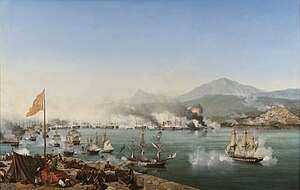 Ambroise-Louis Garneray. "Naval battle at Navarino." 1827 | |||
| date of | October 8 (20), 1827 | ||
| A place | Navarin , Greece | ||
| Total | The decisive victory of Russia, Greece, Great Britain and France | ||
| Opponents | |||
| |||
| Commanders | |||
| |||
| Forces of the parties | |||
| |||
| Losses | |||
| |||


Content
- 1 Background
- 2 battle
- 3 Squadron composition
- 3.1 Ships of the fleet of the Russian Empire
- 3.2 UK Navy Ships
- 3.3 French Navy Ships
- 3.4 Ships of the combined fleet of the Ottoman Empire, Egypt and Tunisia
- 4 Results of the battle
- 5 Memory
- 6 notes
- 7 Literature
- 8 References
Background
In 1827, the London Convention of 1827 was signed between Russia, England and France, according to which Greece was granted full autonomy. The Ottoman Empire refused to recognize the convention.
In the same 1827, the combined squadron of Russia, Great Britain and France (total 1276 guns) under the command of the senior in the rank of English Vice Admiral Edward Codrington approached the Navarino Bay, where the Turkish-Egyptian fleet (up to 2200 guns in total) under the command of Muharrem- bei . The commander in chief of the Turkish-Egyptian troops and navy was Ibrahim Pasha .
The Turkish-Egyptian fleet was protected by coastal batteries (165 guns) and 6 firewalls . It was inferior to the Union in the number of battleships: 3 versus 10, but significantly superior to it in the number of frigates, corvettes and brigs.
The allies were also inferior to the Turks and Egyptians in artillery, but excelled in combat training of personnel. Codrington hoped by demonstration of force (without the use of weapons) to force the enemy to accept allied demands. To this end, he sent a squadron to Navarino Bay [1] .
Battle
At 14:00 the combined fleet approached the entrance to the Navarino harbor with two columns [2] . One of them consisted of English and French ships, and the other a Russian squadron. After the Allied convoy passed the fortress batteries and anchored, the Russian convoy with the admiralty ship Azov in front approached the harbor entrance.
At that time, a strong gun fire occurred at one of the Turkish firewalls [2] , in which the English lieutenant Fitz Roy, who was sent as a parliamentarian, was killed. His tasks included forcing the commander of the firewall to move further from the allied ships. After some time, from one of the Egyptian corvettes the first shot rang out in the direction of the French frigate.
The battle began after the Turks killed the second parliamentarian sent to the flagship Muharrem Bey.
It lasted about 4 hours and ended with the destruction of the Turkish-Egyptian fleet. The most decisive and skillfully operated Russian squadron under the command of Rear Admiral Login Petrovich Heyden , defeating the entire center and the right flank of the enemy fleet. She took upon herself the main blow of the enemy and destroyed most of his ships.
The losses of the Turkish-Egyptian fleet amounted to more than 60 ships and several thousand people killed and wounded. The Allies did not lose a single ship. Their losses killed and wounded amounted to 661 people (79 killed and 284 wounded in the English squadron, 59 killed and 139 wounded in the Russian squadron, 43 killed and 141 wounded in the French squadron [3] .
After the battle, the allied fleet remained in Navarino Bay until October 26.
The flagship of the Russian squadron Azov under the command of Captain 1st Rank Mikhail Petrovich Lazarev distinguished himself in the battle. The flagship destroyed 5 Turkish ships, including the frigate of the commander of the Turkish fleet. The ship received 153 hits, 7 of them below the waterline. In the battle, 24 lower ranks were killed, 6 officers and 61 lower ranks were wounded [4] . The ship was completely renovated and restored only by March 1828 . During the battle, the future Russian naval commanders, the heroes of Sinop and the Sevastopol Defense of 1854-1855 showed themselves at the "Azov":
- Lieutenant Pavel Stepanovich Nakhimov
- midshipman Vladimir Alekseevich Kornilov
- Midshipman Vladimir Ivanovich Istomin
For combat feats in battle, the battleship Azov was the first in the Russian Navy to receive the stern flag of St. George.
Squadron composition
Ships of the fleet of the Russian Empire
Commander - Rear Admiral Count Login Petrovich Heyden
Line ships :
- " Azov " (flagship) (commander - 1st-rank captain Lazarev, Mikhail Petrovich )
- " Gangut " (commander - captain of the 2nd rank A.P. Avinov )
- "Ezekiel" (commander - captain of the 2nd rank I. I. Svinkin )
- "Alexander Nevsky" (commander - captain of the 2nd rank L. F. Bogdanovich )
Frigates :
- “ Agile ” (commander - lieutenant commander I.P. Yepanchin )
- " Constantine " ( S.P. Khrushchov )
- "Elena" (commander - captain-lieutenant N.P. Yepanchin )
- “Castor” (commander - Lieutenant Commander I. S. Sytin )
Corvette " Thundering " (commander - captain-lieutenant A. N. Kolyubakin )
U.S. Navy Ships
Fleet Commander - Vice Admiral Sir Edward Codrington
Line ships :
- HMS Asia (Fleet flagship, Captain Edward Carson)
- HMS Genoa (Captain W. Bathurst)
- HMS Albion (Captain J. Ommany)
Frigates :
- HMS Glasgow (Captain Ashley Mod)
- HMS Cambrian (Captain W. Hamilton)
- HMS Dartmouth (Captain Fellow)
- HMS Talbot (Captain Spencer)
Brigi :
- HMS Mosquito
- Hms philomel
Corvettes :
- Hms brisk
- Hms hind
Tender :
- Hms rose
French Navy Ships
Commander Rear Admiral Henri de Rigny
Line ships :
- Breslau
- Scipion
- Trident
Frigates :
- Sirène (flagship)
- Armide
Corvettes :
- Alcyone
- Daphné
Ships of the United Fleet of the Ottoman Empire, Egypt and Tunisia
- Captain Bey Squadron (Alexandria): 2 battleships, 5 frigates, 12 corvettes
- Muharrem Bey Squadron (Alexandria): 4 frigates, 11 corvettes, 21 brigs, 5 schooners, and 5 (or 6?) Firewalls
- Tunisian squadron (Alexandria,): 2 frigates, 1 brig
- Tagir Pasha Squadron (Constantinople): 1 battleship, 6 frigates, 7 corvettes, 6 brigs
Battle Results
The defeat of the Turkish fleet in the Battle of Navarino significantly weakened the naval forces of Turkey, which served as a significant contribution to the victory of Russia in the subsequent Russian-Turkish war of 1828-1829 . The battle of Navarino provided support for the Greek national liberation movement, which resulted in the autonomy of Greece under the Adrianopol Peace Treaty of 1829 .
Memory
- In the cities of Nikolaev and Sevastopol there is Navarinskaya street.
- In Navarino Bay, in Greece, there are monuments to the fallen soldiers of Russia, France and Britain. The names of the commanders of the Allied squadrons are immortalized on a monument erected on the square of the Three Admirals in the city of Pylos .
- The rural village (originally a Cossack redoubt) in the Agapovsky district of the Chelyabinsk region bears the name "Navarinka".
- In Oranienbaum (now Lomonosov , St. Petersburg ), in the former home of Admiral Anjou, annually on October 8, Navarin Day is celebrated.
- In the work of N. V. Gogol, “ Dead Souls, ” the main character Chichikov had a cloth costume in the color of “ Navarino smoke with flame ” [5] .
Notes
- ↑ 1 2 Military objects - Radio compass / [under the total. ed. N.V. Ogarkova ]. - M .: Military Publishing House of the Ministry of Defense of the USSR , 1978. - P. 463. - ( Soviet Military Encyclopedia : [in 8 vols.]; 1976-1980, vol. 6).
- ↑ 1 2 Bogdanovich E.V. Chapter I. Before going to the Mediterranean Sea // Navarin. - M .: Printing house of I. I. Rodaevich, 1877 .-- 192 p.
- ↑ Andrienko V.G. Before and after Navarin //. - SPb. : Terra Fantastica, 2002 .-- 510 p. . The paper presents the losses for each of the ships of all three squadrons, as well as a list of the dead Russian officers.
- ↑ Andrienko V.G. Before and after Navarin //. - SPb. : Terra Fantastica, 2002 .-- 510 p.
- ↑ "NAVARIAN SMOKE WITH FLAME" COLOR | Folk costume . folk-costume.com. Date of treatment October 20, 2015.
Literature
- Navarino naval battle 1827 // Line of adaptive radio communications - Objective air defense / [under the general. ed. N.V. Ogarkova ]. - M .: Military Publishing House of the Ministry of Defense of the USSR , 1978. - ( Soviet Military Encyclopedia : [in 8 vols.]; 1976-1980, vol. 5).
- Bogdanovich E. V. Chapter I. Before going to the Mediterranean Sea // Navarin. - M .: Printing house of I.I. Rodaevich, 1877 .-- S. 46.
- Andrienko V.G. Before and after Navarin //. - SPb. : Terra Fantastica, 2002 .-- 510 p.