Haji Fakih Usman ( indon. Fakih Usman ; faˈkɪh ʊsˈman , March 2, 1904 , - October 3, 1968 , Indonesia ) is an Indonesian religious and political figure. Minister of Religious Affairs of the Republic of Indonesia as part of the United States of Indonesia (1950). Minister for Religious Affairs of Unitarian Indonesia (1952-1953). Chairman of the Islamic organization "Muhammadiya" (1968).
| Fakih Usman | |||||||
|---|---|---|---|---|---|---|---|
| Fakih usman | |||||||
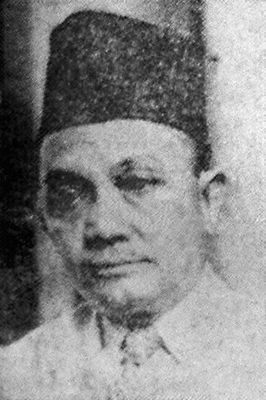 Fakih Usman in 1952 | |||||||
| |||||||
| Head of the government | Abdul Halim | ||||||
| The president | Assaat | ||||||
| Predecessor | |||||||
| Successor | position abolished | ||||||
| |||||||
| Head of the government | Vilopo | ||||||
| The president | Sukarno | ||||||
| Predecessor | |||||||
| Successor | |||||||
| |||||||
| Predecessor | |||||||
| Successor | |||||||
| Birth | March 2, 1904 , East Java , Dutch East Indies | ||||||
| Death | November 27, 1971 (67 years old) Indonesia | ||||||
| Father | Usman Iskandar | ||||||
| The consignment | Mashumi | ||||||
| Profession | religious figure, politician | ||||||
| Religion | Islam | ||||||

- This name is Indonesian ; here "Fakih" is a personal name , and "Usman" is a middle name , not a surname , this person does not have a surname .
Born in the family of a merchant in , he was educated in the (Islamic boarding school). In 1925 he joined the Muhammadiya, in 1938 became the head of the Surabay branch. In parallel, he was engaged in political activities. In 1937, he became the treasurer of the Indonesian Islamic Association - the union of several Islamic organizations, including Muhammadiya. He continued to engage in political and public activities during the Japanese occupation and the war of independence , becoming a member of the Mashumi party. As Minister of Religious Affairs, he oversaw the reorganization of the ministry and the reform of religious education. For two decades, he was deputy chairman of the Muhammadiya; in 1968 , shortly before his death, was elected chairman of the organization.
Content
- 1 Early life
- 2 Getting Started at Muhammadiya
- 3 Work in the Mashumi party and participation in the war of independence
- 4 As Minister of Religious Affairs
- 5 Further activities
- 6 Death and Heritage
- 7 Notes
- 8 Literature
Early life
Fakih Usman was born on March 2, 1904 in the East city of in the family of logger Usman Iskandar. His mother came from a family of ulema [1] . In addition to Fakih, the family had three more children. The family was not wealthy and lived modestly [2] [3] . Under the guidance of his father, Fakih from early childhood began to study the foundations of Islam [3] . At the age of ten, he entered the Grecian (Islamic boarding school ), where he studied for 4 years. In 1919, he continued his education in other pesantrens located near Gresik [1] .
Getting Started at Muhammadiya
With the help of his father, Fakih, in parallel with his studies, began to engage in trade [2] . In 1922 , when the unofficial branch of the Islamic organization Muhammadiya appeared in Gresik, he became one of its most active participants. Having headed this department three years later, he agreed on the recognition of the Grecian branch by the central leadership of Muhammadiya [4] . Later he was transferred to the department of the city of Surabaya , where in 1929 he was elected a member of the city council [5] . Along with social activities, Fakih continued to develop his business; by this time he was engaged in trade in building materials , owned a store for shipbuilding goods, and also worked in the local chamber of commerce [3] .
From 1932 to 1936, Fakih was a member of the regional council and the Legal Committee of the Muhammadiyah, as well as the editor of the official journal of the Bintang Islam organization ( indon. Bintang Islam - The Star of Islam ) [4] . At this time, he acquired a personal car , which was considered a luxury item in the Dutch East Indies , and constantly drove it from Gresik, where his company’s office was located, to and from Surabaya. Fakih devoted his free time to the study of the Dutch language and the works of the Islamic modernist theorist Muhammad Abdo [5] . Fakih’s activities in Muhammadiyah and his adherence to modern Islam were not approved by the conservative Muslims of Gresik, who gave him the nickname “ Black-faced Dutchman ” ( app . Londho silit ireng ) [5] ; they also repeatedly threw stones at the windows of his house [5] [6] .
On September 21, 1937, a meeting of the leadership of several Islamic organizations was held in Surabaya, among which were Muhammadiya, Nahdatul Ulama and Sarekat Islam ; an association was created on it, called the Indonesian Islamic Assembly (IIA; indon. Majilis Islam Ala Indonesia, MIAI ) [7] . Fakih was appointed Treasurer of the IIA [8] . At the same time, he continued to work in Muhammadiya, replacing in 1938 as the head of the Surabay branch [5] . In September 1940, Fakih was elected to the IIA secretariat, after which he resigned as head of the department and as a member of the Surabai city council [8] .
Work in the Mashumi Party and Participate in the War of Independence
In 1942, Japanese troops invaded the Dutch East Indies, and on March 9, 1942, the colony leadership surrendered to the Japanese occupying the country [9] . Occupants banned all political activities, and in May 1942 the IIA was dissolved [10] . On September 5, 1942, it was rebuilt at a meeting of 30 ulama held at the Des Indes Hotel in Jakarta and was recognized by the occupation administration as the only official Islamic organization in Indonesia [11] . At the end of 1943, the IIA was renamed the Council of Indonesian Muslim Associations ( indon. Ma jelis Syu ra M uslimin I ndonesia ), better known by the acronym Mashumi ( indon. Masyumi ) [10] . In Mashumi, as well as in the IIA, Fakih held a rather high position, while combining social activity with service in the advisory council of Surabaya created by the Japanese [12] .
After the Republic of Indonesia (RI) proclaimed its independence on August 17, 1945 , Fakih began to establish contacts with the new republican government [14] . He took part in the Indonesian Islamic Conference ( indon. Muktamar Islam Indonesia ), held in Yogyakarta from November 7 to 8, 1945, at which Mashumi was transformed into a political party. After the conference, he returned to Gresik, but soon due to the outbreak of hostilities between the Indonesians and the Dutch-British expeditionary forces , he was forced to move to Malang . In Malang, Fakih, together with and began to organize armed resistance to the invaders, consisting of fighters trained by the Japanese Muslim troops, becoming deputy commander of the resistance. After the in December 1948 , Fakih and his family fled to Surakarta . There he again joined the work of “Muhammadiya”, becoming the deputy chairman of the organization , who oversaw communications of the head office of “Muhammadiya” in Yogyakarta and Surakarta branch [12] .
As Minister of Religious Affairs
December 27, 1949 in the territory of the former Dutch East Indies was formed the Republic of Indonesia (RSSI) - a federal state created by the agreement between the Republic of Ingushetia and the Netherlands [15] . It included RI (which retained only parts of the islands of Java and Sumatra ) and 15 states created with the support of the Dutch [16] . On January 21, 1950, Fakih became Minister for Religious Affairs in the Government of the Republic of Ingushetia as part of the RSHI, replacing Mashkur. Together with the Minister for Religious Affairs of the UCLA and the leader of Nahdatul Ulam, he was involved in the compilation of programs for religious schools, as well as programs for secular schools for religious education [17] . On August 17, 1950, the RSHI was liquidated, and all its constituent states became part of the Republic of Ingushetia; the joint ministry for religious affairs was headed by Wahid Hashim, and Fakih was appointed director of the Department of Religious Education [18] .
In 1951, disagreements arose in Mashumi between the party leadership and the leaders of the organization Nahdatul Ulama, who believed that the leadership of Mashumi places too much emphasis on political activity, to the detriment of the principles of Islam [19] . The withdrawal of Nahdatul Ulam from Mashumi in April 1952 led to the collapse of Natsir’s and the resignation of Wahid Hashim from the post of Minister for Religious Affairs [20] . Mashumi proposed the candidacy of Fakih to the vacant ministerial post [21] . On April 3, 1952, he, together with the new Vilopo , was sworn in. Soon after, Fakih and his family finally moved to Jakarta. After his appointment, he announced the beginning of the reorganization of the ministry [22] , while emphasizing that his main task would be to ensure the activities of religious education, support interfaith dialogue, and set dates for religious holidays [23] . Under him, the structure of the ministry was streamlined, and a number of its field offices were opened. In addition, thanks to Fakih, Indonesian Muslims were able to perform Hajj [24] . On July 30, 1953, Fakih resigned along with Vilopo’s entire cabinet [22] ; as Minister of Religious Affairs, he was replaced by Mashkur [25] .
Further activities
After his resignation from the ministerial post, Fakih became the first deputy chairman of the Muhammadiya [3] [25] . In 1956, he became, together with two other members of the leadership of Muhammadiya, the author of the concept of a new Islamic society, in which the role of social education was particularly emphasized [26] . In 1955, Fakih was elected to the , remaining until the dissolution of the Constituent Assembly in 1959 [27] . In the same year, in collaboration with , Yusuf Poir Abdullah and Ahmad Yusuf, he began publishing the magazine Pandji Masjarakat ( The Banner of the Society ) [3] . In 1958 , during the uprising led by the Revolutionary Government of the Republic of Indonesia (RPRI), he participated in negotiations between the RPRI and the government [3] [28] .
On August 17, 1960, the Mashumi party was dissolved by President Sukarno because of its support for the RPRI rebellion. This allowed Fakih to focus on his work in Muhammadiya, where, at that time, he was the second deputy chairman of Yunus Anis [28] . He often made policy statements explaining his vision of the Muhammadiya course; So, in a 1961 lecture “What is Muhammadiyah?” ( indon. “Apakah Muhammadiyah Itu” ), he said that the main goal of the organization is to preach Islam ( dawat ), and that in order to achieve the prosperity of Islam, Muhammadiyah should focus on solving real problems of Muslims, while collaborating with the government [29] . In his 1962 speeches , he specified the above provisions, saying that Muhammadiya should strive to build a just Islamic society, while refusing any cooperation with left-wing political forces [30] .
From 1962 to 1965, Fakih held the post of first deputy chairman of the Muhammadiya . After the events of September 30, 1965 and the subsequent change of power in the country, Fakih, among other leaders of the Muhammadiya, signed an appeal to the government with a request to restore Mashumi in a reformed form; the government did not support this idea [3] [31] . After Badawi was re-elected for a second term in 1965, Fakih served as his adviser. In 1968, at the 37th Congress of Muhammadiya, he was elected chairman of the organization [31] .
Death and Heritage
Soon after Fakih was elected chairman, his health was shaken and he began to look for a successor [31] . On October 2, 1968, a meeting of the leadership of Muhammadiya was held in his house, at which he outlined his plans for leading the organization. However, these plans were not implemented: having appointed and interim leaders of the organization, Fakih went abroad for treatment, but did not manage to leave the country and died on October 3 . After his death, Abdul Rozak Fakhruddin [32] [33] was elected Chairman of Muhammadiya, who held this post for 21 years [34] .
The personality of Fakih Usman is still respected among the Muslims of Indonesia in general and among the members of the Muhammadiya in particular [3] [35] . Didin Shafruddin ( indon. Didin Syafruddin ), lecturer at , notes Fakih's high level of education and his desire to educate children; five of his seven children subsequently received their doctoral degrees [36] . Also, Shafruddin justifies Fakih for the fact that he did not carry out more extensive reforms during his tenure as minister, explaining this by the lack of human resources at his disposal [1] . Former chairman of Muhammadiya calls Fakih “calm and clear water” ( indonesian ... air tenang yang menghanyutkan ), which pacified Muhammadiya during the organization’s crisis [37] .
In memory of Fakih Usman, one of the streets of his hometown of Gresik bears his name [1] .
Notes
- ↑ 1 2 3 4 Syafruddin, 1998 , p. 118.
- ↑ 1 2 Syafruddin, 1998 , p. 119.
- ↑ 1 2 3 4 5 6 7 8 Muhammadiyah , KH Faqih Usman.
- ↑ 1 2 Syafruddin, 1998 , p. 122.
- ↑ 1 2 3 4 5 Syafruddin, 1998 , p. 123.
- ↑ The Muhammadiya advocated an individual interpretation of the Qur'an and the Sunnah ( Ijtihad ), and not the indisputable acceptance of the interpretations of the ulama ( taklid ). In addition, the organization did not support the syncretism of Islam, Hinduism, and Buddhism that has developed in traditional Indonesian society. All this caused extreme discontent among adherents of traditional Indonesian Islam (see Djurdi, 2010 , p. Xiv; Ricklefs, 1993 , p. 171; Kutoyo, 1985 , p. 110).
- ↑ Syafruddin, 1998 , p. 125.
- ↑ 1 2 Syafruddin, 1998 , p. 126.
- ↑ Adi, 2011 , pp. 18-24.
- ↑ 1 2 Syafruddin, 1998 , p. 128.
- ↑ Djaelani, 1994 , p. 98.
- ↑ 1 2 Syafruddin, 1998 , p. 132.
- ↑ Ricklefs, 1993 , pp. 212–217.
- ↑ Adi, 2011 , p. 32.
- ↑ Imran, 1980 , p. 83.
- ↑ Syafruddin, 1998 , p. 133.
- ↑ Syafruddin, 1998 , pp. 134-136.
- ↑ Syafruddin, 1998 , p. 138.
- ↑ Syafruddin, 1998 , p. 139.
- ↑ Syafruddin, 1998 , p. 140.
- ↑ Djurdi, 2010 , p. 146.
- ↑ 1 2 Syafruddin, 1998 , p. 141.
- ↑ Syafruddin, 1998 , pp. 142-144.
- ↑ Djurdi, 2010 , p. 144.
- ↑ 1 2 Syafruddin, 1998 , p. 145.
- ↑ Basya, 2009 , A Century of Muhammadiyah.
- ↑ Syafruddin, 1998 , p. 146.
- ↑ 1 2 Syafruddin, 1998 , p. 148.
- ↑ Djurdi, 2010 , p. 169.
- ↑ Syafruddin, 1998 , p. 149.
- ↑ 1 2 3 Syafruddin, 1998 , p. 150.
- ↑ Syafruddin, 1998 , p. 151.
- ↑ According to the tradition established in Muhammadiya, a new leader was elected before the funeral of the old (see Djurdi, 2010 , p. 182).
- ↑ Mohammad, 2006 , p. one hundred.
- ↑ Djurdi, 2010 , p. 271.
- ↑ Syafruddin, 1998 , p. 117.
- ↑ Ramly, Sucipto, 2010 , p. 211.
Literature
- A. Kresna Adi. Soedirman: Father of the Indonesian Military // Soedirman: Bapak Tentara Indonesia. - Yogyakarta: Mata Padi Pressindo, 2011 .-- ISBN 978-602-95337-1-2 . (indon.)
- M. Hilaly Basya. A Century of Muhammadiyah and Modern Indonesia // The Jakarta Post. - 2009. - November 26. Archived July 15, 2012.
- Abdul Qadir Djaelani. The Role of Ulamas and Santris in Islamic Politics in Indonesia // Peran Ulama dan Santri dalam Perjuangan Politik Islam di Indonesia. - Surabaya: Bina Ilmu, 1994. OCLC 34604050 (indon.)
- Syarifuddin Djurdi. A Century of Muhammadiyah // 1 Abad Muhammadiyah . - Jakarta: Kompas, 2010 .-- ISBN 978-979-709-498-0 . (indon.)
- Amrin Imran. Commander in Chief General Soedirman // Panglima Besar Jenderal Soedirman. - Jakarta: Mutiara, 1980. OCLC 220643587 (indone.)
- KH Faqih Usman . - Muhammadiyah. Archived July 15, 2012.
- Sutrisno Kutoyo. Kiai Haji Ahmad Dahlan. - Jakarta: Department of Education and Culture, 1985. OCLC 571207832 (indon.)
- Herry Mohammad. Influential Muslims of the 20th Century // Tokoh-Tokoh Islam yang Berpengaruh abad 20 . - Jakarta: Gema Insani, 2006 .-- ISBN 978-979-560-219-4 . (indon.)
- Nadjamuddin Ramly, Hery Sucipto. Encyclopedia of Muhammadiyah Figures // Ensiklopedi Tokoh Muhammadiyah. - Jakarta: Best Media, 2010 .-- ISBN 978-602-96791-1-3 . (indon.)
- MC Ricklefs. A History of Modern Indonesia since c. 1300. - 2nd. - Hampshire: MacMillan, 1993 .-- ISBN 978-0-333-57689-2 .
- Didin Syafruddin. KH Fakih Usman: Pengembangan Pendidikan Agama: Development of Religious Education // Indonesian Ministers of Religion: Socio-Political Biographies / Azyumardi Azra, Saiful Umam. - Jakarta: Indonesian-Netherlands Cooperation in Islamic Studies, Center for Study of Islam and Society, and the Indonesian Ministry of Religion, 1998. - ISBN 978-979-95248-3-6 . (indon.)