Armored Cruisers [approx. 1] of the Bussard type were built for the Kaiserlichmarine (German imperial fleet) in the late 1880s and early 1890s. The type consisted of six ships: the Bussard (lead ship), Falk , Seeadler , Cormoran , Condor and Geyer . Cruisers of this type were intended for service in the German colonial empire , special emphasis was placed on a long cruising radius and relatively heavy weapons, also these were the last Kaiserlichmarine cruisers equipped with auxiliary sailing weapons. The ships were armed with 105 mm guns.
| Bussard Cruisers | |
|---|---|
| Bussard-klasse | |
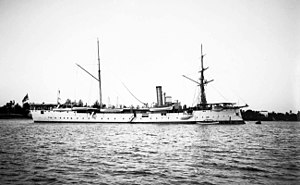 The Bussard in Dar es Salaam 1907 | |
| Project | |
| A country |
|
| Years of construction | 1888 - 1895 years |
| Built | 6 |
| Scrapped | 3 |
| Losses | 3 |
| Main characteristics | |
| Displacement | 1868 t (full) |
| Length | 82.6 m |
| Width | 12.5 m |
| Draft | 4.45 m |
| Engines | 2 three - cylinder steam engines |
| Power | 2800 l. from. |
| Mover | 2 screws |
| Speed | 15.5 knots (28.7 km / h) |
| Sailing range | 3610 km at 9 knots |
| Crew | 9 officers 152 sailors |
| Armament | |
| Artillery | 8 × 105 mm guns KL / 35 5 revolving guns |
| Mine torpedo armament | 2 × 350 mm torpedo tubes |

Cruisers spent most of their service abroad, mainly off the coast of Africa and the South Pacific , where they helped to crush rebellions such as the Ihethuan uprising in China and the Sokeh tribe in the Caroline Islands . "Cormoran" took part in the capture of the Jiao-Zhou concession in China in 1897, "Falk" participated in the Venezuelan crisis from 1902 to 1903. The Bussard and Falk were dismantled for metal in 1912, the four remaining ships remained in service until the outbreak of World War I in August 1914.
"Cormoran" was in Qingdao with idle machines, was flooded in the bay after it lost its combat significance. Geyer briefly acted in the Pacific against British shipping, then went to Hawaii , which at that time belonged to the neutral USA, where it was interned. After the U.S. entered the war in April 1917, the cruiser was captured and enlisted in the US Navy under the name USS Schurz . He served as an escort ship until he drowned after a collision with a cargo ship in June 1918. "Seeadler" and "Condor" after the outbreak of the war were converted into blockchains for storing mines. The Seeadler was destroyed by an accidental explosion in 1917. The Condor was the only ship of this class to survive the war; it was dismantled for metal in 1921.
Content
- 1 Design
- 1.1 General characteristics
- 1.2 Power plant
- 1.3 Armament
- 2 Ships
- 3 Service History
- 4 Comments
- 5 notes
- 6 Literature
- 7 References
Design
Bussard-class cruisers were designed to serve abroad in German colonial possessions and were more advanced than previous armored Schwalbe- type cruisers . The design of the Bussards was developed in 1888. The ships were much larger and faster than the Schwalbe type cruisers, nevertheless they carried the same number of guns, although only one Bussard carried the same type of guns, the rest were equipped with newer rapid-fire guns [1] [2] . The Bussard type was the last series of cruisers of the German Kaiserlichmarine equipped with sailing weapons , the subsequent armless cruiser Gefion was driven exclusively by steam [3] .
General Features
Ships of the Bussard type differed in their characteristics. The first two: Bussard and Falk were 79.62 meters long along the waterline , and the total length of the 82.6 m. Their width was 12.5 m, draft - 4.45 inland and 5.63 m in the stern. The displacement of ships was 1559 tons under the project, with a full combat load, the displacement was 1868 tons. The following three ships: the Seeadler, Cormoran, and Condor, were 79.62 meters long along the waterline and had the same total length as earlier ships of this type. Their width was 12.7 m, draft - 4.42 in front and 5.35 m in the stern. The design displacement of the ships was 1612 tons, with a full combat load, the displacement was 1864 tons. The last Geyer ship had a waterline length of 79.62 m, a maximum length of 83.9 m, a width of 10.6 m and a draft of 4.74 bow and 5.22 m stern [4] .
Cruiser hulls transverse steel set, yellow deck formwork of the upper deck. The body was covered with a covering made of a layer of Muntz metal to protect the tree from a sea worm . The stem and stern post were built of steel and wood. A bronze ram was mounted on the nose. The case was divided into ten waterproof compartments. There was a double bottom under the boiler compartments. The ships had a good move, but badly rolled along the waves, sponsons for the main guns caused a strong vibration. On the Geyer, which was laid down after the commissioning of the remaining five ships, the sponsons were liquidated and the cruiser did not suffer from vibrations. The ships were highly maneuverable, with the exception of turns under the wind at low speed. The crew of cruisers consisted of 9 officers and 152 sailors. The ships were equipped with the following boats: one picket boat, one cutter , two skiffs and two boats [4] .
Power plant
The power plant of cruisers of this type consisted of two horizontal three - cylinder steam engines powered by four cylindrical coal boilers. Machines could theoretically develop power up to 2800 horsepower (2100 kW) and were installed in separate engine rooms . The machines powered a pair of 3-blade propellers with a diameter of 3 meters. The boilers were located in two boiler rooms, chimneys went into one pipe. The ships were additionally equipped with sailing armaments of the barquentines , the total area of the sails ranged from 856 to 877 m². Management was carried out by one ship steering wheel . Each ship was equipped with two electric generators with a total capacity of 24 kW, voltage of 67 volts [4] .
The power plant gave the ship the opportunity to reach a maximum speed of 15.5 knots (28.7 km / h), although all six ships of this type exceeded the estimated speed on sea trials, developing from 15.7 to 16.9 knots (from 29.1 up to 31.3 km / h). Ships could carry from 170 to 205 tons of coal. Thanks to additional bunkers, the capacity could be increased to 305-320 tons of coal. This exceeded the cruising range to 2990 - 3610 nautical miles (5540 - 6690 km) on the move 9 knots [4] .
Armament
The first ship of this type was armed with eight 105-mm KL / 35 non-firing guns on single pedestals; the total ammunition left 800 shots. The guns were hit at 8,200 m. Five subsequent ships of this type were equipped with newer 105 mm SK-L / 35 quick-firing guns. Two guns were placed side by side on the bow, two on each side in sponsons and two aft. There were no sponsors on the Geyer cruiser; a pair of airborne guns was simply mounted on the upper deck. The armament of the cruisers was strengthened by five revolving guns [2] . The first five ships were armed with two 350 mm deck torpedo tubes . On the cruiser "Geyer" were installed torpedo tubes of larger caliber - 450 mm. Each ship carried five torpedoes [4] .
Ships
| Title | Shipyard [4] | Pledged [5] | Launched [5] | Joined the fleet [5] |
|---|---|---|---|---|
| SMS Bussard | Kaiserliche Werft , Danzig | 1888 year | January 23, 1890 | October 7, 1890 |
| SMS Falke | Kaiserliche Werft , Kiel | 1890 year | April 4, 1891 | September 14, 1891 |
| SMS Seeadler | Kaiserliche Werft , Danzig | 1890 year | February 2, 1892 | August 17, 1892 |
| SMS Condor | Blohm & Voss , Hamburg | 1891 year | February 23, 1892 | December 9, 1892 |
| SMS Cormoran | Kaiserliche Werft , Danzig | 1890 year | May 17, 1892 | July 25, 1893 |
| SMS Geier | Kaiserliche Werft , Wilhelmshaven | 1893 year | October 18, 1894 | October 24, 1895 |
Service History
All six ships of this type spent most of their service abroad, mainly in German colonial possessions off the coast of Africa and the Pacific Ocean. The Seeadler in March 1893, together with the armored cruiser Kaiserin Augusta , paid a visit to the United States to take part in the celebration of the 400th anniversary of Christopher Columbus sailing across the Atlantic [6] . In July of that year, the Bussard and Falk, assigned to the East Asian squadron , took part in the suppression of the rebellion raised by Mataafa Josefo Samoa acting together with the British corvette [7] . In the 1890s, Seeadler was in German colonies in eastern and southwestern Africa , suppressing local uprisings there [8] .
In November 1897, “Cormoran” took part in the capture of a concession in the Jiao-Zhou Bay of the Shandong Peninsula of Qing China [9] . "Geyer" in 1898 was present in the Caribbean during the Spanish-American War , but did not take an active part in the conflict [10] . Between 1898 and 1900, the Bussard and Seeadler underwent modernization in Germany [4] . From 1898 to 1900, the Seeadler took part in the suppression of the Ihe-Tuan uprising , and also carried out the blockade of the Chinese coast [11] . In December 1902, the Falk and the armored cruiser Vineta joined the British forces during the Venezuelan crisis of 1902-1903 , after the Venezuelan authorities seized the British merchant ship. Two German cruisers fired at the coastal fortifications of Venezuela and blocked the coast [12] .
From 1907 to 1909, Cormoran and Geyer underwent modernization. Of the ships of this type, only the Falk and the Condor never returned for major repairs at the docks [4] . In January 1911, the Condor and Cormoran, together with the light cruiser Leipzig, participated in the suppression of the Sokekh uprising in the Caroline Islands [13] . In 1912, with the outbreak of the Second Balkan War , Geyer was based in the eastern Mediterranean Sea to observe military operations [14] . On October 25, 1912, Bussard and Falk were removed from the naval register and the following year they were disassembled for metal in Hamburg and at the Kaiserliche Werft in Danzig, respectively [5] .
With the outbreak of the First World War in August 1914, the Seeadler was converted into a mine block in Wilhelmshaven. In April 1917, a spontaneous explosion occurred that destroyed the ship; the hull was never raised. The Condor also served as a mineblock in Kiel, he survived the war and in 1921 was disassembled for metal in Hamburg. The "Cormoran", still in Qingdao, was flooded in the bay due to the poor condition of the vehicles [15] . After the outbreak of the war, Geyer took action against British merchant shipping in the Pacific. In October, he ran out of coal and was cut off from any sources of supply, so he went to Hawaii , where he was interned by the US Navy. After the United States declared war on Germany on April 6, 1917, the cruiser was captured and entered into the US Navy under the name USS Schurz and served as an escort ship. In June 1918, the ship sank as a result of a collision with a merchant ship [1] .
Comments
- ↑ According to the German classification of the time, small cruisers ( German Kleiner Kreuzer )
Notes
- ↑ Gröner, 1990 , p. 93–97.
- ↑ 1 2 Gardiner, 1979 , p. 253.
- ↑ Gröner, 1990 , S. 97-99.
- ↑ 1 2 3 4 5 6 7 8 Gröner, 1990 , p. 97.
- ↑ 1 2 3 4 Gröner, 1990 , p. 97-98.
- ↑ Sondhaus, 1997 , p. 206.
- ↑ Clowes et al., 1903 , p. 414.
- ↑ Die Deutschen Kriegsschiffe. Vol. 7, 1993 , p. 152-153.
- ↑ Die Deutschen Kriegsschiffe. Vol. 2, 1993 , p. 193.
- ↑ Nunez, 1899 , p. 76.
- ↑ Die Deutschen Kriegsschiffe. Vol. 7, 1993 , p. 154.
- ↑ Marley, 2008 , p. 924-925.
- ↑ Die Deutschen Kriegsschiffe. Vol. 2, 1993 , p. 191.
- ↑ Vego, 1996 , p. 124.
- ↑ Gröner, 1990 , p. 98.
Literature
- Clowes WL , Markham C. , Mahan AT , Wilson HW , Roosevelt T. The Royal Navy: A History From the Earliest Times to the Death of Queen Victoria. - London, UK: Sampson Low, Marston and Company, 1903. - T. VII. - OCLC 1296915 .
- Gardiner R. Conway's All the World's Fighting Ships 1860–1905. - Greenwich: Conway Maritime Press, 1979. - ISBN 0-8317-0302-4 .
- Gröner E. . German Warships 1815–1945. - Annapolis, MD: Naval Institute Press, 1990. - ISBN 0-87021-790-9 .
- Hildebrand HH, Röhr A., Steinmetz HO Die Deutschen Kriegsschiffe. - Vol. 2. - Ratingen, DE: Mundus Verlag, 1993. - ISBN 978-3-8364-9743-5 .
- Hildebrand HH, Röhr A., Steinmetz HO Die Deutschen Kriegsschiffe. - Vol. 7. - Ratingen, DE: Mundus Verlag, 1993. - ASIN B003VHSRKE (link not available)
- Marley D. Wars of the Americas: A Chronology of Armed Conflict in the Western Hemisphere, 1492 to the Present. - Santa Barbara, CA: ABC-CLIO, 2008 .-- ISBN 978-1-59884-100-8 .
- Nunez SG . The Spanish-American War: Blockades and Coast Defense. - Washington, DC: Washington, Govt. Print Off., 1899. - OCLC 1707856 .
- Sondhaus L. Preparing for Weltpolitik: German Sea Power Before the Tirpitz Era. - Annapolis, MD: Naval Institute Press, 1997. - ISBN 1-55750-745-7 .
- Vego MN Austro-Hungarian Naval Policy, 1904-14. - London: Frank Cass Publishers, 1996 .-- ISBN 978-0-7146-4209-3 . - OCLC 560641850 .