Frei Jorge is a biosphere reserve in Chile . Includes national parks of Frei Jorge , Talin and Punta del Fiento. Since 1976, it has been included in the worldwide network of biosphere reserves , in 2012 the reserve was expanded [1] .
| Fry jorge | |
|---|---|
| Spanish Fray jorge | |
 | |
| basic information | |
| Square | 99.59 km2 |
| Established | 1976 year |
| Management organization | CONAF |
| Location | |
| A country |
|


Content
Physico-geographical characteristics
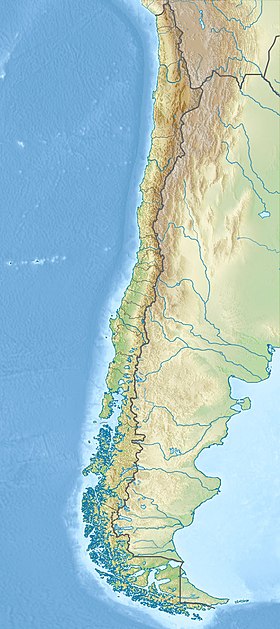
The Frei Jorge Biosphere Reserve is located in the province of Limari , north of Santiago . It includes the estuary of the Limari River, the coastal zone, semi-arid and arid zones of shrubbery, and evergreen relict forests [1] . The reserve stretched along the Coastal Cordillera [2] .
According to the concept of zoning reserves, the total area of 1343.11 km² is divided into three main zones: core — 99.59 km², buffer zone — 256.82 km², cooperation zone — 986.7 km² [1] . According to protectedplanet, the reserve area is 98.45 km² [3] .
Flora and Fauna
The reserve is the habitat of typical Mediterranean species in Chile, including birds ( Nothoprocta perdicaria ), ( Sturnella loyca ), ( Diuca diuca ), ( Mimus thenca ), mammals ( Dusicyon culpaeus ) [2] .
440 species of local flora grow on the territory of the reserve, of which 266 species are endemic to Chile. In particular, one can meet here ( Aextoxicon punctatum ) and ( Drimys winteri ), which usually grow southward for 1000 km [1] . The main species are ( Azara celastrina ), ( Schinus latifolius ), ( Lithraea caustica ), ( Porlieria chilensis ), ( Senna cummingii ), ( Fuchsia lycioides ), ( Echinopsis coquimbana ), Baccharis , Salix , Potamogeton pectinllumus, mycti 2 aquatic , .
Human Interaction
The reserve was created in 1976 and expanded in 2012. It includes the national park of the same name, as well as the parks of Talin and Punta del Fiento [1] . The managing organization is CONAF - National Forestry Corporation [3] .
The core of the reserve remains an untouched zone where there are no farms and deforestation. In the transit zone, there is some economic activity [2] . On the territory of the reserve, various studies and educational programs are carried out. About 15 thousand tourists visit the reserve annually [1] .
According to 1999 data, about 750 people lived in the buffer zone, mainly employed in agriculture [2] .
Notes
- ↑ 1 2 3 4 5 6 Fray Jorge - Man and the Biosphere (English)
- ↑ 1 2 3 4 5 Fray Jorge - Database of the program Man and the Biosphere (English)
- ↑ 1 2 Bosque Fray Jorge UNESCO-MAB Biosphere Reserve // protectedplanet.net