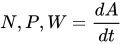
Power is a scalar physical quantity that is generally equal to the rate of change, conversion, transmission, or energy consumption of a system. In a narrower sense, power is equal to the ratio of work performed over a certain period of time to this period of time [1] .
| Power | |
|---|---|
| Dimension | L 2 MT −3 |
| Units | |
| SI | Tue |
| GHS | erg s −1 |
Content
Designations Used
Usually in the formulas of mechanics is indicated by the symbol N (the origin of the symbol is to be clarified).
In electrical engineering, it is usually indicated by the symbol P - from lat. p otestas (strength, power, effectiveness);
Sometimes the symbol W is used (from English watt).
Basic Formulas
Distinguish average power over a period of time :
and instantaneous power at a given time:
The time integral of the instantaneous power over a period of time is equal to the total energy transferred during this time:
Units
In the International System of Units (SI), the unit of measure for power is a watt (W) equal to one joule per second (J / s). In theoretical physics , astrophysics , erg per second (erg / s) is often used as a unit for power.
Another common, but now obsolete unit of measure for power is horsepower . In its recommendations, the International Organization of Legal Metrology (OIML) defines horse power as a unit of measurement “which should be withdrawn from circulation as soon as possible where it is currently used, and which should not be introduced if it is not used” [2 ] .
| Units | Tue | kw | MW | kgf · m / s | erg / s | l with. (met.) | l with. (eng.) | |
|---|---|---|---|---|---|---|---|---|
| 1 watt | one | 10 −3 | 10 −6 | 0.102 | 10 7 | 1.36⋅10 −3 | 1.34⋅10 −3 | |
| 1 kilowatt | 10 3 | one | 10 −3 | 102 | 10 10 | 1.36 | 1.34 | |
| 1 megawatt | 10 6 | 10 3 | one | 102⋅10 3 | 10 13 | 1.36⋅10 3 | 1.34⋅10 3 | |
| 1 kilogram-force meter per second | 9.81 | 9.81⋅10 −3 | 9.81⋅10 −6 | one | 9.81⋅10 7 | 1.33⋅10 −2 | 1.31⋅10 −2 | |
| 1 erg per second | 10 −7 | 10 −10 | 10 −13 | 1,02⋅10 −8 | one | 1.36⋅10 −10 | 1.34⋅10 −10 | |
| 1 horsepower (metric) | 735.5 | 735.5⋅10 −3 | 735.5⋅10 −6 | 75 | 7,355⋅10 9 | one | 0.9863 | |
| 1 horsepower (English) | 745.7 | 745.7⋅10 −3 | 745.7⋅10 −6 | 76.04 | 7,457⋅10 9 | 1.014 | one |
Power in mechanics
If a force acts on a moving body, then this force does the work. Power in this case is equal to the scalar product of the force vector by the velocity vector with which the body moves:
where F is the force vector; v is the velocity vector; - the angle between the velocity and force vector; F is the modulus of force; v is the velocity modulus.
A special case of power during rotational motion:
M is the moment of force , - angular velocity Is the number of pi , n is the rotation frequency (number of revolutions per minute, rpm.).
Electric power
Electric power - a physical quantity that characterizes the speed of transmission or conversion of electrical energy .
Instant electrical power electric circuit area:
- Where - instantaneous current through the circuit;
- - instantaneous voltage in this area.
When studying AC networks , in addition to the instantaneous power corresponding to the general physical definition, the following concepts are also introduced:
- active power equal to the average over the period value of instantaneous power,
- instant active power:
- reactive power , which corresponds to the energy circulating without dissipation from source to consumer and vice versa,
- instant reactive power:
at
at
- total power , calculated as the product of the effective values of current and voltage without taking into account the phase shift .
- instantaneous apparent power
Where
- current amplitude;
- voltage amplitude;
- the angle between the initial voltage angle and initial current angle -
- angular velocity;
- time.
Instruments for measuring electrical power
- Wattmeters (including varometers )
Hydraulic Power
The power of the hydraulic machine or hydraulic cylinder is equal to the product of the differential pressure on the machine (pressure difference at the inlet and outlet) and the fluid flow:
- Where - fluid flow rate, m 3 / s ;
- - pressure drop, Pa .
For example, the NP-89D pump, standing on the Su-24 , Tu-134 and Tu-154 , has a capacity of 55 l / min (~ 0,000917 m 3 / s) at a pressure of 210 kgf / cm 2 (21 MPa) [ 3] - therefore, its hydraulic power is approximately 19.25 kW.
See also
- Power density
- Active power
- Reactive power
- Luminosity
- Energy
- Explosive power
- Sound power
- Amplifier
Notes
- ↑ Power - an article from the Physical Encyclopedia
- ↑ OIML International Document D2. Legalized (officially approved for use) units. Appendix B (inaccessible link) . Date of treatment April 5, 2013. Archived on October 14, 2013.
- ↑ NP-89D. Description. Specifications. Aggregates of production of OJSC MMZ Znamya