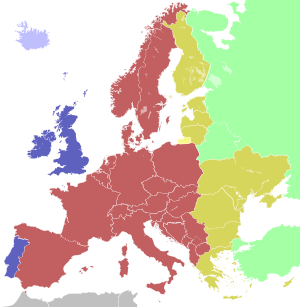
| Blue | Western European Time (WET) ( UTC + 0 ) |
| blue | Western European Time (WET) ( UTC + 0 ) Western European Summer Time (WEST, BST) ( UTC + 1 ) |
| red | Central European Time (CET) ( UTC + 1 ) Central European Summer Time (CEST) ( UTC + 2 ) |
| light yellow | Eastern European Time (EET) / Kaliningrad time ( UTC + 2 ) |
| khaki | Eastern European Time (EET) ( UTC + 2 ) Eastern European Summer Time (EEST) ( UTC + 3 ) |
| light green | Far Eastern European Time (FET) ( UTC + 3 ) |

| the black | UTC-1 : Cape Verde Time . |
| green | UTC : Western European Time · Greenwich Mean Time . |
| blue | UTC + 1 : Central European Time · West African Time · Western European Summer Time . |
| red | UTC + 2 : Eastern European Time · Central African Time · West African Summer Time · South African Time . |
| yellow | UTC + 3 : Eastern European Summer Time · Eastern African Time . |
| Gray | UTC + 4 : Mauritius time · Seychelles time . |
Eastern European Summer Time ( EEST , English East European Summer Time ) is one of the names of the 3rd time zone (UTC +3). Eastern European Summer Time is three hours ahead of Coordinated Universal Time (UTC). It is used as summer time (turning the hands forward an hour) in some countries in Europe and Asia .
Countries and Territories
The following countries and territories use Eastern European Summertime:
- Bulgaria
- Greece
- Israel
- Jordan
- Cyprus
- Latvia
- Lebanon
- Lithuania
- Moldavia
- State of Palestine
- Transnistrian Moldavian Republic [1] [2]
- Romania
- North Cyprus
- Ukraine
- Finland , including the Åland Islands
- Estonia
In all of the above countries, except Israel , the UTC + 3 time is used from 1:00 UTC on the last Sunday of March and until 1:00 UTC on the last Sunday of October.
In Israel, summer time is from 2:00 am from Thursday to Friday, the last Sunday of March, and 2:00 am from Saturday to the first Sunday following the date of October 1. This law was adopted on July 8, 2013 [3] . If the first Sunday following the date of October 1 falls on the Rosh Hashanah holiday , the date of the end of summer time is postponed for the day ahead (at 2:00 am from Sunday to the first Monday following the date of October 1).
Until 2010 and from 2014 to 2015, Eastern European summertime also operated in Egypt [4] . However, it has now been canceled again. .
Notes
- ↑ "On the introduction and coordination of" summer "time in Transnistria"
- ↑ Transdniestria, following Ukraine, refused to live without hours . Lenta.ru (October 26, 2011). The appeal date is April 13, 2014.
- ↑ Knesset votes to extend Daylight Saving Time , jpost.com (July 8, 2013). The appeal date is April 13, 2014.
- Light Daylight saving in Egypt .