The 2003 parliamentary elections in Serbia were held on December 28th .
← 2000  2007 → 2007 → | |||
| Legislative Election in Serbia (2003) | |||
|---|---|---|---|
| 2003 | |||
| December 28th | |||
| Voter turnout | 58.74% | ||
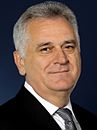 |  | 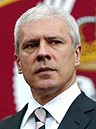 | |
| Party head | Tomislav Nikolic | Vojislav Kostunica | Boris Tadich |
| The consignment | Serbian Radical Party | Democratic Party of Serbia | Democratic Party |
| Seats received | 82/250 ( ▲ 59) | 53/250 ( ▲ 8) | 37/250 ( ▼ 25) |
| Votes | 1,056,256 ( 27.61% ) | 678 031 ( 17.72% ) | 481,249 ( 12.58% ) |
| Change in the percentage of votes | ▲ 19.01 | ||
| Past number of seats | 23 | 45 | 62 [~ 1] |
 |  |  | |
| Party head | Mirolyub Labus | Vuk Draskovic | Ivica Dacic |
| The consignment | G17 + | Serbian Renewal Movement / New Serbia | Socialist Party of Serbia |
| Seats received | 34/250 ( ▲ 34) | 22/250 ( ▲ 14 [~ 2] ) | 22/250 ( ▼ 15) |
| Votes | 438,422 ( 11.46% ) | ( 7.66% ) | ( 7.61% ) |
| Change in the percentage of votes | ▼ 6.15 | ||
| Past number of seats | 0 | 0 | 37 |
| Election result | The government, led by Vojislav Kostunica, was formed by the Democratic Party of Serbia , G17 + , the Serbian Renewal Movement and New Serbia, with the support of the Socialist Party of Serbia .
| ||
After the overthrow of the post-communist regime of Slobodan Milosevic in 2000, Serbia was in a state of serious and prolonged political crisis. The presidential election was held three times, but the new president could not be elected because of the low turnout. The situation was aggravated by the assassination in March 2003 of the popular Prime Minister Zoran Djindjic , which dealt a serious blow to the reformist forces. In early November, disagreements between reformists led to the collapse of the coalition government of the Democratic Opposition of Serbia, which led to the announcement of early elections.
By December 2003, the Democratic Opposition of Serbia (DOS) reformist alliance had split into three main parts. Separately from each other, the Democratic Party of Serbia, former President of Yugoslavia Vojislav Kostunica , went to the polls, the Democratic Party headed by Boris Tadic , who was then Acting Minister of Defense of the Union of Serbia and Montenegro , and the new G17 + party, created by a group of liberal economists led with Mirolyub Labus . The remaining parties either joined the coalition or decided to go to the polls on their own.
The main opponents of the reformist forces were the Socialist Party of Serbia , which instead of the arrested Milosevic was led by his deputy Ivica Dacic , the nationalist Serbian radical party , whose sole leader after the extradition of Vojislav Seselj was Tomislav Nikolic and the coalition for Popular Unity, created by the famous Serbian Unity Party , organized by the famous Serbian unity fighter Zeljko Razhnatovich , nicknamed "Arkan", who was killed in 2000 .
Content
Election Participants
- Serbian Radical Party ;
- The Democratic Party of Serbia, together with candidates from the People’s Democratic, Serbian Liberal and Serbian Democratic Parties;
- The Democratic Party, together with candidates from the Civil Alliance of Serbia , the Democratic Center, the Social Democratic Union and the Sandjak List Coalition, including the Sanjak Democratic Party , the Bosnian Sanjak Democratic Party, the Sanjak Reform Party, the Sanjak Social Democratic Party and the Social Democratic Party Sanjak
- G17 + along with candidates from the Social Democratic Party;
- Coalition Serbian Renewal Movement - New Serbia ;
- Socialist Party of Serbia ;
- The Together for Tolerance coalition, including the League of Social Democrats of Vojvodina , the Alliance of Vojvodina Hungarians , the Sandzak Democratic Party, the League for Noise, the Democratic Alliance of Croats of Vojvodina, the Croatian People's Alliance, the Christian Democratic European Movement, the Democratic Civil Movement , The Democratic Alliance of the Bulgarians in Serbia, the Vojvodina Coalition, the European Party, the Party for Sanjak, the Bosnian Liberal Organization and the Social Democratic Worker party;
- Democratic alternative;
- Coalition “For National Unity” , including the Party of Serbian Unity , the party “Our Home Serbia”, the Peasant, Peoples, People’s and Serbian Parties;
- People’s movement “Resistance!” ;
- The Independent Serbia Coalition, which includes the Christian Democratic Party of Serbia, the Democratic Party of the Fatherland, the Democratic Movement of the Romanians of Serbia, the Peasant Party and the Serbian Justice Party;
- Socialist People's Party ;
- Liberals of Serbia ;
- Reformists of Vojvodina ;
- The Defense and Justice Coalition, which includes the Social Democracy Party, the People’s Justice Party, the Workers and Pensioners Party, and the Social Democratic Green Party;
- The economic strength of Serbia and the diaspora ;
- Labor Party of Serbia ;
- Yugoslav Lefty ;
- Alliance of the Serbs of Vojvodina .
Election Results [1]
| The consignment | original name | Vote | % | Places | Changes |
|---|---|---|---|---|---|
| Serbian Radical Party | Serb. Srpska Radical Stranka, CPC | 1,056,256 | 27.62 | 82 | ▲ 59 |
| Democratic Party of Serbia | Serb. Democrat stranka Srbiјe, DPS | 678 031 | 17.73 | 53 | ▲ 8 |
| Democratic Party | Serb. Demokratska stranka, DS | 481,249 | 12.58 | 37 | ▼ 25 [~ 1] |
| G17 + | Serb. G17 plus | 438,422 | 11.46 | 34 | ▲ 34 |
| Serbian Renewal Movement / New Serbia | Serb. Srpski will update, open source software / Serb. Nova Srbiјa, NS | 293,082 | 7.66 | 22 | ▲ 14 [~ 2] |
| Socialist Party of Serbia | Serb. Socialist Party Srbiјe | 291 341 | 7.62 | 22 | ▼ 15 |
| “Together for tolerance” | Serb. For the tolerance | 161 765 | 4.23 | 0 | ▼ 19 [~ 3] |
| Democratic alternative | Serb. Democrat alternative | 84 463 | 2.21 | 0 | ▼ 6 |
| “For Popular Unity” | Serb. For the national unity | 68 537 | 1.79 | 0 | ▼ 10 |
| People’s movement “Resistance!” | Serb. Narodni will fight back! | 62,545 | 1,64 | 0 | new |
| “Independent Serbia”]] | Serb. Samostalna Srbiјa | 45,211 | 1.18 | 0 | ▼ 8 [~ 4] |
| Socialist People's Party | Serb. Socialist folk stranger | 27 596 | 0.72 | 0 | new |
| Liberals of Serbia | Serb. Liberals Srbiјe | 22 852 | 0.60 | 0 | ▼ 9 |
| Reformists of Vojvodina | Serb. Reform Vojvodina | 19 464 | 0.51 | 0 | ▼ 4 |
| “Defense and justice” | Serb. Audran and Really | 18 423 | 0.48 | 0 | ▼ 9 |
| The economic power of Serbia and the diaspora | Serb. Ekonomska snaga Srbiјe and Diaspora | 14 113 | 0.37 | 0 | new |
| Labor Party of Serbia | Serb. Party Labour Srbi | 4,666 | 0.12 | 0 | new |
| Yugoslav Lefty | Serb. Ј gosposlenska levitsa | 3,771 | 0.10 | 0 | ▬ |
| Vojvodina Alliance of Serbs | Serb. Savez Srba u Vovodini | 3 015 | 0.08 | 0 | new |
| Invalid votes | 49,755 | 1.30 | - | ||
| Total | 3 824 557 | 100 | 250 | ||
| Voter Registered / Turnout | 6.511.450 | 58.74 |
- ↑ 45 deputies from the Democratic Party, as well as 17 deputies from the Civil Alliance of Serbia, the Democratic Center and the Social Democratic Union, whose candidates ran on the list of the Democratic Party
- ↑ Including 8 deputies from the New Serbia party, elected on the list of the Democratic Opposition of Serbia
- ↑ 19 deputies from the League of Social Democrats of Vojvodina , the Alliance of Vojvodina Hungarians , the Sanjak Democratic Party, the Vojvodina Coalition and the League for Shumadia, elected from the democratic opposition of Serbia
- ↑ Including 7 deputies from the Christian Democratic Party of Serbia, elected on the list of the Democratic Opposition of Serbia, and 1 deputy from the Peasant Party, elected on the list of the Party of Serbian Unity
Asset Allocation
Serbian Radical Party (82) Democratic Party of Serbia (53) Democratic Party - Serbian Civil Alliance - Social Democratic Union (37) G17 + - Social Democratic Party (34) Serbian Renewal Movement - New Serbia (22) Socialist Party of Serbia (22)
Election Results
Although the radicals of Tomislav Nikolic got the most votes, but being isolated they did not have a chance to gain power. In the struggle for the right to form a government, three main reformist parties, formerly members of the Serbian Democratic Opposition coalition, joined. Only at the second session in February was it possible to choose a new head of the Assembly . It was Dragan Marshicanin , representative of the Kostunica Democrats, whose candidacy was supported by deputies from the G17 +, the Serbian Renewal Movement, the New Serbia and the socialists.
In mid-February, the leader of the Democratic Party of Serbia Vojislav Kostunica received a mandate to form a new government of Serbia. He managed to reach a coalition agreement with G17 +, the Serbian Renewal Movement and the New Serbia Party, with the support of 109 deputies. Since obtaining a parliamentary majority required 126 out of 250 seats, Kostunice required the support of the socialists to form a new government. He managed to agree that the deputies of the Socialist Party will support the government in parliament, although they will not receive ministerial posts. On March 3, 2004, a new Serbian government led by Kostunica came to power.
Notes
- ↑ D. Nohlen, & P. Stöver. Elections in Europe: A data handbook , p1715. 2010 . ISBN 978-3-8329-5609-7
Links
- B92 : Hronologija parlamentarnih izbora . 01/21/2007 (Serb.)
- B92 : Specijali Izbori 2003 (Serb.)