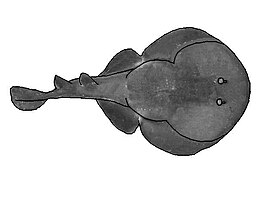
Tembladera [1] ( Latin: Discopyge tschudii ) is a type of skates of the genus Temblader of the Latin family . Narcinidae detachment of electric rays . These are cartilaginous fishes with a bottom lifestyle, with large, flattened pectoral fins in the form of a disk and with a long tail. They are capable of generating electrical current. They inhabit the temperate waters of the southwestern part of the Atlantic Ocean and the southeastern Pacific Ocean at a depth of 165 m. The maximum recorded length is 53.8 cm [2] [3] [4] .
| Tembladera |
 |
| Scientific classification |
|---|
| No rank : | Bilateral symmetric |
|
| International Scientific Name |
|---|
Discopyge tschudii Heckel , 1846 |
| Synonyms |
|---|
Torpedo chilensis Guichenot, 1848 |
| Security status |
|---|
Close to VulnerabilityIUCN 3.1 Near Threatened : 44993 |
|
Content
The species was first scientifically described in 1846 [5] . Later it was named after the Swiss naturalist and researcher Jacob von Chudi (1818–1889), who described the first individual caught [6] .
There are two independent sub-populations of Themblader, one of which lives in the southwestern Atlantic off the coast of Argentina , Brazil and Uruguay , and the other in the southeastern part of the Pacific Ocean in the waters of Chile and Peru . These slopes are found in temperate latitudes at a depth of 22 to 165 m [3] , and according to other data up to 181 m [4] . They live on the continental shelf at a temperature of 11.6–13.5 ° C and salinity of 32.3–33 and prefer a sandy bottom [4] .
These rays have oval and rounded pectoral and abdominal discs and a rather long tail with lateral folds on the tail stem. There are two dorsal fins. At the base of the pectoral fins, electric paired organs in the form of the kidneys appear through the skin [7] . The distinctive feature of the temblader are the ventral fins spliced together under the tail, forming a single disc [8] . Maximum recorded length is 53.8 cm.
Tembladery are bottom fishes, probably leading a pack way of life [9] . They are able to generate an electric current of average power. Analysis of the contents of their stomachs showed that 90% of it consists of the tips of the siphons of Amiantis purpurata bivalve mollusks . The size of the residues correlated with the size of the slopes, and the males bit off pieces of siphons of greater length compared with females. [10] . Other sources say that the basis of the Temblader ration consists of scuds . Tembladera multiply by egg production , embryos hatch from eggs in the womb [7] . In litter from 1 to 5 newborns, most often 4-5. The length of newborns is 8.5–9.2 cm. Males and females reach sexual maturity with a length of 35–46 cm and 27.5 cm, respectively [4] .
These stingrays are occasionally caught as by- catch in the trawling fishery for shrimp. They are of no interest to commercial fishing, fish caught or thrown overboard, or used for the production of fish meal . For the period 1994-1990 in the waters of Uruguay, their catch decreased by 88%. The International Union for Conservation of Nature has assigned the status of "Vulnerable" to the Atlantic population of this species, and the Pacific - "Causes the least concern" [4] .
- ↑ Reshetnikov Yu. S. , Kotlyar A. N. , Russ T. S. , Shatunovsky M. I. Pyatiazychny dictionary of animal names. Fish. Latin, Russian, English, German, French. / edited by Acad. V.E. Sokolova . - M .: Rus. laz., 1989. - p. 48. - 12 500 copies. - ISBN 5-200-00237-0 .
- Ni Menni, RC, RA Ringuelet and RH Aramburu, 1984. Peces marinos de la Argentina and Uruguay. Editorial Hemisferio Sur SA Buenos, Aires, Argentina. 359 p.
- ↑ 1 2 Pequeño, G., R. Navarro and J. Oporto, 1988. Discopyge tschudii Heckel 1845: aportex taxonomia con hincapie sexual dimorfismo sexual (Chondrichthyes, Narcinidae). Estudios Oceanologicos 7: 41-50.
- ↑ 1 2 3 4 5 TEMBLADERA (English) . The IUCN Red List of Threatened Species . The appeal date is April 9, 2014.
- ↑ Von Tschudi, JJ (1846) Ichthyologie. In: Untersuchungen über die Fauna Peruana. Scheitlin & Zollikofer, St. Gallen 1844-46, in 12 parts. Untersuchungen über die Fauna Peruana: ii-xxx + 1-35, Pls. 1-6
- ↑ Christopher Scharpf and Kenneth J. Lazara. Fish Name Etymology Database (Unreferenced) . The ETYFish Project . The appeal date is April 9, 2014.
- ↑ 1 2 Compagno, LJV and Last, PR Narcinidae. Numbfishes. p. 1433-1437. In: KE Carpenter and VH Niem (eds.) FAO identification guide for fishery purposes. The living marine resources of the Western Central Pacific .. - Rome: Food and Agricultural Organization, 1999.
- Ord Jordan, David Starr and Evermann, Barton Warren (. The Fishes of the North and Middle America // Bulletin of the United States National Museum. - 1896. - Vol. 47, No. 1 .
- ↑ Méndez, B., Garrido, J., Maldonado, M., Jaksic, FM, and Inestrosa, NC, Theory of Molecular Biology, Cellular and Molecular Biology. - 1984. - Vol. 4, No. 2 . - P. 125-142.
- Rig Arrighetti, F., Livore, JP and Penchaszadeh, PE Saphon on the bivalve of the United Kingdom . - 2005. - Vol. 85, № 5 . - P. 1151-1154. - DOI : 10.1017 / S0025315405012221 .
- View Tembladera (Eng.) In the World Register of Marine Species ( World Register of Marine Species ).
- Tembladera (Eng.) In the database FishBase .