Louis XIV de Bourbon , born at birth Louis-Dieudonnay ("God-given", fr. Louis-Dieudonné ), also known as the "sun king" [5] ( fr. Louis XIV Le Roi Soleil ), also Louis the Great ( fr. Louis le Grand ; , - , ) - king of France and Navarre from May 14, 1643. Reigned 72 years - longer than any other European king in history (of the monarchs of Europe, only some rulers of the small states of the Holy Roman Empire , for example, Bernard VII Lippsky, were in power longer or Karl Friedrich of Baden ).
| Louis XIV | |||||||
|---|---|---|---|---|---|---|---|
| Louis XIV | |||||||
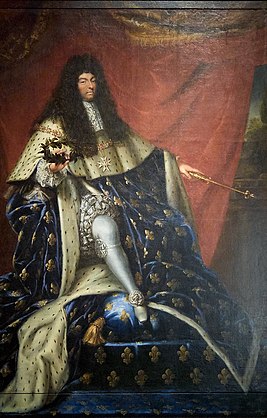 | |||||||
| Coronation | June 7, 1654 , Reims Cathedral , Reims , France | ||||||
| Regent | Anna of Austria (1643–1651) | ||||||
| Predecessor | Louis XIII | ||||||
| Successor | Louis XV | ||||||
| Heir | 1643 - 1661 : Philip I of Orleans 1661 - 1711 : Louis the Great Dauphin 1711 - 1712 : Louis, Duke of Burgundy 1712 : Louis, Duke of Breton 1712 - 1715 : Louis, Duke of Anjou | ||||||
| |||||||
| Regent | Anna of Austria (1643–1651) | ||||||
| Predecessor | Louis XIII | ||||||
| Successor | Louis XV | ||||||
| |||||||
| Predecessor | Louis XIII | ||||||
| Successor | Louis the Great Dauphin | ||||||
| Birth | |||||||
| Death | |||||||
| Burial place | |||||||
| Kind | Bourbons | ||||||
| Father | |||||||
| Mother | |||||||
| Spouse | 1st: Maria Theresa of Austria 2nd: Francoise de Maintenon | ||||||
| Children | from 1st marriage: sons: Louis the Great Dauphin , Philippe-Charles and daughters: Anna-Elizabeth , and Maria-Teresa Had many illegitimate children (some legalized) | ||||||
| Religion | |||||||
| Autograph | 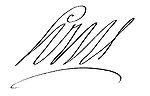 | ||||||
| Monogram |  | ||||||
| Awards |
| ||||||


Louis, who survived the Fronde war in his childhood, became a staunch supporter of the principle of absolute monarchy and the divine right of kings (he is credited with the expression “The state is me!”), He combined the strengthening of his power with the successful selection of statesmen for key political posts. The reign of Louis - a time of considerable consolidation of the unity of France, its military power, political weight and intellectual prestige, the heyday of culture, went down in history as the Great Age . At the same time, the long-standing military conflicts in which France participated during the reign of Louis the Great led to an increase in taxes, which placed a heavy burden on the population and caused popular uprisings, and as a result of the adoption of the Fontainebleau edict , which abolished the Nantes edict on religious tolerance within the kingdom, about 200 thousand Huguenots emigrated from France.
Biography
Childhood and Youth
Louis was the eldest son of King Louis XIII and Queen Anne of Austria, the first child in 23 years of their life together. After him, the ruling couple had another son, Philip . Louis XIV ascended the throne in May 1643, when he was not even five years old, therefore, according to the will of his father, the regency was transferred to Anna of Austria , who ruled in close tandem with the first minister, Cardinal Mazarin . Even before the end of the war with Spain and the Austrian House, the princes and high aristocracy, supported by Spain and in alliance with the Paris Parliament , began unrest, which received the general name Fronde (1648-1652) and ended only with the subordination of Prince de Conde and the signing of the Iberian Peace (7 November 1659 ).
In 1660, Louis married the Spanish infante of Maria Theresa of Austria . At this time, the young king, who had grown up without sufficient upbringing and education, did not yet give much hope. However, as soon as Cardinal Mazarini died ( 1661 ), the next day Louis XIV assembled the Council of State , at which he announced that he now intends to rule independently, without appointing the first minister.
So Louis proceeded to independent government, the king followed this course until his death. Louis XIV had the gift of picking up talented and capable employees (for example, Colbert , Vauban , Letellier , Lyonne , Luvois ). You could even say that Louis elevated the doctrine of royal rights into a semi-religious dogma. Thanks to the work of the talented economist and financier J. B. Colbert, much has been done to strengthen state unity, the welfare of representatives of the third estate, promote trade, and develop industry and the navy. At the same time, the Marquis de Louvois reformed the army, consolidated its organization and increased its military strength.
After the death of King Philip IV of Spain (1665), Louis XIV declared France's claim to part of the Spanish Netherlands and kept it with him in the so-called Devolutionary War . The prisoner of May 2, 1668, the Aachen world passed into his hands the French Flanders and a number of border areas.
War with the Netherlands
Since that time, the United Provinces had a passionate enemy in the person of Louis. Contrasts in foreign policy, state views, trade interests, religion led both states to constant clashes. Louis in 1668-1671 masterfully managed to isolate the republic. Through bribery, he managed to distract England and Sweden from the Triple Alliance , to attract Cologne and Munster to France. Bringing his army to 120,000 people, Louis in 1670 took possession of the ally of the General States, Duke Charles IV of Lorraine, and in 1672 crossed the Rhine, conquered half the provinces for six weeks and returned to Paris in triumph. The breakthrough of the dam, the appearance of William III of Orange , and the intervention of the European powers halted the success of French weapons. The states-generals allied with Spain, Brandenburg, and Austria; The Empire joined them after the French army attacked the archbishopric of Trier and occupied half the 10 imperial cities of Alsace, already connected to France. In 1674, Louis opposed his enemies with 3 large armies: with one of them he personally occupied Franche-Comté ; the other, under the command of Conde, fought in the Netherlands and defeated Senof; the third, led by Tyurenn , devastated the Palatinate and successfully fought with the troops of the emperor and the great elector in Alsace. After a short break due to the death of Türenn and the removal of Conde, Louis at the beginning of 1676 came to the Netherlands with renewed vigor and conquered a number of cities, while Luxembourg devastated Breisgau . The whole country between Saarland, the Moselle and the Rhine was turned into a desert by order of the king. In the Mediterranean, Duchenne defeated Reuters ; Brandenburg forces were distracted by the attack of the Swedes. Only as a result of hostile actions on the part of England, Louis concluded the Nimwegian peace in 1678, which gave him great acquisitions from the Netherlands and the whole of Franche-Comté from Spain. He gave the emperor to Philippsburg , but received Freiburg and kept all the conquests in Alsace.
Louis at the Top of Power
This moment marks the apogee of the power of Louis. His army was the largest, best organized and led. His diplomacy dominated all European courts. The French nation with its achievements in art and science, in industry and commerce has reached unprecedented heights. The court of Versailles (Louis moved the royal residence to Versailles) became the envy and surprise of almost all modern sovereigns who tried to imitate the great king, even in his weaknesses. At court, strict etiquette was introduced that governs all court life. Versailles became the center of all high life, in which the tastes of Louis himself and his many favorites reigned ( Lavalier , Montespan , Fontange ). The entire highest aristocracy sought court posts, since living far from the yard for a nobleman was a sign of front-door or royal opal. “Absolute without objection,” according to Saint-Simon , “Louis destroyed and uprooted any other force or power in France, except for those that emanated from it: a reference to the law, to the right was considered a crime.” This cult of the Sun King, in which capable people were increasingly pushed aside by courtesans and schemers, would inevitably lead to the gradual decline of the entire building of the monarchy.
King less and less restrained his desires. In the years 1679-1681, France launched a large-scale campaign of annexation of border territories, called the " accession policy ". In Metz , Breisach and Besançon, the king established chambres de réunions to seek the rights of the French crown to one or another locality ( September 30, 1681 ). The imperial city of Strasbourg in peacetime was suddenly occupied by French troops. Louis did exactly the same with respect to the Dutch borders. In 1681 , his fleet bombarded Tripoli , in 1684 - Algeria and Genoa . Finally, an alliance was formed between Holland, Spain and the emperor , forcing Louis in 1684 to conclude a 20-year truce in Regensburg and abandon further “reunions”.
Religious Policy
The political dependence of the clergy on Pope Louis XIV tried to destroy. He even intended to form a French patriarchy independent of Rome. But, thanks to the influence of Bossuet, the famous bishop of Moss, the French bishops refrained from breaking with Rome, and the views of the French hierarchy received official expression in the so-called. declaration of the Gallican clergy (declaration du clarge gallicane) 1682
On matters of faith, the confessors of Louis XIV (the Jesuits ) made him an obedient instrument of the most ardent Catholic reaction, which was reflected in the merciless persecution of all individualistic movements in the church.
A number of harsh measures were taken against the Huguenots : they took their temples, priests were deprived of the opportunity to baptize their children according to the rules of their church, marry and burial, and worship. Even mixed marriages between Catholics and Protestants were banned.
The Protestant aristocracy was forced to convert to Catholicism in order not to lose their social advantages, and shy decrees were launched against the Protestants from other classes, ending with dragoons of 1683 and the abolition of the Nantes Edict in 1685. These measures, despite severe penalties for emigration, forced more than 200 thousand Protestants to move to England, Holland and Germany. An uprising even broke out in the Cévennes. The increasing piety of the king was supported by Madame de Maintenon , who, after the death of the Queen (1683), was married to him in secret.
The Palatinate War
In 1688 , a new war broke out, the reason for which was the claim to the Palatinate made by Louis XIV on behalf of his daughter-in-law, Elizabeth-Charlotte, Duchess of Orleans, who was related to the deceased shortly before the Elector Karl-Ludwig. Having entered into an alliance with the Elector of Cologne, Karl-Egon Fürstemberg, Louis ordered his troops to occupy Bonn and attack the Palatinate, Baden , Württemberg and Trier .
At the beginning of 1689 , French troops devastated the entire Lower Palatinate in a terrible way. An alliance was formed against France from England (which had just overthrown the Stuarts ), the Netherlands, Spain, Austria and the German Protestant states.
The Marshal of France, the Duke of Luxembourg defeated the Allies on July 1, 1690 under Fleurus; Marshal Katina conquered Savoy, Vice-Admiral Tourville defeated the British-Dutch fleet in the battle at Cape Beachy Head, so that the French for a short time had an advantage even at sea.
In 1692 , the French besieged Namur , Luxembourg prevailed at the battle of Stenkerken; but on May 28, the French fleet was defeated at Cape La Ough.
In 1693-1695, the preponderance began to lean toward the Allies; in 1695 the Duke de Luxembourg, a pupil of Turenne, died; in the same year a huge military tax was required, and peace was a necessity for Louis. It took place in Riswick, in 1697, and for the first time, Louis XIV had to confine himself to the status quo.
War of the Spanish Succession
France was completely exhausted when, a few years later, the death of Charles II of Spain led Louis to war with the European coalition. The War of the Spanish Succession , in which Louis wanted to conquer the entire Spanish monarchy for his grandson Philip of Anjou, inflicted incurable wounds on the power of Louis. The old king, personally leading the struggle, held himself in the most difficult circumstances with dignity and firmness. According to the world concluded in Utrecht and Rastatt in 1713 and 1714, he kept Spain proper for his grandson, but its Italian and Dutch possessions were lost, and England, by destroying the Franco-Spanish fleets and conquering a number of colonies, laid the foundation for her naval dominion. The French monarchy no longer had to recover from the defeats at Hochstedt and Turin, Ramilla and Malplack before the revolution itself. She was exhausted under the weight of debts (up to 2 billion) and taxes, causing local outbreaks of discontent.
Last years. Family tragedy and the question of successor
Thus, the result of the entire Louis system was economic ruin, the poverty of France. Another consequence was the growth of opposition literature, especially developed under the successor of the “great Louis”.
The family life of an elderly king at the end of his life was not a bright picture. On April 13, 1711, his son, the Great Dauphin Louis (born in 1661 ) , died; in February 1712, he was followed by the eldest son of the Dauphin, the Duke of Burgundy , and on March 8 of the same year, the eldest son of the latter, the young Duke of Breton. On March 4, 1714, he fell from his horse and a few days later the younger brother of the Duke of Burgundy, Duke of Berry , died, so that, in addition to Philip V of Spain , the Bourbons had only one heir - the king’s four-year-old great-grandson, the third son of the Duke of Burgundy (later Louis XV ).
Even earlier, Louis legitimized his two sons from Madame de Montespan - the Duke of Mans and Count of Toulouse , and gave them the name Bourbon . Now, in his will, he appointed them members of the regency council and declared the eventual right of succession to them . Louis himself remained active until the end of his life, firmly supporting court etiquette and already beginning to fade the decor of his “great century”.
Louis XIV passed away on September 1, 1715 at 8.15 a.m. surrounded by courtiers. Death occurred after several days of agony, from gangrene of the leg, which the king damaged when falling from a horse on a hunt (he considered amputation unacceptable for royal dignity). The era of the reign of Louis XIV lasted 72 years and 110 days.
The body of the king for 8 days was put up for farewell at the Salon of Hercules in Versailles. On the night of the ninth day, the body was transported (taking the necessary measures so that the population did not arrange holidays along the funeral procession) [6] in the basilica of the Saint Denis Abbey , where Louis was interred with the observance of all the rituals of the Catholic Church.
In 1822, he was erected an equestrian statue (modeled on Bosio) in Paris, on Victory Square .
Family
Marriages and children
- (from June 9, 1660, Saint-Jean-de-Lutz) Maria Theresa (1638–1683), infante of Spain, cousin of Louis XIV along two lines - both maternal and paternal:
- Louis the Great Dauphin (1661-1711)
- Anna Elizabeth (1662-1662)
- (1664-1664)
- Maria Theresa (1667–1672)
- Philip Charles (1668-1671)
- (1672–1672).
Louis
Anna-Elizabeth and
Maria Teresa
Philip Charles
- (since June 12, 1684, Versailles) Francoise d'Aubigne (1635-1719), Marquis de Maintenon.
- Vnebra. communication of Louise de La Baume Le Blanc (1644-1710), Duchess de Lavalier:
- (1663-1665)
- Philippe de La Baume Le Blanc (1665-1666)
- Marie-Anne de Bourbon (1666-1739), Mademoiselle de Blois
- Louis de Bourbon (1667–1683), Count of Vermandois .
- Vnebra. communication Francoise-Athenais de Rocheshoir de Mortemar (1641-1707), Marquise de Montespan:
- First child left in secret (1669–1672)
- Louis-Auguste de Bourbon, Duke of Manx (1670-1736)
- (1672–1683)
- Louise-Francoise de Bourbon (1673-1743), Mademoiselle de Nantes
- Louise-Maria-Anna de Bourbon (1674–1681), Mademoiselle de Tours
- Francoise Marie de Bourbon (1677-1749), Mademoiselle de Blois
- Louis-Alexander de Bourbon, Count of Toulouse (1678-1737).
- Vnebra. communication (1678-1680) Marie-Angelica de Scoray de Roussil (1661-1681), Duchess de Fontange:
- N (1679-1679), the child was born dead.
- Vnebra. communication of Claude de Ven (c. 1638 - September 8, 1686), Mademoiselle des Hoyers:
- (1676-1718).
History of the nickname Sun King
In France, the sun was a symbol of royal power, and personally of the king, and before Louis XIV. The luminary became the personification of the monarch in poetry, solemn odes and court ballets. The first references to the solar emblem date back to the reign of Henry III, the grandfather and father of Louis XIV used it, but only with it the solar symbolism became truly widespread.
At the age of twelve ( 1651 ), Louis XIV made his debut in the so-called "ballets de cour" - court ballets , which were staged annually during the carnival .
The Baroque era carnival is not just a celebration and amusement, but an opportunity to play in an “inverted world”. For example, for several hours the king became a jester, artist or gambler, at the same time, the jester could very well afford to appear in the image of the king. In one of the ballet productions (“Ballet of the Night” by Jean-Baptiste Lully ), young Louis had the opportunity to appear before his subjects for the first time in the image of the Rising Sun ( 1653 ), and then Apollo - the Sun God ( 1654 ).
When Louis XIV began to rule on his own ( 1661 ), the genre of court ballet was put at the service of state interests, helping the king not only create his representative image, but also manage the court society (however, like other arts). The roles in these productions were distributed only by the king and his friend - Count de Saint-Enigne . The princes of blood and courtiers, dancing next to their sovereign, depicted various elements, planets and other creatures and phenomena subject to the Sun. Louis himself continues to appear before his subjects in the image of the Sun, Apollo and other gods and heroes of Antiquity. The king left the stage only in 1670 .
But the emergence of the nickname of the Sun King was preceded by another important cultural event of the Baroque era - the Tuileries Carousel of 1662 . This is a festive carnival cavalcade, which is a cross between a sports festival (in the Middle Ages it was a tournament) and a masquerade. In the XVII century, the Carousel was called "equestrian ballet", because this action was more like a performance with music, rich costumes and a fairly consistent script. On the Carousel of 1662 , given in honor of the birth of the firstborn of the royal couple, Louis XIV pranced in front of the audience in a costume of the Roman emperor. In the king’s hand was a golden shield with the image of the Sun. This symbolized the fact that this luminary protects the king and with him the whole of France .
According to the French Baroque historian F. Bossant, “It was on the Big Carousel of 1662 that the Sun King was born in some way. The name was not given to him by the politician or victory of his armies, but by equestrian ballet.
The Image of Louis XIV in Popular Culture
Fiction
- Louis XIV is one of the main historical characters of the Alexander Dumas musketeers trilogy .
- Mikhail Bulgakov . The bondage of the holy .
- The hero of the series of novels "Angelica" by Anna and Serge Golon .
- The hero of the novel by Francoise Chandernagor "The Royal Alley: the memoirs of Francoise d'Aubigne, Marquise de Maintenon, wife of the King of France"
- A. A. Gurshtein “The Stars of Paris” 2016. (A novel-chronicle from the life of astronomers from the time of Louis XIV).
Cinema
- Iron Mask / The Iron Mask ( USA ; 1929 ) directed by Allan Duon , in the role of Louis William Bakewell .
- The Man in the Iron Mask / The Man in the Iron Mask ( USA ; 1939 ) directed by James Wale , in the role of Louis Louis Hayward .
- Iron mask / Le masque de fer ( Italy , France ; 1962 ) directed by Henri Decouin , in the role of Louis Jean-Francois Poron .
- The seizure of power by Louis XIV / La prise de pouvoir par Louis XIV ( France ; 1966 ) directed by Roberto Rossellini , in the role of Louis Jean-Marie Patt .
- The Man in the Iron Mask / The Man in the Iron Mask ( United Kingdom , USA ; 1977 ) directed by Mike Newell , in the role of Louis Richard Chamberlain .
- The Way of the King / L'allée du roi ( France; 1996 ) directed by Nina Kompaneets , in the role of King Louis XIV Didier Sandr .
- In 1993, Roger Planchon made a biographical film “ Louis, the King Child ” about the childhood and youth of Louis XIV.
- In the 1998 film "The Man in the Iron Mask ", Louis XIV is presented as a cruel, selfish, loving all kinds of entertainments, as well as a weak politician. According to the plot of the film, Louis has a twin brother, who subsequently takes the place of the king and leads France to the Golden Age. Played by Louis XIV Leonardo DiCaprio .
- “King Dancing” / Le Roi danse ( France , Germany , Belgium ; 2000 ), in the role of Louis Maggimel, Benoit . The film reveals the theme of the relationship between power and art.
- Louis XIV is one of the main characters and Roland Joffe ’s drama The Vatel . In the film, Prince Conde invites the king to his Chantilly castle and tries to impress him in order to take the post of commander in chief in the upcoming war with the Netherlands. Louis XIV is played by Julian Sands .
- Louis XIV appears in the image of a beautiful seducer in the film " Angelica and the King ", where he was played by Jacques Toja ( French Jacques Toja ), also appears in the first two films of the epic " Angelica - Marquise of Angels " and "The Magnificent Angelica ".
- In Oleg Ryaskov ’s film “The Servant of the Sovereigns ”, the role of King Louis XIV was played by Dmitry Shilyaev, artist of the Moscow New Drama Theater.
- In the films of George Yungvald-Khilkevich, “ The Secret of Queen Anne, or the Musketeers Thirty Years Later ” (1993) and “The Return of the Musketeers or Treasures of Cardinal Mazarin ” (2008), Louis XIV was played by Dmitry Kharatyan .
- In the film Alan Rickman's “ Versailles Novel ” (2014), the director himself played the role of King Louis XIV.
- The series "Versailles" (France — Canada, 2015—). The role of King Louis XIV is played by George Blagden .
- Death of Louis XIV / La mort de Louis XIV (Portugal, France, Spain; 2016) directed by Albert Serra, in the role of Louis Jean-Pierre Leo.
Music
- German speed metal group Chroming Rose released the 1990 Louis XIV album, the title track of which is dedicated to Louis XIV.
- About Louis XIV in France, the musical The King of the Sun is staged.
Documentary Films
- 2015 - Death of the Sun King / 1715. The Sun King is Dead! / La mort de Louis XIV (dir. Sylvie Fevley / Sylvie Faiveley)
Notes
- ↑ 1 2 Encyclopédie Larousse en ligne
- ↑ 1 2 3 4 Encyclopædia Britannica
- ↑ 1 2 3 4 RKDartists
- ↑ 1 2 SNAC - 2010.
- ↑ Spelling with a small letter and in quotation marks “king-sun” is given in the dictionary: Lopatin V.V. , Nechaeva I.V. , Cheltsova L.K. Orthographic dictionary. - M .: Eksmo , 2009 .-- S. 228. - 512 p.
- ↑ Alain Baraton, Vice et Versailles - Crimes, trahisons et autres empoisonnements au palais du Roi-Soleil , Grasset, 2011, p. 208
Literature
- Anselme de Sainte-Marie, Père. Histoire généalogique et chronologique de la maison royale de France : [ fr. ] . - 3rd. - Paris: La compagnie des libraires, 1726. - Vol. one.
- Ashley, Maurice P. Louis XIV And The Greatness Of France (1965) excerpt and text search
- Beik, William . Louis XIV and Absolutism: A Brief Study with Documents (2000) excerpt and text search
- Bély, Lucien. The History of France. - Editions Jean-Paul Gisserot, 2001 .-- ISBN 978-2-87747-563-1 .
- Bluche, François , Louis XIV , (Franklin Watts, 1990) ISBN 0531151123
- Bryant, Mark (2004), "Partner, Matriarch, and Minister: Mme de Maintenon of France, Clandestine Consort, 1680-1715", in Campbell Orr, Clarissa, Queenship in Europe 1660-1815: The Role of the Consort , Cambridge University Press, pp. 77-106, ISBN 978-0-521-81422-5
- Buckley, Veronica . Madame de Maintenon: The Secret Wife of Louis XIV . London: Bloomsbury, 2008. ISBN 9780747580980
- Wolf Burchard: “The Sovereign Artist: Charles Le Brun and the Image of Louis XIV”, Paul Holberton Publishing, 2016, ISBN 1911300059
- Burke, Peter. The Fabrication of Louis XIV (1994) ISBN 0300051530
- Cambridge Modern History: Vol. 5 The Age Of Louis XIV (1908), old, solid articles by scholars; complete text online
- Cowart, Georgia J. The Triumph of Pleasure: Louis XIV and the Politics of Spectacle U of Chicago Press, 2008. ISBN 9780226116389
- Cronin, Vincent . Louis XIV . London: HarperCollins, 1996. ISBN 9781860460920
- Dunlop, Ian. Louis XIV (2000), 512pp excerpt and text search
- Engerand, Fernand, editor (1899). Inventaire des tableaux du Roy rédigé en 1709 et 1710 par Nicolas Bailly . Paris: Ernest Leroux. Copy at Gallica.
- Erlanger, Philippe, Louis XIV Praeger, 1970.
- Fraser, Antonia. Love and Louis XIV: The Women in the Life of the Sun King . London: Weidenfeld & Nicolson, 2006 (hardcover, ISBN 0-297-82997-1 ); New York: Nan A. Talese, 2006 (hardcover, ISBN 0-385-50984-7 )
- Goubert, Pierre. Louis XIV and Twenty Million Frenchmen. - 197. - ISBN 978-0394717517 .
- Hatton, Ragnhild Marie. Louis XIV and His World. - New York: Putnam, 1972.
- Jones, Colin. The Great Nation: France from Louis XIV to Napoleon (1715-1799) (2002)
- Lewis, WH The Splendid Century: Life in the France of Louis XIV (1953) excerpt and text search ; also online complete edition
- Le Roy Ladurie, Emmanuel. The Ancien Régime: A History of France 1610-1774 (1999), survey by leader of the Annales School excerpt and text search
- Lynn, John A. The Wars of Louis XIV, 1667–1714 . - New York: Longman, 1999.
- McCoy, Bernard J. St. Vincent De Paul's Letters on Jansenism (English) // The Catholic Historical Review : journal. - 1942. - Vol. 27 , no. 4 . - P. 442-449 .
- Mitford, Nancy. The Sun King (1995), popular excerpt and text search
- Nolan, Cathal J. Wars of the Age of Louis XIV, 1650-1715: An Encyclopedia of Global Warfare and Civilization . (2008) 607pp; over 1000 entries; ISBN 978-0-313-33046-9
- Petitfils, Jean-Christian. Louis XIV: [ fr. ] . - Paris: Perrin, 2002.
- Shennan, JH Louis XIV (1993) online edition
- Sonnino, Paul. Prelude to the Fronde: The French Delegation at the Peace of Westphalia // Der Westfälische Friede: Diplomatie – Politische Zäsur – Kulturelles Umfeld – Rezeptionsgeschichte / Heinz Duchhardt, ed .. - München: Oldenberg Verlag GmbH, 1998. - ISBN 3-48 56328-9 .
- Thompson, Ian. The Sun King's Garden: Louis XIV, André Le Nôtre And the Creation of the Gardens of Versailles . London: Bloomsbury Publishing, 2006 ISBN 1-58234-631-3
- Treasure, Geoffrey. Louis XIV (London, 2001). ISBN 0582279585
- Wilkinson, Rich. Louis XIV Routledge, 2007. ISBN 9780415358156
- Wolf, John B. Louis XIV. - WW Norton & Company, Inc., 1968.
- Ranum, Orest, ed. The Century of Louis XIV (1972) documents; online